Last reviewed: 7 May 2026
Living with a food intolerance can feel like detective work. You eat something, feel unwell hours later, and struggle to pinpoint exactly what caused it. The right app can make that process far simpler — turning scattered guesses into clear, trackable patterns. We have compared the five best options available to UK users in 2026.
Food intolerances affect an estimated 20% of the UK population, according to the NHS. Unlike food allergies — which trigger an immune response and can be diagnosed through blood tests — intolerances are harder to pin down. Symptoms like bloating, headaches, skin flare-ups, and fatigue can appear anywhere from 30 minutes to 48 hours after eating a trigger food.
The NHS recommends keeping a food diary as a first step in identifying intolerances. A good app makes this significantly easier than pen and paper by letting you:
Food intolerance apps are tools to help you track and observe — they are not diagnostic devices. If you suspect a serious allergy or your symptoms are severe, please consult your GP or a registered dietitian. The FSA provides guidance on the 14 major allergens that must be declared on UK food labels.
Not all food tracking apps are created equal, especially when your goal is identifying intolerances rather than simply counting calories. Here is what matters most:
You need to know exactly what is in your food — not just the macros. Look for apps that show full ingredient lists, including additives, preservatives, and E-numbers. A food that seems harmless might contain a hidden trigger like sulphites (E220–E228) or MSG (E621).
The app should let you record how you feel after eating, with options for different symptom types (digestive, skin, headache, fatigue) and severity levels. Timestamps are essential for linking symptoms to meals consumed hours earlier.
An app filled with American products is of limited use when you are shopping at Tesco, Sainsbury's, or Aldi. Prioritise apps with a strong UK food database that includes branded products from major supermarkets.
Manually typing ingredient lists is tedious and error-prone. Barcode scanning lets you instantly see what is in a product, making it far more likely you will actually log everything you eat.
The best apps help you see connections between foods and symptoms over time. Whether through visual timelines, correlation reports, or simple charts, this is what transforms raw data into useful insight.
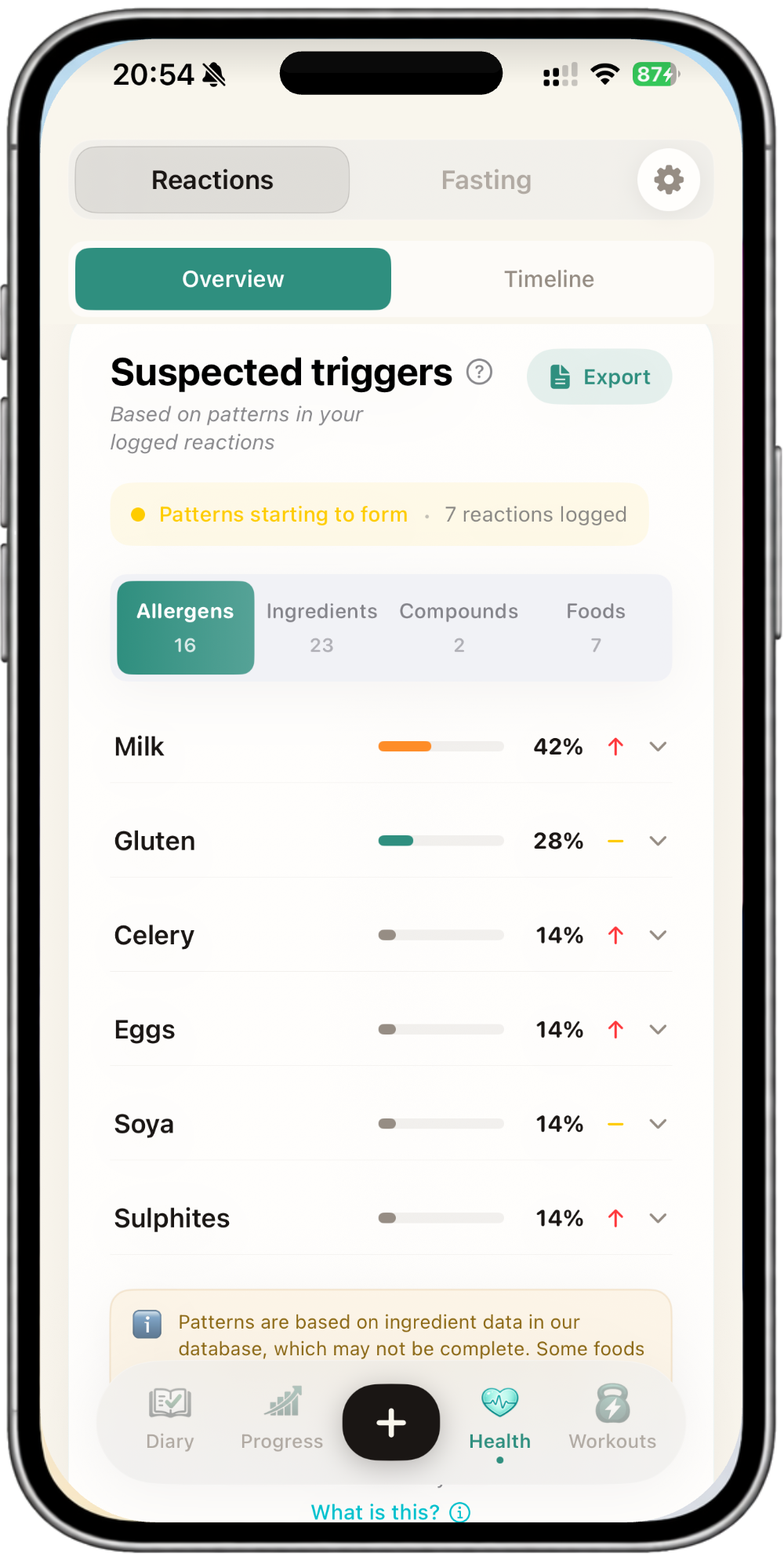
NutraSafe stands out by combining food diary tracking with detailed ingredient analysis in a single app. When you scan a barcode, you do not just see calories and macros — you see the full ingredient list, every E-number and additive flagged with safety information, and you can log any reactions directly against that food entry.
The reaction tracking feature lets you record symptoms by type and severity, then review your diary to spot which ingredients or foods appear most often alongside flare-ups. The app's comprehensive E-number database is particularly useful for people sensitive to specific additives like sulphites, artificial colours, or preservatives.
Strengths: UK food database, barcode scanning with full ingredients, reaction tracking, E-number and additive database, food diary with timestamps
Price: Free tier available; Premium from £3.99/month
Platform: iOS
Cara Care is purpose-built for digestive issues and is well-regarded in the gut health space. It offers a food diary alongside detailed stool tracking, stress logging, and symptom recording. The app uses this data to produce weekly reports highlighting potential trigger foods.
It was developed in collaboration with gastroenterologists, which lends it clinical credibility. The guided low-FODMAP diet feature is especially useful for IBS sufferers. However, it is less focused on ingredient-level detail — you will not get E-number breakdowns or additive scanning.
Strengths: Gut-specific symptom tracking, stool diary, stress correlation, low-FODMAP guidance, weekly pattern reports
Price: Free basic; Premium from £9.99/month
Platform: iOS, Android
mySymptoms is a straightforward symptom diary that has been around for over a decade. It lets you log foods, drinks, medications, and activities alongside symptoms, then produces analysis reports showing statistical correlations between what you consumed and how you felt.
The app's strength is its simplicity and its analysis engine, which uses a proprietary algorithm to identify likely trigger foods. It does not have barcode scanning or a food database — you type everything manually — but the correlation analysis is genuinely useful.
Strengths: Statistical correlation analysis, medication tracking, long track record, export reports for GP visits
Price: One-off purchase ~£3.99
Platform: iOS, Android
Fig takes a different approach by focusing on what you can eat rather than what you cannot. You set up your dietary needs (e.g. dairy-free, low-FODMAP, no artificial colours) and then scan products to see an instant compatibility rating. It uses Open Food Facts data and is strong on ingredient-level filtering.
Fig is excellent for grocery shopping but weaker as a food diary. It will tell you whether a product suits your needs before you buy it, but it does not offer the same meal-by-meal tracking and reaction logging you need for identifying new intolerances.
Strengths: Personalised ingredient alerts, grocery scanning, dietary compatibility ratings, clean interface
Price: Free basic; Premium from £4.99/month
Platform: iOS, Android
Spoon Guru partners with UK supermarkets (including Tesco) to let you filter their product ranges by dietary need. If you know your triggers, it helps you find safe alternatives. You can set filters for common intolerances — gluten, dairy, soy, eggs — and browse products that meet your requirements.
It is more of a shopping tool than a tracking app. There is no food diary, reaction logging, or pattern analysis. But if you already know your intolerances and want help finding safe products at UK supermarkets, it fills a genuine gap.
Strengths: UK supermarket integration, dietary filtering, product discovery, allergen-safe shopping
Price: Free
Platform: iOS, Android
Here is how the five apps compare across the features that matter most for food intolerance tracking:
| Feature | NutraSafe | Cara Care | mySymptoms | Fig | Spoon Guru |
|---|---|---|---|---|---|
| Food diary | ✓ | ✓ | ✓ | ✗ | ✗ |
| Reaction/symptom tracking | ✓ | ✓ | ✓ | ✗ | ✗ |
| Barcode scanning | ✓ | ✗ | ✗ | ✓ | ✓ |
| Full ingredient lists | ✓ | ✗ | ✗ | ✓ | Partial |
| E-number/additive database | ✓ | ✗ | ✗ | Partial | ✗ |
| UK food database | ✓ | Partial | ✗ | Partial | ✓ |
| Pattern/correlation analysis | ✓ | ✓ | ✓ | ✗ | ✗ |
| Gut health features | Partial | ✓ | Partial | ✗ | ✗ |
| Elimination diet support | ✓ | ✓ | Partial | ✗ | ✗ |
| Free tier | ✓ | ✓ | ✗ | ✓ | ✓ |
| Premium price | £3.99/mo | £9.99/mo | £3.99 once | £4.99/mo | Free |
| Platform | iOS | iOS, Android | iOS, Android | iOS, Android | iOS, Android |
The principle behind using a food diary for intolerance identification is straightforward: if you consistently record what you eat and how you feel, patterns will eventually emerge. But the detail matters.
Unlike allergies (which typically cause symptoms within minutes), intolerance reactions can take anywhere from 30 minutes to 48 hours to appear. This delayed response is precisely what makes intolerances so difficult to identify without systematic tracking. You might blame your dinner when the real culprit was something you ate at lunchtime — or even the day before.
A good food diary app with timestamped entries lets you look back across a 48-hour window when symptoms appear. Over weeks of data, you start to see which foods or ingredients consistently precede your symptoms.
Many people discover that their intolerance is not to a broad food group but to a specific ingredient or additive. For example, you might think you are intolerant to “bread” when the actual trigger is a particular emulsifier (such as E471 or E472e) used in commercial bread. This is where apps with ingredient-level tracking, like NutraSafe, offer a significant advantage over simple meal-logging apps.
The FSA requires all 14 major allergens to be clearly labelled on packaged food in the UK, but many other ingredients that cause intolerance symptoms — such as sulphites, certain emulsifiers, or artificial sweeteners — are only listed in small print on ingredient panels. A barcode scanner that highlights these ingredients can be invaluable.
Once your food diary suggests potential triggers, the standard approach (recommended by the NHS and most dietitians) is an elimination diet:
An app that supports this structured process — with the ability to mark elimination phases and log reintroduction results — makes the whole process significantly more manageable. our elimination diet tracking and reaction logging features are designed specifically for this workflow.
Understanding the most common intolerances can help you know what to look out for when reviewing your food diary data. According to the NHS and EFSA research, these are among the most frequently reported:
NutraSafe offers dedicated trackers for several of these conditions, including a bloating tracker and an IBS food diary, so you can focus your tracking on the symptoms that affect you most.
NutraSafe can help you log meals, scan ingredients, and track reactions — all in one app, built for UK foods.
Get NutraSafe on the App StoreNutraSafe is our top pick for UK users in 2026. It combines a detailed food diary with reaction tracking, barcode scanning for ingredient checks, and a comprehensive E-number database — all built with UK supermarket products in mind. Cara Care is a strong alternative if your focus is specifically on gut health.
A food diary app can help you spot patterns between what you eat and how you feel, which is a recognised first step recommended by the NHS. However, apps are not diagnostic tools. If you suspect a food intolerance, share your food diary data with your GP or a registered dietitian for proper assessment.
A food allergy triggers an immune system response and can be life-threatening (e.g. anaphylaxis). A food intolerance typically causes digestive discomfort — bloating, gas, nausea — and is not immediately dangerous but can significantly affect quality of life. The NHS advises seeking medical advice for allergies, while intolerances can often be managed through careful dietary tracking and elimination.
Most dietitians recommend keeping a detailed food and symptom diary for at least 2–4 weeks to start seeing patterns. An elimination diet — where you remove suspected trigger foods and reintroduce them one at a time — typically takes 6–8 weeks. Consistency is key: logging every meal and snack, along with any symptoms and their timing, gives you the best chance of identifying triggers.
Most food intolerance apps offer a free tier with basic features. NutraSafe provides free daily food logging and barcode scanning. Cara Care and mySymptoms both have free versions with limited functionality. Premium features — such as detailed analytics, unlimited logging, and AI-powered insights — typically cost between £3.99 and £9.99 per month.
Last updated: February 2026