Food reaction tracker · UK
The food reaction tracker that counts your reactions with a food, and without it.
Log a reaction when it hits: bloating, headache, rash, brain fog, one of twelve. Your food diary is already there, with the ingredients off the pack, so the app lines the two up and counts. After five reaction days and five clear days it names the food that keeps turning up. A count for your GP, not a diagnosis.
Free download · Reaction logging free while you build a baseline · Pro £3.99 a month
It's the only app that does thisUKJaneK
You Need This AppGmac2005
Best AppGK getting skinny
Log the food, log the reaction, read the count.
Two things are on you and take seconds each. The third the app does over the weeks that follow.
Log what you ate
Scan the barcode, search by name, or photograph the plate and the label for a takeaway or a home-cooked dinner. The ingredients come off the pack, not out of your memory, so a herb buried in a stuffing mix or a sauce is in the record. Up to 25 entries a day on the free tier. More on the food diary.
Log a reaction when it hits
Tap what you feel. Tap again if it is worse: mild, moderate, severe. Say when it started, because skin and sleep can lag a meal by a day, and the app looks back further for you if you told it your reactions usually come late.
The app counts the days
A reaction day is a day you logged a reaction. A clear day is a day you logged food and no reaction. Once you have five of each, every food in your diary is split in two: the days you had it, and the days you didn't. The food you reacted to on far more of the first than the second is named. Nothing you do; it is there next time you open the tab.

The days you had it against the days you didn't.
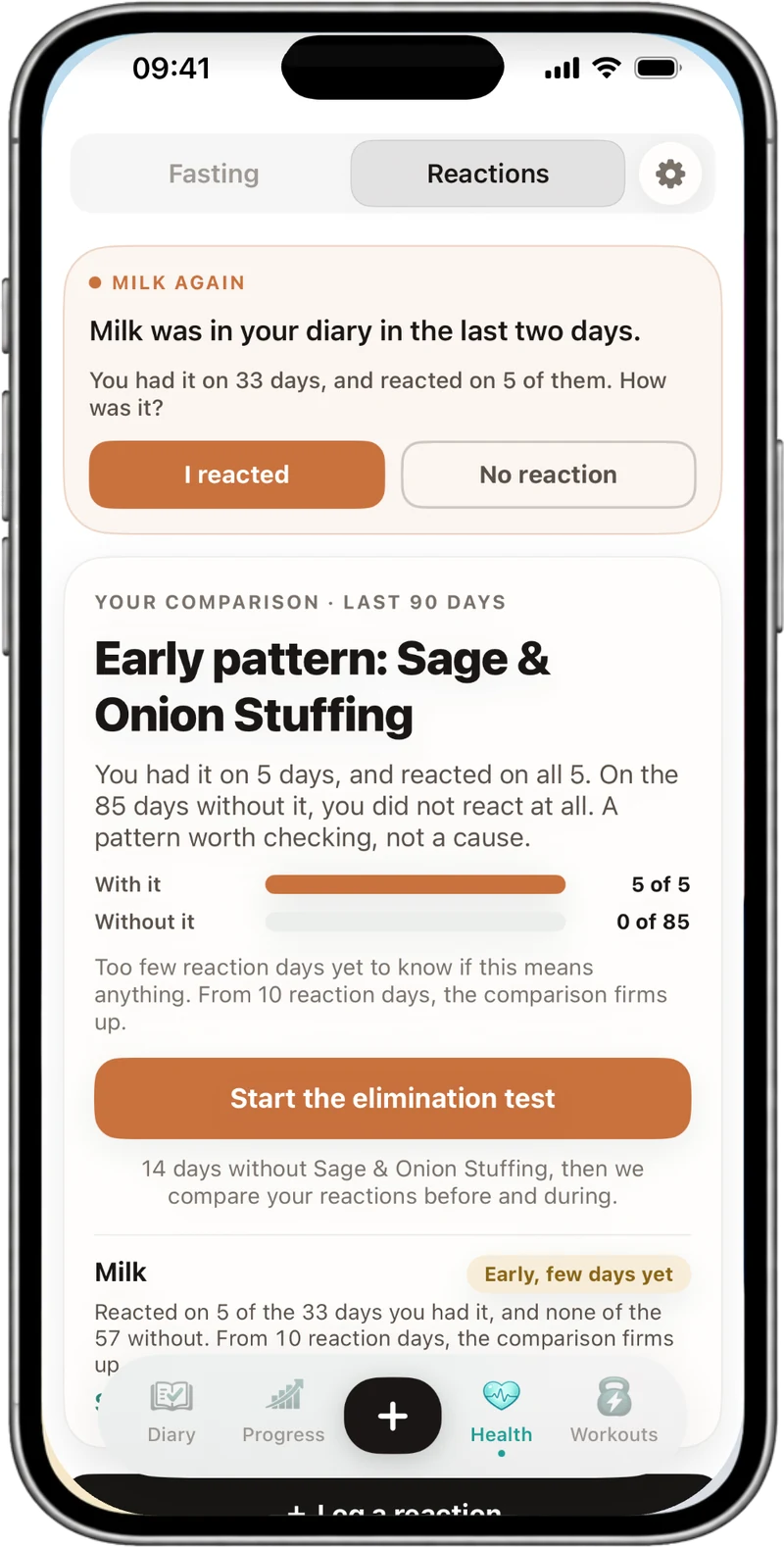
A reaction day is a day you logged a reaction. A clear day is a day you logged food and no reaction. For every food in your diary, the app splits your logged days into the ones with that food and the ones without, then counts how many of each carried a reaction. The three numbers on the screen above:
The wording on the screen is the app's, not a marketing line: "A pattern worth checking, not a cause." The count says you reacted far more often on the days you had a food than on the days you did not. It does not say the food did it. Coincidence, a second food eaten alongside it, a stressful week: a count cannot tell those apart, and the app does not pretend it can.
What it does give you is a shortlist worth taking further, and one way to take it further yourself: a 14-day elimination test, below. The other way is your GP or a registered dietitian, with the diary pack in hand.
The comparison reads your last 90 days. The 30-day grid on the same screen shows each day as reaction, clear or not logged, so you can see at a glance whether the diary behind the count is complete. More on why the last thing you ate is rarely the food that did it.
Milk, from setup
Setup asks whether you already wonder about a food. Milk, wheat, whatever it is, gets its own card from the first day, with the same count run on it: "Not enough logged days with milk yet to say anything about it" until there are. An open mind about everything else.
Fourteen days without it, counted against the fourteen before.
One food, one fortnight, two plain counts at the end.
Stop the one food. Log as normal.
Nothing extra. You keep logging meals and reactions the way you already do. The app flags the food when it appears in anything you log, on its own or inside a sandwich or a sauce.
That day is set aside
The app spots the food in your diary and leaves that day out of the count, so one slip does not spoil the fortnight. The result on day 15 says how many days were counted and how many were not.
Serious reactions are not tested
Before it starts, the app asks whether you have ever had a serious reaction to food: trouble breathing, swelling of your face or throat, collapsing. If you have, the test is not offered. Stopping a food and eating it again after a reaction like that is for a specialist, so the app points you to your GP and an allergy referral instead.

Thirty days on a grid, and a diary pack for your GP.
The NHS says you may be asked to keep a food and symptoms diary. This is what you hand over.
Under the comparison sits your last 30 days, one square per day: reaction logged, food logged with no reaction, or nothing logged. Your reactions are listed beneath it with the food each one sat behind, the date, whether it was logged as it started, and how bad it was.
Tap Diary pack for your GP and the app builds one file: every reaction in detail with its food, symptoms, severity and notes; your reaction days against your symptom-free days; the foods that stood apart and how every food sorted, including recognised allergens and foods too common to point at; your symptom and severity mix; frequency over time and any completed 14-day test; and a methodology appendix so the person reading it can see how the counts were made.
A ten-minute appointment goes further with six weeks of dated entries in front of it than with "I think it might be dairy". The pack is free. If the symptom is more bloating than anything else, that page covers what to log for it.


We are the diary, not the diagnosis.
Three things the app will not do, and the NHS wording behind each.
Diagnose an intolerance or allergy
Allergy is diagnosed by a specialist with skin prick tests, specific IgE blood tests or a supervised food challenge. Most intolerances are worked out by supervised elimination and reintroduction with a registered dietitian. A count in an app is neither.
Tell you to cut a food out
The NHS wording: "it's important to not cut foods out of your or your child's diet without the advice of a GP or food and nutrition specialist (dietitian)". The 14-day test is one food, for a fortnight, with a safety check in front of it. Anything longer or wider is a conversation with a clinician.
Handle a serious reaction
Trouble breathing, swelling of the lips, face or throat, or a reaction within minutes of eating is allergy territory and it is urgent. That is not a diary job. The NHS food allergy page says what to do; our setup asks about it so the test is never offered to someone it could harm.
Free while you build a baseline. Pro for the finding.
Checked against the app's own gating code on 9 September 2026.
The diary, both halves
Food logging up to 25 entries a day with barcode scanning and the additive count. Reaction logging with no cap while you build up your first five reaction days and five clear days. The 30-day grid, your reaction list, the setup, and the diary pack for your GP. Once the comparison is live, the free tier holds five reactions.
The finding, and the test
The food that stands out, with its reaction-day and clear-day counts. Every food, counted: the full table of what was on which days. The 14-day elimination test result. Unlimited reaction logging. Pro also covers the rest of the app: additives named with their evidence, vitamins and minerals against UK reference values, fasting, workouts and the coach.
Food reaction tracker questions.
Answered from the app as it ships and from NHS guidance. None of this replaces a GP.
A diary that holds two things side by side: what you ate, with the ingredients off the pack, and how you felt afterwards, with a time and a severity. NutraSafe adds a count on top: over the last 90 days, how often you logged a reaction on the days you had each food, against the days you did not. The NHS says you may be asked to keep a food and symptoms diary before anything else, and this is that diary.
Twelve on the sheet: headache, bloating, nausea, stomach pain, diarrhoea, constipation, fatigue, brain fog, joint pain, rash, anxiety and insomnia, plus your own under Other. Tap a symptom once for mild, again for moderate, a third time for severe, then say when it started.
A reaction day is a day you logged a reaction. A clear day is a day you logged food and no reaction. Once you have five of each, the comparison starts. Days with no food logged are left out rather than counted as clear.
It counts. For every food and ingredient in your diary it splits your logged days into the ones you had it and the ones you did not, then counts how many of each carried a reaction. A food you reacted to on all 5 of the 5 days you had it, and on none of the 85 days you did not, stands out. A food you eat every day is there on your good days too, so its first number drops and it falls down the list rather than getting blamed for being common. From five reaction days the app calls it an early pattern; from ten the comparison firms up. It is a count, not a cause.
You stop eating the food that stands out for 14 days and keep logging as normal. The app counts your reactions during those 14 days against the 14 days before, and if the food slips into a meal it spots it in your diary and sets that day aside. On day 15 you get the two counts side by side. Before it starts, the app asks whether you have ever had a serious reaction to food. If you have, it does not offer the test and points you to your GP for an allergy referral instead.
No. A food allergy is diagnosed by a specialist with skin prick tests, specific IgE blood tests or a supervised food challenge. Most intolerances are worked out through supervised elimination and reintroduction with a registered dietitian. The app gives you the dated record those people ask for, and the NHS says not to cut foods out of your diet without the advice of a GP or dietitian.
One file: every reaction in detail with its food, symptoms, severity and notes; your reaction days against your symptom-free days; the foods that stood apart and how every food sorted; your symptoms and severity mix; frequency over time and any completed 14-day test; and a methodology appendix explaining how the counts were made.
Logging food, up to 25 entries a day, and logging reactions are free while you build up your first five reaction days and five clear days. Once the comparison is live, the free tier holds five reactions and Pro lifts that. The food that stands out, the every-food count and the elimination test result are Pro, at £3.99 a month or £34.99 a year. The diary pack for your GP is free.
Where the wording comes from.
NHS and FSA pages, quoted rather than summarised, so you can check them yourself.
What you ate, how you felt, and the count between them.
Free download. Log food and reactions while you build a baseline, and take the diary pack to your GP. Pro, £3.99 a month or £34.99 a year, names the food that stands out and runs the 14-day test.
iPhone · iOS 17 · Cancel any time