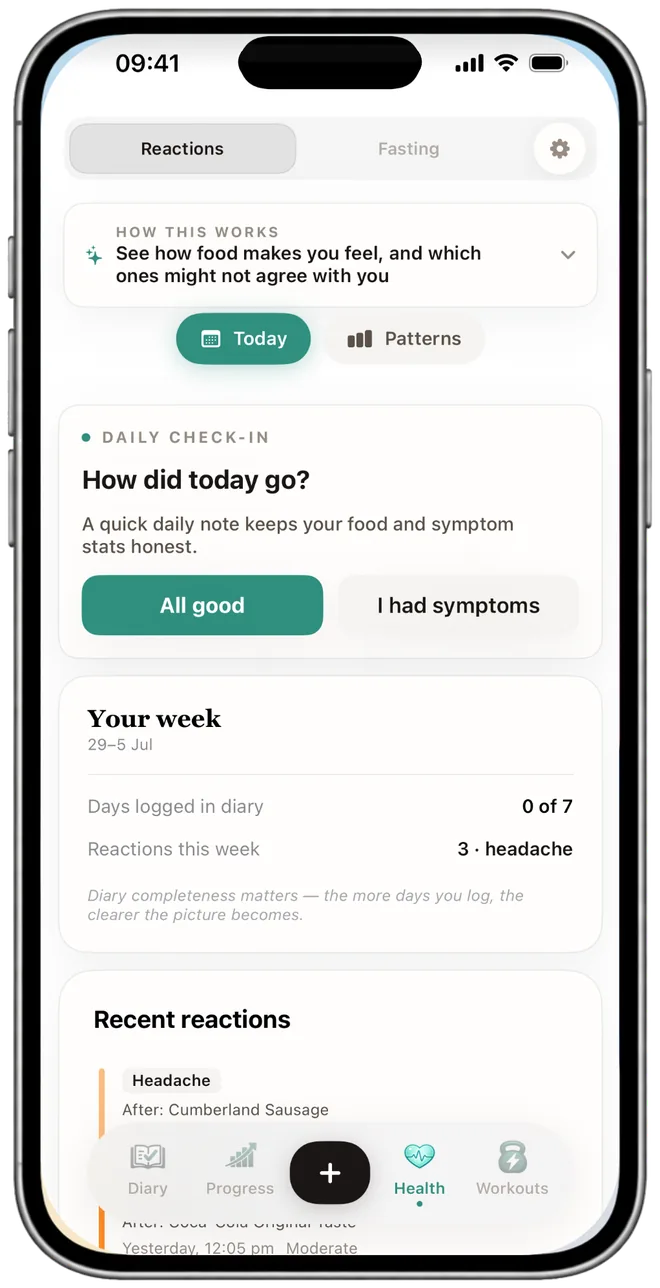
Log every meal. Log how you felt. The suspected-triggers analysis (Pro) looks across the hours and days before each reaction and surfaces ingredients that keep recurring. Lactose, wheat, FODMAPs, eggs, soy, histamine: we surface whatever the data points at. You take it to your GP or dietitian for the diagnosis.
Free download Pro £3.99/month or £34.99/year Cancel any time
Last reviewed: 4 September 2026 · NHS guidance and the free-tier limits named below checked against their own sources on that date.
These are the categories the NHS and the British Dietetic Association point at when someone walks in with vague "food doesn't agree with me" symptoms. The diary is what they ask you to keep first.
Bloating, wind, looseness 30 minutes to a couple of hours after dairy. About 1 in 20 white-British adults; more in other populations.
Milk, soft cheese, yoghurt, ice cream
Non-coeliac gluten sensitivity sits separately from coeliac disease. Coeliac needs a blood test plus biopsy from your GP, not a diary.
Bread, pasta, cereal, malted drinks
Onion, garlic, wheat, beans, certain fruits. The low-FODMAP protocol is a registered-dietitian-led diet; we're the diary you use during it.
Onion, garlic, wheat, apples, beans
Flushing, headache, gut symptoms after aged cheese, cured meats, wine, fermented foods. Pattern usually 1 to 4 hours after.
Aged cheese, wine, cured meat, fermented foods
Symptoms range from gut upset to skin flares. Worth keeping a dated log because eggs hide in bakery, mayo and sauces.
Bakery, mayo, sauces, custards
Common in plant-based foods, sauces, and many bakery items as lecithin (E322). We flag soy in the ingredient list on the scan.
Soy sauce, plant milk, bakery, ready meals
In wine, dried fruit, processed meats. UK law requires >10mg/kg to be declared on labels.
Wine, dried fruit, sausages, prawns
Fruit and high-fructose corn syrup in sugary drinks and confectionery. Bloating and gut symptoms in sensitive people.
Fruit, juice, fizzy drinks, sweets
After a couple of weeks of consistent logging, the Pro analysis lists ingredients by how many of your logged reactions they were in. Open any ingredient to see the diary days and reactions behind its count. The numbers come from your diary, not ours.
You log every meal, then log a reaction when you get one, with the time and a severity score. The analysis counts how many of those reactions came on a diary day containing each ingredient, food or UK allergen. You can open any row to check the days behind it.
A same-day match cannot show whether the food or the reaction came first, or whether one caused the other. These are diary counts to take to your GP or a registered dietitian, not a diagnosis and not an instruction to cut anything out.
The NHS treats these as separate clinical pictures. We treat both. Different urgency, different testing path, different diary. Worth knowing which one you're tracking.
IgE-mediated allergies trigger the immune system within minutes. Hives, swelling, breathing trouble, in severe cases anaphylaxis. Diagnosed by a clinical specialist with skin prick tests, specific IgE blood tests or supervised oral food challenges.
Typically dose-dependent and delayed. Bloating, gut upset, fatigue, headaches, skin flares. No single diagnostic test for most. NHS and BDA recommend a 7 to 14 day food and symptom diary followed by supervised elimination and reintroduction.
This is the part most intolerance pages leave out, and it is the reason a diary is worth keeping at all.
Search “food intolerance test” and you will be offered a home kit: a finger-prick IgG blood panel, a hair sample, a Vega machine. The NHS position on them is short. “Some tests you can buy that claim to diagnose food intolerances are not recommended.” Its reasoning is that there is limited evidence they give accurate results, and that they tend to come back naming a long list of foods, which can be harmful if you act on it.
What the NHS asks for instead is the boring thing: a food and symptoms diary, so you and a clinician can see what actually recurs. Then, if a food looks likely, a supervised period without it and a reintroduction to see whether the symptoms come back. The warning attached to that matters as much as the method. Do not cut foods out without the advice of a GP or a registered dietitian, because the risk of taking whole food groups out of a diet, especially a child’s, is nutritional rather than hypothetical.
So the diary is not a lesser option that you keep until you can afford a test. It is the thing the health service actually asks for, and the test is the part it warns you off. That is the whole job this page is for: keeping that record properly, so the person who can diagnose you has something real to read.
Who this is not for. If your reactions come on within minutes, or involve swelling, hives or any difficulty breathing, that is the allergy picture above and it is urgent. Stop tracking and get clinical help. A diary is for the slow, repeating, hours-later kind of reaction, not the fast dangerous kind.
Source: NHS, Food intolerance.
If you and your GP or dietitian decide to try one food out, the app can count the fortnight for you. One food, one fortnight, two plain counts at the end.
Nothing extra. You keep logging meals and reactions the way you already do. The app flags the food when it appears in anything you log, on its own or inside a sandwich or a sauce.
The app spots the food in your diary and leaves that day out of the count, so one slip does not spoil the fortnight. The result on day 15 says how many days were counted and how many were not.
Serious reactions are not tested. Before it starts, the app asks whether you have ever had a serious reaction to food: trouble breathing, swelling of your face or throat, collapsing. If you have, the test is not offered. Stopping a food and eating it again after a reaction like that is for a specialist, so the app points you to your GP and an allergy referral instead.

The questions that come in from people about to start tracking. Answers sourced to NHS and BDA guidance.
There is no single answer, and the honest shape of it is that the established one is mySymptoms, which has done symptom-and-food logging for years and is what most roundups name first. It is a dedicated symptom diary and that is all it does. We are a better fit if you want the food side to do the work too: barcode scanning, the full ingredient list, additives and the Big 14 allergens read off the label, with reactions on the same timeline. If you only want to log symptoms and never scan anything, a dedicated symptom diary is the lighter tool.
Downloading is free, and so is scanning, food logging and reaction logging while you are building up a baseline. Once you have logged enough for patterns to be worth showing, the suspected-triggers analysis and unlimited reactions are part of Pro at £3.99 a month or £34.99 a year. Free alternatives exist and are worth knowing about: mySymptoms has a free tier, and the NHS Food Scanner app is free but reads sugar, salt and saturated fat rather than tracking symptoms.
The NHS asks for a food and symptoms diary first, then, if something looks likely, a supervised period without that food and a reintroduction to see whether symptoms return. It specifically does not recommend the home tests you can buy, on the grounds that evidence for their accuracy is limited and they tend to name a long list of foods. Keep the diary, take it to a GP or registered dietitian, and do not cut foods out on your own.
We are not an IBS programme and do not run the low-FODMAP protocol, which is a dietitian-led diet with a structured reintroduction rather than something an app should hand you. Apps built around that protocol exist and are the right shape for it. What we are useful for during it is the diary itself: logging every meal and every reaction on one timeline so you and your dietitian can see what recurs.
No app detects an allergy. Allergy is diagnosed by a clinician with skin prick tests, specific IgE blood tests or a supervised food challenge, and if your reactions are fast or involve breathing that is the route to take, urgently. What an app can do is read a label: we surface the Big 14 allergens we can see in a product's ingredient list, so you can check a pack. The pack itself is always the final word, because we can only speak to the ingredient data we hold.
Two to four weeks of consistent logging is the usual answer, because the analysis needs reactions on enough logged days, plus enough days with food logged and no reaction logged. Logging only on bad days is the common mistake: without the ordinary days there is nothing to compare with, and a food you eat constantly will look guilty simply for being common.
No, and nothing that works from a diary can. We surface correlations between what you ate and how you felt. A correlation is a lead, not a diagnosis. Take the record to your GP or a registered dietitian.
A food diary records what you eat. An intolerance tracker also records symptoms, severity and timing, then looks for what recurs before the bad days. We do both on one timeline: the meals, the scans, and the reactions, so the analysis has both halves to compare.
More on this, sourced the same way.
Free download. Reaction logging stays open on the free tier while you build a baseline. Pro is £3.99/month or £34.99/year for unlimited reactions, the suspected-triggers analysis and AI Coach.
iPhone · iOS 17 · Cancel any time