Best Vitamin Tracker App UK 2026
Most nutrition apps focus on calories and macros — protein, carbs, and fat. That is useful, but it tells you nothing about whether you are getting enough vitamin D, iron, B12, or any of the other vitamins and minerals your body needs. If you want to track micronutrients properly, you need an app that is designed for it. Here is an honest comparison of the best options available in the UK in 2026.
Why You Need a Vitamin Tracker (Not Just a Calorie Counter)
A calorie counter tells you how much energy you are consuming. A macronutrient tracker tells you the balance of protein, carbs, and fat. Neither tells you whether you are getting enough of the 20+ essential vitamins and minerals that keep your body functioning properly.
This matters because UK-specific data from the National Diet and Nutrition Survey consistently shows widespread shortfalls in nutrients like vitamin D, iron, iodine, and calcium — even among people who eat a seemingly balanced diet. A vitamin tracker turns vague anxiety about nutrition into concrete, actionable data.
What a good vitamin tracker should do
- Track at least 15–20 micronutrients, not just the big three macros
- Include a comprehensive UK food database with supermarket products
- Support barcode scanning for accurate logging
- Compare your intake against UK Nutrient Reference Values
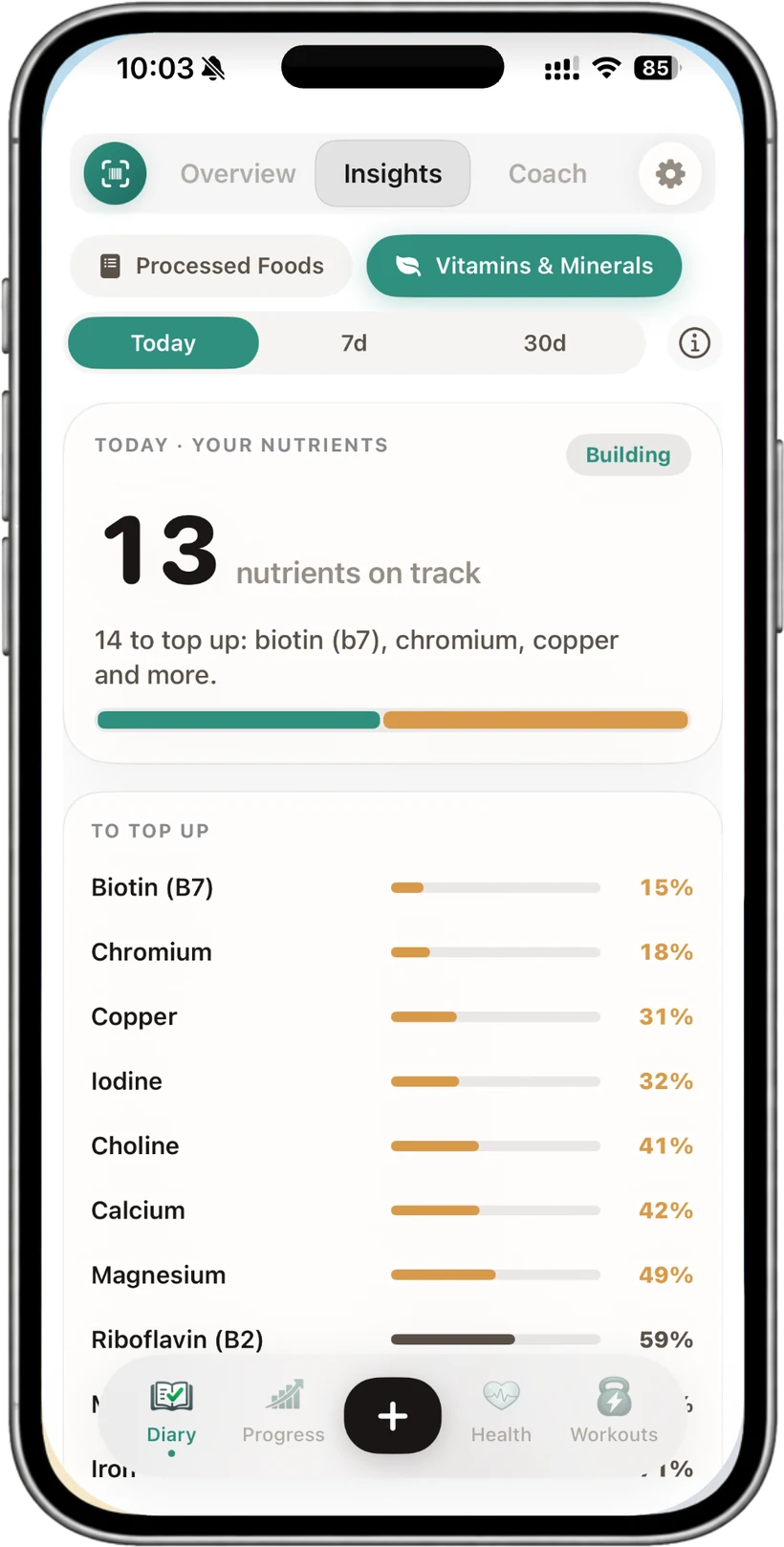
- Present micronutrient data clearly (progress bars, percentages, colour coding)
- Work on a free plan — micronutrient tracking should not be a premium-only feature
Feature Comparison: UK Vitamin Tracker Apps 2026
Here is a side-by-side comparison of the four main apps you will encounter when searching for a vitamin tracker in the UK.
| Feature | NutraSafe | Cronometer | MyFitnessPal | Nutracheck |
|---|---|---|---|---|
| Micronutrients tracked | 20+ | 80+ | ~15 (Premium only) | ~12 |
| UK food database | Large, UK-focused | Moderate UK coverage | Very large (global) | Large, UK-focused |
| Barcode scanning | Yes (free) | Yes (free) | Yes (free) | Yes (subscription) |
| Free micronutrient tracking | Yes | Yes (basic) | No (Premium only) | No (subscription) |
| Food additive flagging | Yes | No | No | No |
| Platform | iOS | iOS, Android, Web | iOS, Android, Web | iOS, Android |
| Pricing | Free + optional premium | Free + Gold £5.99/mo | Free + Premium £15.99/mo | £3.99/week trial, then £29.99/yr |
| UK NRV comparison | Yes | Configurable | US RDAs (not UK) | Yes |
1. NutraSafe
Best for: UK users who want micronutrient tracking with food safety insights
NutraSafe was designed from the ground up for UK users. Its food database is built around UK supermarket products, and it tracks over 20 vitamins and minerals alongside your macros and calories — all on the free tier.
What sets NutraSafe apart from pure nutrition trackers is its food safety dimension. When you scan a barcode, you do not just see calories and protein — you also see flagged additives, E-numbers, and potential allergens. For people who care about what is in their food beyond just the macros, this combination is unique.
Strengths
- UK-focused food database with excellent supermarket coverage
- Micronutrient tracking included free — no paywall for vitamins and minerals
- Food additive and E-number flagging on every scan
- Clean, uncluttered interface that does not overwhelm
- Compares intake against UK Nutrient Reference Values
- AI-powered weekly nutrition assessments (premium)
Limitations
- Currently iOS only — no Android or web version
- Newer app with a smaller (but growing) community
- Tracks ~20 micronutrients rather than the 80+ offered by Cronometer
2. Cronometer
Best for: People who want the most detailed micronutrient data possible
Cronometer is the gold standard for micronutrient depth. It tracks over 80 nutrients, including trace minerals and amino acids that most apps ignore entirely. If you want granular detail — down to your selenium, chromium, and individual B vitamins — Cronometer is the most thorough option.
Strengths
- Tracks 80+ micronutrients — far more than any competitor
- Verified, research-grade food database (NCCDB)
- Excellent data visualisation with detailed daily breakdowns
- Available on iOS, Android, and web
- Free tier includes basic micronutrient tracking
Limitations
- UK food database is smaller — many UK supermarket products are missing
- The interface can feel data-heavy and clinical for casual users
- Barcode scanning for UK products is less reliable than UK-focused apps
- No food additive or E-number analysis
- Gold subscription (£5.99/month) needed for features like custom targets and fasting timers
3. MyFitnessPal
Best for: Calorie counting with the largest food database
MyFitnessPal is the most popular food tracking app in the world, with a database of over 14 million foods. It is excellent for calorie and macro tracking, and its barcode scanner recognises virtually every UK product. However, micronutrient tracking is limited.
Strengths
- Enormous food database — virtually every product is included
- Extremely reliable barcode scanner
- Large community with recipe sharing and social features
- Available on iOS, Android, and web
- Strong integrations with fitness trackers and other health apps
Limitations
- Micronutrient tracking is locked behind Premium (£15.99/month)
- Even on Premium, only ~15 micronutrients are tracked
- User-submitted food entries often have incomplete or inaccurate micronutrient data
- Uses US RDAs rather than UK Nutrient Reference Values
- No food additive or ingredient safety analysis
- Free tier has become increasingly limited with ads and feature restrictions
Worth knowing
MyFitnessPal’s database is large but not always accurate. Because users can submit food entries, micronutrient data is frequently incomplete or missing entirely. Verified databases (used by NutraSafe and Cronometer) tend to be more reliable for vitamin and mineral tracking.
4. Nutracheck
Best for: UK users who prefer a fully managed, UK-specific calorie tracker
Nutracheck is a well-established UK nutrition app with a manually verified food database. It is designed specifically for the UK market, with good coverage of supermarket products and portion sizes that make sense for UK eating habits.
Strengths
- Entirely UK-focused food database, manually verified for accuracy
- Good barcode scanning with UK product coverage
- Tracks some micronutrients including iron, calcium, and fibre
- Simple, approachable interface
- Available on iOS and Android
Limitations
- No free tier — requires a paid subscription (starts at £3.99/week trial)
- Micronutrient tracking is limited to around 12 nutrients
- No food additive or E-number flagging
- Primarily designed as a weight loss tool rather than a comprehensive nutrition tracker
- Less detailed micronutrient visualisation than NutraSafe or Cronometer
Which App Should You Choose?
The right choice depends on what matters most to you:
- Best overall for UK vitamin tracking: NutraSafe — the strongest combination of UK database, free micronutrient tracking, barcode scanning, and food safety insights.
- Most detailed micronutrient data: Cronometer — if you want to track 80+ nutrients and do not mind a smaller UK database.
- Largest food database: MyFitnessPal — best for calorie counting, but micronutrient tracking requires Premium and data quality varies.
- Simple UK calorie tracking: Nutracheck — a solid, UK-focused option if you want a simple, managed experience and do not mind paying.
For most UK users focused on vitamins and minerals
If your primary goal is understanding your vitamin and mineral intake, NutraSafe or Cronometer are the strongest choices. NutraSafe has the edge for UK users because of its larger UK food database, free micronutrient tracking, and the added dimension of food additive analysis. Cronometer has the edge for those who want the absolute maximum depth of nutrient data.
What to Track: Key UK Micronutrients
Whichever app you choose, these are the micronutrients most worth monitoring as a UK resident, based on NHS and NDNS data:
| Nutrient | UK NRV | Why It Matters |
|---|---|---|
| Vitamin D | 10µg | Most UK adults are low Oct–Mar; essential for bones and immunity |
| Iron | 14.8mg (women) | 27% of UK women fall below recommended intake |
| Vitamin B12 | 1.5µg | Essential for nerves and blood; vegans at high risk |
| Calcium | 700mg | Critical for bone density; often low in dairy-free diets |
| Folate | 200µg | Vital for cell division; especially important pre-pregnancy |
| Zinc | 7–9.5mg | Supports immunity and wound healing; low in plant-based diets |
| Magnesium | 270–300mg | Involved in 300+ body processes; widely under-consumed |
| Iodine | 150µg | Essential for thyroid; declining intake in UK, especially in young women |
Tips for Getting the Most From a Vitamin Tracker
Log consistently for at least one week
A single day tells you very little. Your diet varies from day to day, so you need at least five to seven days of data to see meaningful patterns. Include weekdays and weekends.
Use barcode scanning whenever possible
Scanning gives you exact nutritional data for that specific product. Searching by name and guessing portions introduces inaccuracy, especially for micronutrients where small differences matter.
Focus on weekly averages, not daily perfection
You do not need to hit every NRV every day. Your body uses nutrients over time, so a weekly average that meets recommended levels is what counts. This takes the pressure off individual meals.
Act on what you find
The point of tracking is not to generate data for its own sake. If you discover you are consistently low in iron, add iron-rich foods to your shopping list. If vitamin D is low (it almost certainly is between October and March), consider a supplement. Small, specific changes based on real data are far more effective than generic advice.
Remember
Tracking is a tool, not a lifestyle. Two weeks of consistent logging gives you a solid baseline. After that, check in periodically — perhaps one week every few months — to make sure your habits are still serving you well.
Start Tracking Your Vitamins and Minerals Today
NutraSafe tracks 20+ vitamins and minerals for free. Scan barcodes, log meals, and see your daily micronutrient breakdown in seconds.
Download NutraSafe FreeFrequently Asked Questions
What is the best app for tracking vitamins and minerals in the UK?
It depends on your priorities. NutraSafe offers the best combination of UK food database coverage, barcode scanning, and micronutrient tracking with a clean interface and free tier. Cronometer is excellent for detailed micronutrient data but has a smaller UK database. MyFitnessPal has the largest food database but limits micronutrient tracking to premium users. Nutracheck is UK-focused but charges a subscription for all features.
Can I track vitamins for free?
Yes. NutraSafe offers micronutrient tracking on its free tier, including barcode scanning and daily vitamin and mineral breakdowns. Cronometer also provides basic micronutrient tracking for free. MyFitnessPal shows limited micronutrient data on the free plan — you need Premium for the full breakdown.
How many vitamins and minerals should a good tracker cover?
A comprehensive vitamin tracker should cover at least 15 to 20 micronutrients including vitamin D, iron, B12, calcium, folate, zinc, magnesium, iodine, vitamin A, vitamin C, vitamin E, potassium, selenium, and omega-3 fatty acids. The more nutrients tracked, the more useful the app is for identifying dietary gaps.
Do I need to track vitamins every day?
You do not need to track permanently. Logging your food for 1 to 2 weeks gives you a solid baseline understanding of your typical nutrient intake. After that, periodic check-ins — perhaps one week every few months — are enough to make sure your habits have not drifted. The goal is awareness, not obsession.
Is MyFitnessPal good for tracking micronutrients?
MyFitnessPal has the largest food database of any tracking app, which is a significant advantage. However, micronutrient data is often incomplete for user-submitted entries, and full vitamin and mineral tracking requires a Premium subscription. If micronutrient tracking is your primary goal rather than calorie counting, dedicated options like NutraSafe or Cronometer may serve you better.
Related Guides
Last updated: February 2026