
Nutrition tracker for the UK: calories, macros, vitamins and minerals
Most trackers stop at calories and macros. NutraSafe keeps going. It logs your food, then scores 14 vitamins and 12 minerals against the UK Nutrient Reference Values, the same figures printed on UK labels, and reads the additives and processing level too. The full picture of your week, in one diary.
Free download Pro £3.99/month or £34.99/year UK NRVs, not US RDAs
One diary for calories, macros, vitamins and minerals
A calorie counter gives you one number. This one carries on through macros, vitamins, minerals, additives and how processed your food is, because that is where the picture of your week actually sits.
Vitamins and minerals scored against UK NRVs
Every food you log is checked for 14 vitamins and 12 minerals, and each one is measured against the UK Nutrient Reference Values, the figures that sit on UK food labels, rather than a US RDA or a generic chart. So a day is not just a calorie total. It is a read on where you actually stand on vitamin D, folate, iron, calcium, magnesium and the rest.
The reference data behind those percentages draws on SACN, EFSA, NIH and the UK CoFID food-composition tables, so the numbers reflect UK guidance rather than a single overseas source. Vitamin and mineral tracking is a NutraSafe Pro feature (£3.99 a month or £34.99 a year on iOS). The free tier keeps calories, macros and the additive flag.
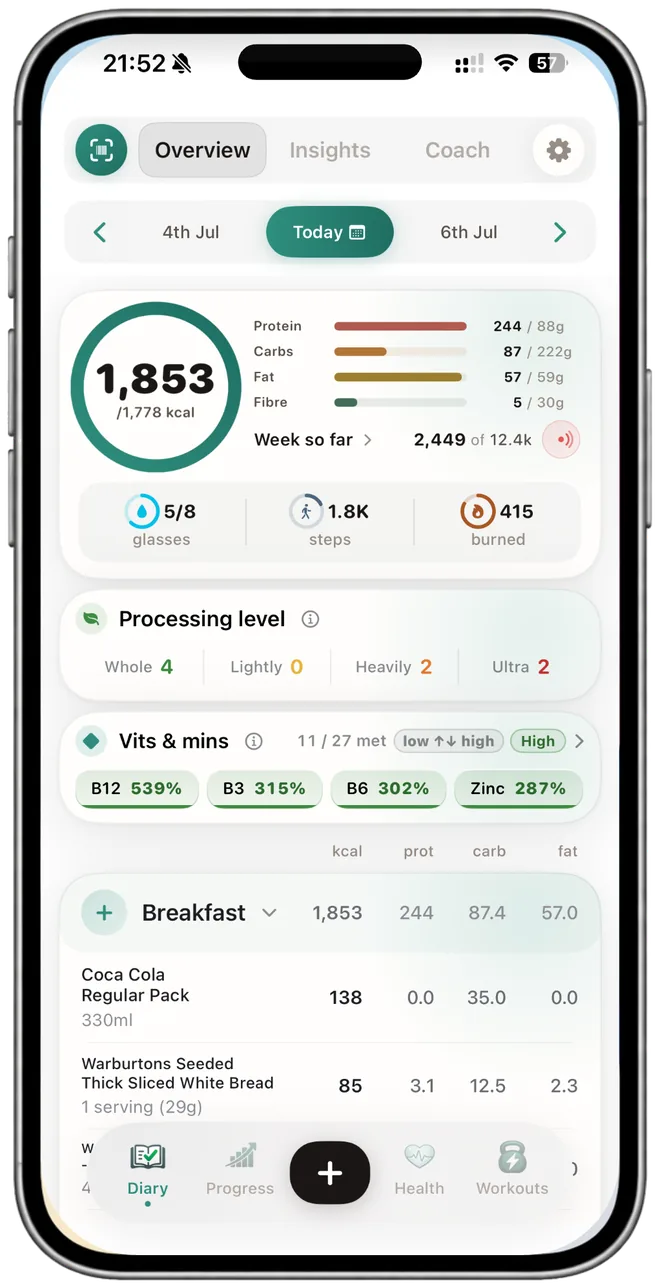
Log food, calories and macros in one diary
Type a food, scan its UK barcode, or photograph the plate. NutraSafe finds it in the UK database, branded and own-brand, and fills in the calories, protein, carbs, fat, fibre and salt straight off the label. Pick the meal and the portion and your running totals move as you go.
Calories and macros are free for up to 25 foods a day, so you can run the basics without paying. If all you want is the energy-in number, the calorie and macro views do that on their own. The point of a nutrition tracker is that the same diary also carries what those calories were made of.
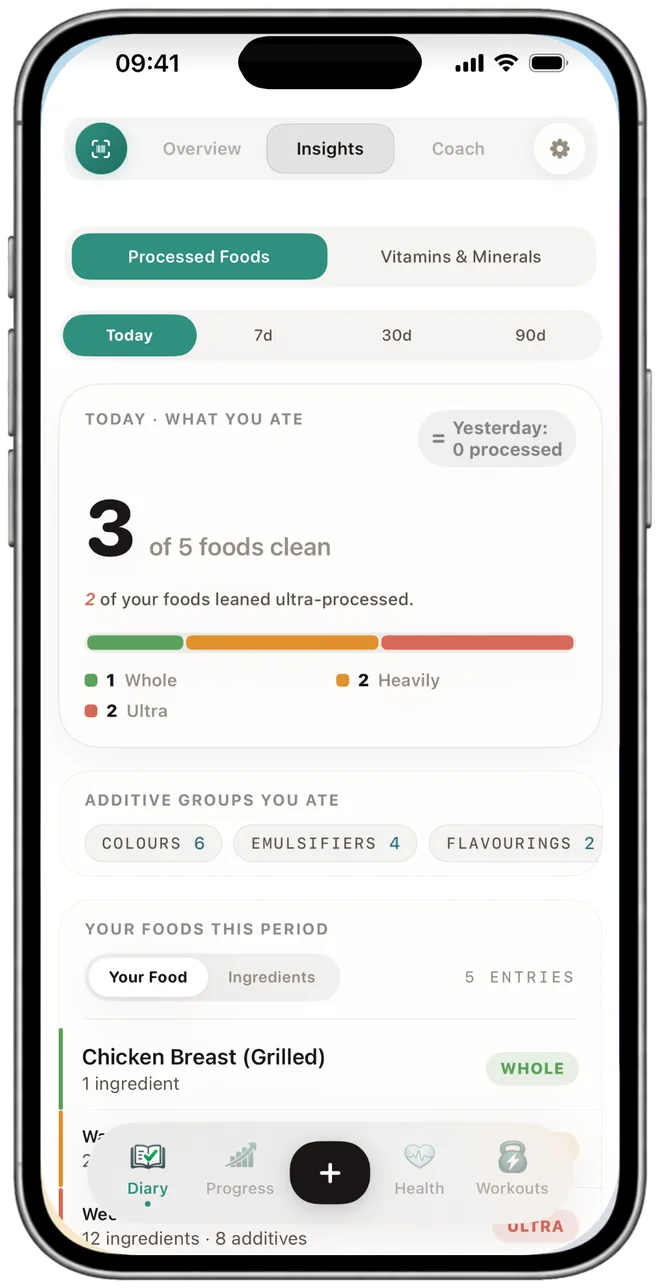
See how processed your week is, and what is in it
A nutrition tracker that stops at macros misses what the food is made of. NutraSafe reads the ingredients list on every packaged food you log, pulls out the additives, and flags the ones that carry a published concern, with the source on the line. It also tracks how processed your week is, day by day.
That gives you a second axis next to the numbers: not just how many calories and grams, but how much of the week came from ultra-processed food and which additives keep turning up. You get the evidence and where it was published, so what you make of it is your call. Processed-food insights are a Pro feature.
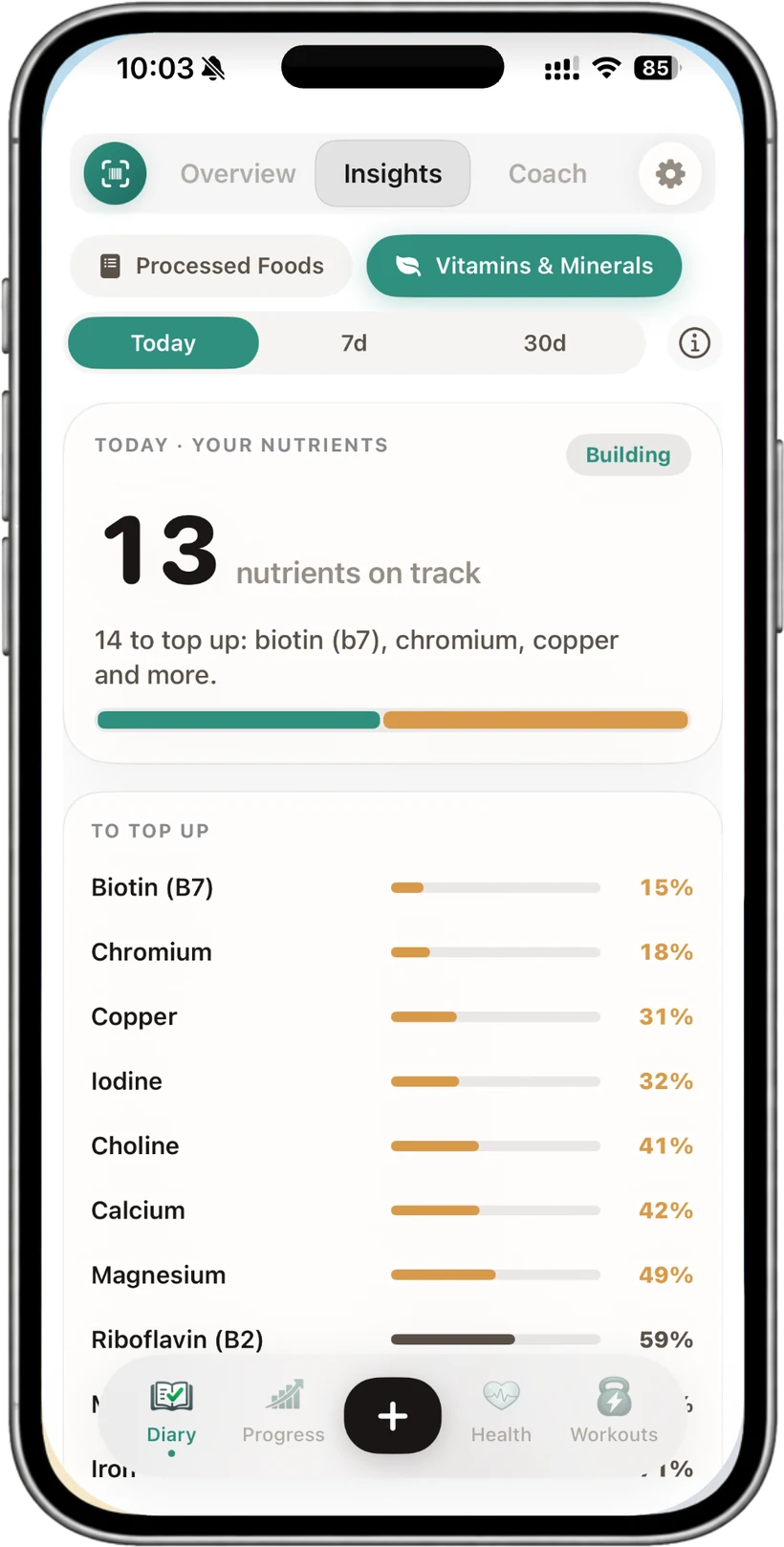
Spot the vitamin and mineral gaps before a blood test does
One day is a snapshot. The value of tracking your nutrition rather than counting calories is the pattern across a week or a month: the nutrients you consistently hit, and the ones you keep falling short on. NutraSafe holds daily, weekly and monthly NRV views, so the trend is visible rather than buried under a single day's figure.
It matters because the UK's national diet survey keeps finding shortfalls most people never notice, in vitamin D, folate and iron especially. A tracker shows you the pattern first; a GP or a registered dietitian is who you take it to. We do not diagnose and we do not prescribe.
What a day in the tracker adds up to
Three meals and a snack, and here is what the day looks like against UK NRVs.
A worked day
Porridge with milk and berries for breakfast, a chicken and spinach salad at lunch, an apple in the afternoon, and a salmon dinner with potatoes and broccoli. Log each one by search or barcode and the calories and macros add themselves up. On Pro, the vitamins and minerals score against UK Nutrient Reference Values as you go.
By the evening the dashboard might show you well over on vitamin C and iron, close on calcium, and short on vitamin D, the nutrient a UK winter diet most often misses. Those figures are an illustration, not a promise about your day. Your own totals depend on what you actually log and the portions you pick.
One day is a snapshot, not a trend. The pattern only shows once you have logged a week or two: where you are consistently short, and where you are not. That is the difference between tracking your nutrition and counting calories alone. More on the vitamin tracker →
Why tracking vitamins and minerals matters
Calorie counting is the easy half. Vitamin and mineral patterns are where the UK data keeps showing why a broader tracker earns its place.
National Diet and Nutrition Survey, 2019 to 2023
The UK NDNS 2019 to 2023 report (gov.uk, June 2025) found 18% of UK adults aged 19 to 64 had low vitamin D status, and 83% of women of childbearing age had red-cell folate below the threshold associated with reduced neural-tube-defect risk.
Most people only learn about gaps like this from a blood test, after the fact. Log a normal week on Pro and the dashboard tells you, for instance, that you reached your folate NRV on two days out of seven. That is not medical advice, and we will not tell you to take a supplement. It is the kind of fact you can take to your GP or a registered dietitian.
We are a tracking tool, not a clinician. We do not diagnose, we do not prescribe. We surface the pattern in your own food and leave the decisions to you and your doctor.
Free to use. Pro is £3.99 a month
Calories, macros, the additive flag and the barcode scanner are free. The vitamins, minerals, AI Coach, workouts and fasting sit on Pro.
- Up to 25 food logs a dayType, search, or barcode.
- Calories, macros, fibre, saltPulled straight off the UK label.
- Barcode scanner with the additive flagEvery additive we recognise on the pack.
- Reaction log, up to 5 entriesBloating, energy, mood, gut, skin.
- 14 vitamins, 12 minerals vs UK NRVDaily, weekly and monthly views.
- Processed-food insightsHow processed your week was, tracked over time.
- AI Coach & AI meal scanChat coach that reads your diary; plate-photo logging.
- Workouts & fastingSets, reps, Apple Watch. 16:8, 5:2, custom.
- Lifted free caps & suspected triggersNo 25-a-day cap; patterns across food and reactions.
Nutrition tracker FAQ
The questions we see most in app reviews and support. If yours isn't here, our contact page goes to a real inbox.
A calorie counter adds up energy and macros. A nutrition tracker goes further and adds up the vitamins and minerals in your food too. We do both. On Pro we score your day against UK Nutrient Reference Values, so you can see where you sit on vitamin D, folate, iron, calcium and the rest, not just whether you hit a calorie number.
Yes. We track 14 vitamins (A, B-complex, C, D, E, K) and 12 minerals (iron, calcium, magnesium, zinc, potassium, selenium and more) against UK Nutrient Reference Values. This is a Pro feature (£3.99/month or £34.99/year, iOS). The free tier covers calories, macros, barcode scanning with the additive flag, 5 reactions, and the E-number library on this website.
Three ways. Scan the barcode on a UK packaged food (any GTIN/EAN, the same format every UK supermarket uses). Search the food database by name. Or, on Pro, photograph the plate with AI meal scan. Pick a portion, hit add, and we update your daily totals. The free tier lets you log up to 25 foods per day.
We're a tracking tool, not your GP. What we can do is show you the pattern in your own week. The UK National Diet and Nutrition Survey 2019 to 2023 (gov.uk, June 2025) found 18% of adults aged 19 to 64 had low vitamin D status, and 83% of women of childbearing age had red-cell folate below the threshold associated with reduced neural-tube-defect risk. Most people only learn about gaps like this from a blood test. With our tracker you see the pattern first, and take it to a GP or dietitian if you want to act on it.
The download is free. The free tier lets you log up to 25 foods per day, scan UK barcodes for additives and the flag, log up to 5 reactions, and use the E-number library on this website. Pro is £3.99 per month or £34.99 per year on iOS and unlocks vitamin and mineral tracking against UK NRVs, AI Coach, AI meal scan, allergen warning detail, fasting, workouts, suspected-triggers analysis, and processed-food and NRV insights.
UK NRVs (Nutrient Reference Values under retained FIC 1169/2011), the figures used on UK food labels. Not the US RDA, not the EFSA Reference Intake. So when you see vitamin C at 96%, it's 96% of the UK NRV (80mg).
Log a meal, count the calories, and see the vitamins too
Free download. Calories and macros are free; vitamins and minerals against UK NRVs are on Pro for £3.99 a month or £34.99 a year. Cancel any time.
iPhone · iOS 17 · Cancel any time