
A UK food scanner that reads the whole label, not just the calories
Point the camera at the barcode on a UK pack. Back comes the calories and macros off the panel, the full ingredient list, how many additives the pack holds, and the Big-14 allergens we can read. The back of the pack, decoded, before you eat it.
Last reviewed: 4 September 2026 · Free-tier limits and the alternatives named below checked against their own listings on that date.
Free download Scanning, the score and the additive count are free Pro £3.99/month
One barcode, the calories, the additive count and the allergens
A calorie app stops at the number. We read the ingredients list too, so a single scan tells you what is actually in the pack and what it adds to your day.
Scan a UK barcode and get the whole label
The camera reads the standard UK barcode, the GTIN or EAN printed on every pack in every UK supermarket. Tesco, Sainsbury's, Asda, Morrisons, Aldi, Lidl, Co-op, Waitrose and M&S own-brands look up the same way as the big names. The database is built around UK supermarket ranges, own-label included, and many packs now come back with the real photo rather than a generic icon, so you can see at a glance you have the right item and not the multipack next to it.
Scanning is free. So is the food's score, the ingredient list and the count of how many additives the scan found. No typing, no scrolling a list of near-identical products trying to work out which one is the thing in your hand.
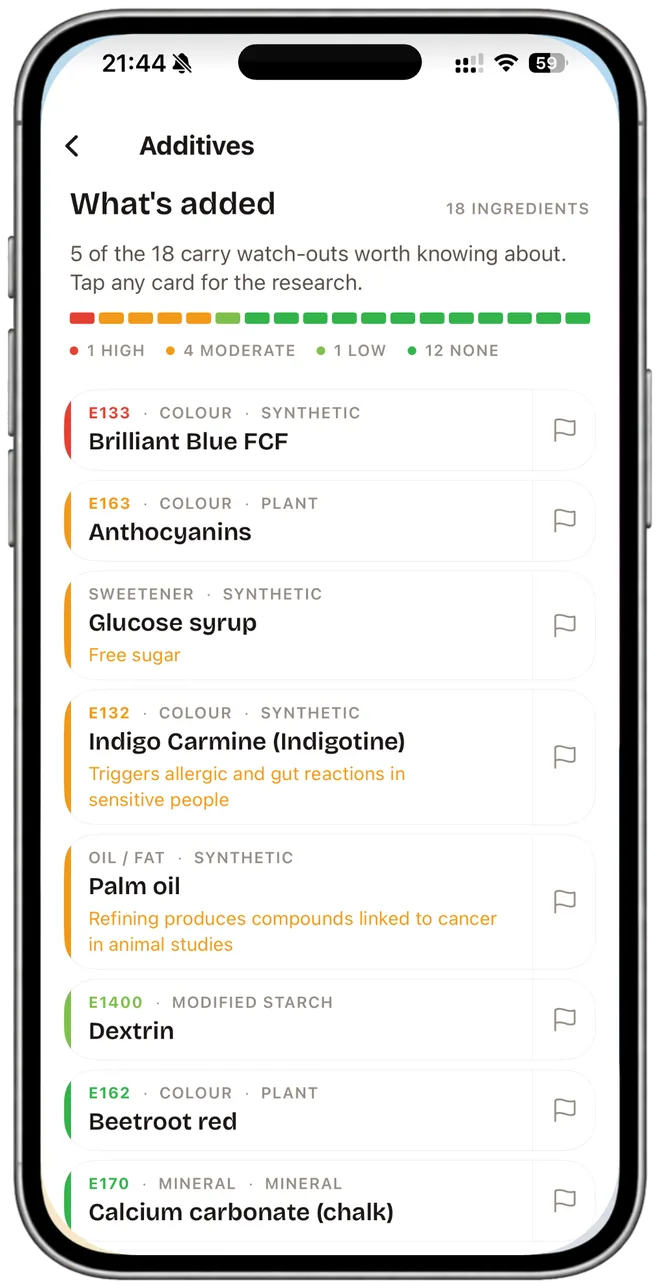
How many additives, then what each one is
Every scan checks the ingredients against the additive library and tells you the count for free. Three additives in a pack you thought was plain is the thing you want to know standing in the aisle, and you get it without paying us anything.
Pro opens the list. Each additive gets its name, the plain-English line on what it does and where it turns up, and, where research exists, the concern and the body that published it. E150d, the caramel colour in many colas, carries a flag because two of the four caramel types can contain a possible carcinogen, per IARC. Sodium nitrite (E250) in bacon and ham is flagged to the same body, which classes processed meat as a cause of bowel cancer. We name the source on the line, so you can go and read it rather than take our word for it.
Big-14 allergen flags, read from the ingredients
We read the ingredients for the 14 allergens UK law requires a label to declare (celery, cereals with gluten, crustaceans, eggs, fish, lupin, milk, molluscs, mustard, nuts, peanuts, sesame, soya and sulphites) and flag the ones we find. This is free on every scan. Tell us which ones you care about and the panel leads with your answer instead of making you read all fourteen.
One caveat, and we mean it. We surface only the allergens we can read from the ingredient list, and that data can be incomplete or out of date. Always check the packet yourself, and never rely on any app for a serious allergy. The flag is a prompt to look closer, not the last word on what is in the product.
Scan a barcode for calories, then log the day
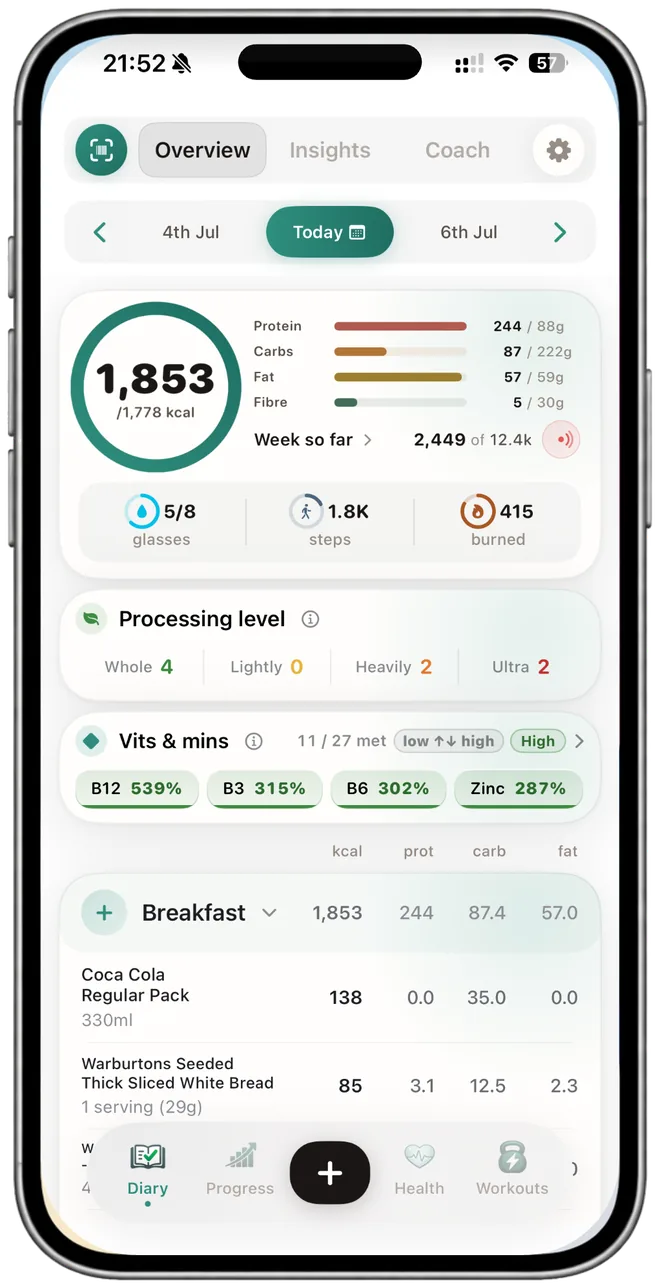
The calories and macros come straight off the pack's own panel, per serving and per 100g, so a barcode scan doubles as a calorie counter. Add the food to your day with one tap and we keep the running totals: calories, protein, carbs, fat, fibre and salt against your targets. Logging is free for up to 25 foods a day. What you scan stays in the diary, so a week builds a picture rather than one snack.
For food that never had a barcode, a restaurant plate or a dinner you cooked, the AI meal scan reads a photo and estimates the calories and likely ingredients. The card says it is an estimate. Pro adds that, plus 13 vitamins and 12 minerals against UK reference values, the reaction diary, workouts and fasting.
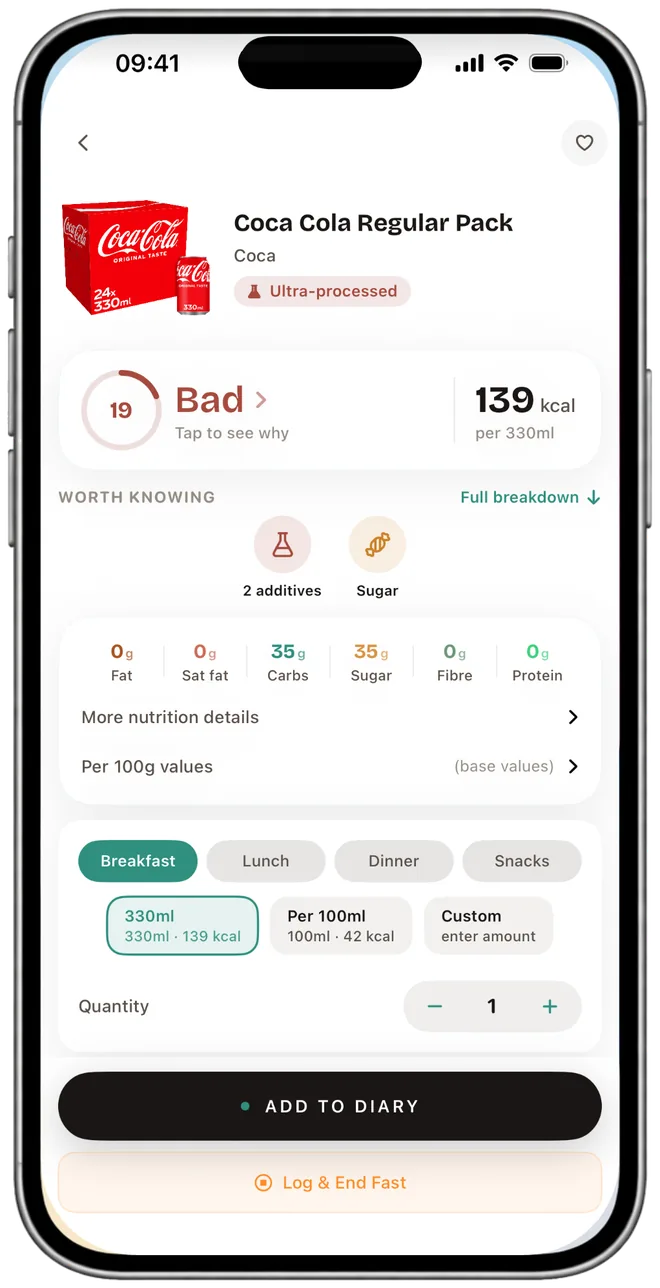
What a scan of a can of cola shows
Scan a can of cola
The nutrition comes straight off the can, roughly 139 kcal in a 330ml can, with the sugar beside the ingredient list and the score at the top. Free, on the first scan, before you have decided whether any of this is worth paying for.
Open the additives on Pro and each one is named and sourced. E150d, the caramel colour, is flagged to IARC. Phosphoric acid is flagged because a lot of it over the years is hard on kidneys and bone. The caffeine and the natural flavourings carry no flag. Every line names where the concern was published, EFSA, the FSA or IARC, so you can go and check it yourself.
A calorie is a calorie. The rest of the label is not
Two products can carry the same calories and look nothing alike once you read past the number. One is a short list of ingredients you recognise. The other runs to three lines and includes colours, sweeteners and preservatives. A calorie counter cannot tell them apart. A scanner that reads the ingredients can.
It matters because ultra-processed food makes up around 57% of the average UK adult's calories, and closer to two thirds of a teenager's, according to analyses of the National Diet and Nutrition Survey (Rauber et al. 2018; Cambridge, 2024). Most of the additives that come with that are printed on the label and then never read, because reading them means knowing what E471 is. We do that part for you, and name the body that raised each concern, EFSA, the FSA or IARC, so you can check the source.
We do not tell you a food is off limits and we do not hand out a verdict. We show you what is in the pack, where each concern was published, and how it stacks up across your day and week. What you do with that is your call, and if a pattern looks worth raising, it is there to take to your GP or dietitian.
Is there a free food barcode scanner?
Yes, several, and they are not all doing the same job. Which one to reach for depends on the question you are standing in the aisle asking. Here is the straight version, including where the answer is not us.
The NHS Food Scanner
Free on iOS and Android, from the NHS. Scan a pack and it shows sugar, salt, saturated fat and calories on the traffic-light system, then offers healthier swaps. It is built for families and there is an augmented-reality view that shows children the sugar in a bottle. If your question is "is this high in sugar" and you want a government answer for nothing, start there.
Free · NHSOpen Food Facts
Free, open and filled in by volunteers, returning the Nutri-Score and the panel. Coverage is broad because anyone can add a product, and it varies for the same reason: a pack is only as current as the last person who updated it. Worth knowing it exists, and worth checking the pack against what it tells you.
Free · crowd-filledWhat ours does without paying
Scan the barcode, read the ingredient list in pack order, see the food's score, see how many additives the pack holds, and see the Big-14 allergens we can read. Log up to 25 foods a day. What costs £3.99 a month is naming each additive, what it does and who published the concern, plus vitamins and minerals against UK reference values, the AI meal scan, reactions, workouts and fasting.
Free tier · Pro £3.99Which additives get a flag, and who published it
Most additives on a UK pack carry no flag at all. One appears when a named body has published something about that additive, and the app shows you which body and what it said. Four turn up on UK shelves more than any others.
The Southampton Six colours: E102, E104, E110, E122, E124 and E129. A UK pack containing any of them has to print the line that it may have an adverse effect on activity and attention in children. That wording is a legal labelling requirement, following the 2007 Southampton study, and it is already on the pack whether or not anyone reads it.
Aspartame, E951. IARC classified it as possibly carcinogenic to humans, Group 2B, in July 2023. JECFA reviewed it the same month and left its acceptable daily intake unchanged. We show both on the same line, because the two bodies looked at the same evidence and said different things, and that is worth seeing rather than one of them.
Nitrites in cured meat: E249, E250, E251 and E252. IARC places processed meat in Group 1, causes cancer in humans, for bowel cancer. NHS advice is to cut down to 70g a day if you currently eat more than that.
Caramel colour E150d. IARC has graded 4-MEI, which forms while it is being made, as possibly carcinogenic to humans, Group 2B.
Where nothing has been published on an additive, it is named and left without a flag. We do not fill the gap with a verdict of our own. The longer write-up on any of them is in the E-number A to Z, and food additives in plain English covers what the categories do.
Food scanner FAQ
Any UK barcode. The database is built around UK supermarket ranges, so Tesco, Sainsbury's, Asda, Morrisons, Aldi, Lidl, Waitrose, Co-op and M&S own-brands and the big names all look up the same way. Independents are hit and miss. Send us a pack we are missing through the in-app report.
Free: scan the barcode, read the ingredient list, see the food's score, and see how many additives the pack holds. The Big-14 allergens we can read from the ingredients are free too, and so is logging up to 25 foods a day. Pro names each additive, says what it does and shows who published the concern. NutraSafe Pro is £3.99 a month or £34.99 a year on iOS.
Ours reads the ingredients line off a UK barcode and picks out every additive and E-number in it, in the order they appear on the pack. The count is free. Naming each one, saying what it does and showing which body published a concern about it is Pro. Yuka and Open Food Facts also list additives from a scan, and we put all three next to each other in our roundup of the best food scanner apps in the UK.
Both, in the same diary. A calorie counter totals the day. A food scanner reads what is in the pack before you eat it: the ingredient order, the additive count, the allergens and the panel. If you are weighing up options, see how we compare in our roundup of the best food scanner apps in the UK.
Yes. Every ingredient is checked against the additive library, and the count of what it found comes back free. Open an additive on Pro and you get the plain-English line on what it is and where it turns up, plus what the regulator or IARC published where research exists, with the source.
Treat them as a prompt, not the last word. We surface the Big-14 allergens we can read from the ingredient list, and that data can be incomplete or out of date. Always check the packet, and never rely on any app for a serious allergy.
AI meal scan photographs a plate and estimates the calories, macros and likely ingredients. Less precise than a barcode scan, useful for restaurant food, home cooking and takeaways. Pro feature.
Products you have already scanned open offline from the diary. A fresh barcode needs a connection to look it up.
Search the product by name, or send the pack through the in-app report.
Yes. The NHS Food Scanner is free on iOS and Android and shows sugar, salt, saturated fat and calories on the traffic-light system with healthier swaps. Open Food Facts is free and volunteer-filled. Ours is free to download too: scanning, the ingredient list, the food's score, the additive count and the Big-14 allergen flags cost nothing, and so does logging up to 25 foods a day. Naming each additive and what it does is Pro at £3.99 a month.
Yes, the phone camera is the scanner. There is no extra hardware. Point it at the GTIN or EAN barcode printed on the pack, hold steady for a moment and the product comes back. If the light is poor or the barcode is curved around a tin, type the numbers underneath it instead.
It depends what you want the scan to tell you. We tested seven against real UK packs, including Yuka and the NHS app, and wrote up where each one wins in our roundup of the best food scanner apps in the UK. If you want the short version: the NHS app for a free traffic-light read, and ours if you want the additives named and the day totalled.
Scan a product, read the whole label, log the day
Free download. Scanning, the score, the ingredient list, the additive count and the allergen flags are free. Pro names each additive and its source, and adds 13 vitamins and 12 minerals against UK reference values, the AI meal scan, the reaction diary, workouts and fasting. £3.99 a month or £34.99 a year.
iPhone · iOS 17 · Cancel any time