
Food additives: what the evidence says.
Food additives are added to food for different reasons. Some give it colour, some preserve it or sweeten it, and others thicken it, change its texture or help it last longer on the shelf. Every additive approved in the UK has an E number, although most manufacturers print the additive's real name on the label instead.
We checked the ingredients of over 43,000 foods sold in UK supermarkets, and two in every three list at least one additive. Most additives have very little published research against them, but a small number have more, and some of those turn up in thousands of everyday products. This page goes through those additives one by one, explaining what the research found, how strong that research is and how to spot each one on a label.
What counts as a food additive?
Whether something counts as an additive depends on why it has been added to the food, rather than on what it is made from.
Vitamin C is a good example. In an orange it is simply a nutrient, but when it is added to bread dough to strengthen it, it counts as an additive. In the same way, pectin from apple peel is an additive when it is used to set jam, and so is the sodium nitrite that is used to cure bacon.
Every additive allowed in Great Britain is on a list kept by the Food Standards Agency, and each one has its own E number. The first digit of the number tells you what the additive is used for, but it tells you nothing about whether it is harmful. Numbers in the 100s are colours, the 200s are preservatives, the 400s are thickeners and emulsifiers, and most sweeteners are in the 900s. Our guide to what E numbers are explains the whole system.
By law, a label has to name each additive and say what it is there for, for example "emulsifier: mono- and diglycerides of fatty acids". Printing the E number is optional, and most labels leave it out. Of the foods we checked that list an additive, only 14% print an E number anywhere in their ingredients.
Where an additive comes from does not tell you much about what it does in your body. Carrageenan is made from seaweed and carmine is made from insects, yet both have research findings that we cover below. Vitamin C made in a factory is exactly the same molecule as the vitamin C in fruit.
How common are these additives in supermarket food?
These bars show the share of 43,325 supermarket foods that list each additive, either by name or by E number. We counted them on 26 September 2026 from the ingredient lists that supermarkets publish, and the bars are drawn on a scale from 0 to 25%.
The additives with the most research against them are not rare ones. Mono- and diglycerides, the emulsifier that has been linked to heart disease and some cancers in the studies below, is the fifth most common additive in supermarket food. Potassium sorbate, which three studies published this year looked at, is the eighth most common.
You can see all 166 additives ranked in the same way, along with how we counted them and a free download of the figures, in the UK Food Additive Index.
To count these, we used the ingredient lists of foods on UK supermarket websites and took out anything that is not food. An additive was counted whenever the list named it or printed its E number. This tells you how many foods contain each additive, not how much of it they contain.
Which additives have evidence against them?
There are six groups, and each one has its own section further down. For every finding we say what kind of study it came from, because a link found in a large study of people is not the same thing as proof.
Emulsifiers
A study of around 100,000 French adults linked them to heart disease and some cancers, and in mice they upset the balance of gut bacteria.
Sweeteners
The WHO's cancer agency says aspartame could possibly cause cancer, and erythritol and xylitol have been linked to blood clots.
Six colours
These have been linked to more hyperactive behaviour in some children, so any food that contains one has to carry a warning.
Nitrite in cured meat
The WHO's cancer agency says processed meat causes bowel cancer, and the nitrite used to cure it is thought to be one of the main reasons.
Preservatives
Three studies published in 2026 linked some preservatives to cancer, type 2 diabetes and high blood pressure.
Glycerol in slush drinks
One large slush drink can give a young child glycerol poisoning, and the Food Standards Agency says children under 7 should not have them.
Two more additives, titanium dioxide and silicon dioxide, are the subject of a scientific disagreement about their tiny particles. There is also a question that applies to all of them, which is what happens when you eat several additives together.
Do emulsifiers harm your gut and heart?
Emulsifiers stop oil and water from separating. They are the reason a supermarket loaf stays soft for days and ice cream stays smooth as it melts, and they are the most active area of additive research at the moment.
The research began with mice. In 2015 researchers added two common emulsifiers, cellulose gum (E466) and polysorbate 80 (E433), to the drinking water of mice. The mice's gut bacteria changed, bacteria moved into the layer of mucus that normally protects the gut wall, and the mice developed mild inflammation. It is important to remember that these were mice rather than people, and that the doses were high.
The research in people so far is made up of a few small trials and one large study. One of the trials, published in 2022, found that cellulose gum changed the gut bacteria of some healthy adults but not others, and it found no consistent sign of inflammation.
The large study is called NutriNet-Santé. It asks French adults to record everything they eat and then follows their health for several years, and it has found the following links with emulsifiers.
A further analysis of 95,442 adults, published in The BMJ in 2023, linked eating more E471 and more cellulose gum (E466) with more heart and circulation disease.
These findings are links, not proof. People who eat more emulsifiers also tend to eat more ultra-processed food, and a study like this can only partly separate the two. The researchers say the results need to be repeated in other groups of people. They also found that no emulsifier was linked to bowel cancer.
All of these emulsifiers are approved for use in the UK. To find them on a label, look for the words "emulsifier", "stabiliser" or "thickener", followed by the name of the additive. We explain each one in more detail on our pages about E471, cellulose gum, carrageenan and polysorbate 80.
What does the research say about sweeteners?
Sweeteners are used instead of sugar in diet drinks, sugar-free sweets and low-carb products, and four of them have research findings worth knowing about.
Aspartame (E951)
In 2023 the WHO's cancer agency said aspartame could possibly cause cancer, based on limited evidence about liver cancer. At the same time, the WHO's committee on additives kept the daily limit at 40mg for every kg of body weight, which is about 2,800mg for an adult who weighs 70kg.
In the NutriNet-Santé study, people who had more aspartame had a 15% higher risk of cancer overall and a 22% higher risk of breast cancer. People with the condition phenylketonuria have to avoid it completely.
Erythritol (E968)
A study published in 2023 followed more than 1,000 people with heart problems for three years. Those with the most erythritol in their blood had about twice the risk of a heart attack, stroke or death compared with those who had the least, and the same link showed up in two more groups of people in the US and Europe.
In laboratory tests, erythritol at the levels seen after a normal serving made blood platelets clump together more, which could make the blood more likely to clot.
Xylitol (E967)
A study published in the European Heart Journal in 2024 found that xylitol made blood platelets more likely to form clots.
In August 2026, researchers presented results from 17,710 people in Canada and Norfolk, which showed that those with the most xylitol in their blood had more heart and circulation disease. These results have not yet been published in full.
Acesulfame K (E950)
In 2025 European reviewers raised a possible risk of DNA damage from a tiny impurity left over from manufacturing, rather than from the sweetener itself. They asked for a strict limit on the impurity, or for more tests to settle the question.
Studies in mice found that it changed their gut bacteria, but there is only limited evidence in people.
There is one piece of advice that covers all sweeteners. In 2023 the WHO advised against using sweeteners to control body weight. Its review found no long-term benefit for body fat in adults or children, and it found possible links between long-term use and type 2 diabetes and heart disease. This advice does not apply to people who already have diabetes.
There are two lines you may see on a pack that point to sweeteners. "Contains a source of phenylalanine" means the food contains aspartame, and "excessive consumption may produce laxative effects" appears when more than 10% of a food is made up of added sweeteners such as sorbitol, xylitol or erythritol. Our sweeteners guide covers the rest.
Do food colours affect children's behaviour?
Six food colours have to carry a warning in the UK, because of a single trial carried out in Southampton.
In 2007 the Food Standards Agency paid for a trial involving 153 three-year-olds and 144 children aged 8 and 9. The children were given drinks containing mixtures of artificial colours and the preservative sodium benzoate, and on some of the mixtures, children in both age groups behaved more hyperactively than when they had a dummy drink. The children were from ordinary families rather than being chosen because of behaviour problems.
European reviewers later described this as limited evidence of a small effect, because the results were not the same across the two age groups and the different mixtures. Even so, it led to a change in the law, and any food that contains one of the six colours must now say it "may have an adverse effect on activity and attention in children". The colours themselves are not banned in the UK.
- E102 tartrazine
- E104 quinoline yellow
- E110 sunset yellow
- E122 carmoisine
- E124 ponceau 4R
- E129 allura red
After the trial, the Food Standards Agency asked manufacturers to stop using these colours, and most supermarket food no longer contains them. Each of the six is listed by fewer than 90 of the 43,325 foods we checked. When one of them is used, the warning on the pack is the easiest way to spot it. Our page on the Southampton Six and children goes through the trial and each colour in more detail.
Why is nitrite in bacon and ham a concern?
This is the strongest finding on this page. The WHO's cancer agency puts processed meat in its highest group, which means it is known to cause cancer in people, mainly bowel cancer.
Sodium nitrite (E250) and potassium nitrite (E249), along with the nitrates E251 and E252, are used to cure bacon, ham and salami. They keep the meat pink and stop the growth of the bacteria that cause botulism. In the meat, and later in the gut, nitrite forms substances called N-nitroso compounds, which cause cancer in animals, and this is thought to be one of the main reasons that processed meat raises the risk of bowel cancer.
Bacon that is sold as "nitrite-free" is often cured with celery or other vegetable extracts instead. These are rich in nitrate, which turns into nitrite during curing, so the meat still ends up containing it. Our page on sodium nitrite has more detail.
What did the 2026 studies on preservatives find?
Three papers published this year, all from the NutriNet-Santé study, looked at the preservatives people eat. Potassium sorbate (E202), which is listed by 3,430 of the foods we checked, came up in all three.
Just like the emulsifier results, these are links found in one group of French adults, and they do not prove that the preservative causes the disease.
Two older findings are more specific. Sodium benzoate (E211) can react with vitamin C in soft drinks to form benzene, which is known to cause cancer, and heat and light make this happen faster. Regulators tested drinks in the 2000s, and the few that were over the limit for drinking water were changed. Sulphites (E220 to E228) are used in dried fruit, wine and some drinks, and they can trigger asthma in some people. For that reason, UK labels have to highlight sulphites when there are more than 10mg per kg, in the same way as the other 13 major allergens.
You can read more on our pages about potassium sorbate and sodium benzoate, and in our preservatives guide.
Why is titanium dioxide banned in Northern Ireland but not in England?
Titanium dioxide (E171) is used to make sweets, icing and coatings bright white. In 2021 European reviewers said they could not rule out the possibility that it damages DNA, which meant they could not set a daily limit for it. The EU stopped its use in food in 2022, and because Northern Ireland follows EU food rules, it is not allowed there either.
England, Scotland and Wales kept it. UK reviewers looked at the same studies and did not come to the same conclusion as the EU, and neither did regulators in Canada, in Australia and New Zealand, or in the US. This is a genuine disagreement between scientists reading the same evidence, and it has not been settled. Titanium dioxide is listed by 34 of the 43,325 foods we checked.
Silicon dioxide (E551) raises a similar question. It is used to stop salt, spices and powders from clumping, and some of its particles are nano-sized, which means they are extremely small. In 2018 European reviewers pointed out that the legal description of E551 did not define or limit how much of it can be made up of these tiny particles. A follow-up review in 2024 found that the tiny particles are poorly absorbed and do not build up in the body, and it asked for particle size to be written into the rules. Silicon dioxide is listed by 399 of the foods we checked.
There is more on our pages about titanium dioxide and silicon dioxide, and on which E numbers are banned in the UK.
Why does the FSA warn about slush drinks and young children?
Slush drinks stay slushy because they contain glycerol (E422), which stops them freezing solid. Glycerol is a natural part of every fat and oil, so the problem is not the substance itself but the amount, because a small child can drink a lot of it very quickly. Hospitals have reported toddlers and young children with glycerol poisoning after drinking slush drinks.
In 2026 European reviewers set a limit for how much glycerol a person should have in one sitting, which is 125mg for every kg of body weight. Their calculations showed that a child drinking a standard 250ml slush drink would go over that limit. The Food Standards Agency's advice from 2025 is as follows.
- 1Children under 7 should not have slush drinks that contain glycerol.
- 2Children aged 7 to 10 should have no more than one 350ml slush drink a day.
- 3Shops are asked not to offer free refills to children under 10.
What happens when additives are eaten together?
Regulators assess each additive on its own and set a limit for each one, but in real life people eat many additives together.
In 2025 the NutriNet-Santé researchers looked at the combinations of additives that people actually eat. They followed 108,643 adults for an average of 7.7 years and found five common mixtures of additives. Two of those mixtures were linked to more type 2 diabetes, and the risk went up as people ate more of them.
One of the two mixtures was mostly thickeners and emulsifiers, including modified starches, pectin, guar gum, carrageenan, polyphosphates, potassium sorbate, curcumin and xanthan gum. The other matched the ingredients of a diet fizzy drink, with citric acid, sodium citrates, phosphoric acid, caramel colour, acesulfame K, aspartame and sucralose among the additives in it.
The researchers make it clear that a single study like this cannot show cause and effect. What it does show is that a limit set for one additive on its own may not tell the whole story.
Additives are also one of the signs of ultra-processed food, which is a wider question with its own evidence. Our list of ultra-processed foods explains what counts and what does not.
What an E number does not tell you
An E number does not tell you whether an additive came from an animal, and eight of them always do. Carmine (E120) is a red colour made from insects and is listed by 237 of the foods we checked, while beeswax (E901) and shellac (E904) are used to glaze sweets and fruit.
Other additives can come from either plants or animals, and the label does not have to say which. Mono- and diglycerides (E471) is the most common of these. Our page answering are E numbers vegan? lists all of them.
How to spot additives on a food label
Additives are listed along with the reason they are in the food, so if you find that word on the label, the additive's name will come straight after it.
- 1Look for the words colour, preservative, emulsifier, stabiliser, thickener, sweetener and flavour enhancer.
- 2The warning "may have an adverse effect on activity and attention in children" means the food contains one of the six colours.
- 3"Contains a source of phenylalanine" means the food contains aspartame.
- 4"May produce laxative effects" means more than 10% of the food is made up of sweeteners such as sorbitol.
- 5Sulphites are highlighted with the other allergens, usually in bold.
If you come across a name or code you do not recognise, our E-number A to Z has a page for each of the 454 additives we cover.
What people ask about food additives
Are food additives bad for you?
For most additives, published research has found very little against them at the amounts used in food. A small number have more evidence against them, including some emulsifiers, some sweeteners, six food colours, the nitrite used in cured meat and some preservatives. The strongest finding is for processed meat, which the WHO's cancer agency says causes bowel cancer. Most of the other findings are links seen in large studies of people, rather than proof.
Which food additives have the most evidence against them?
The additives with the most evidence against them are the nitrite used in cured meat (E249 to E252), the emulsifiers mono- and diglycerides (E471), cellulose gum (E466) and carrageenan (E407), the sweeteners aspartame (E951), erythritol (E968) and xylitol (E967), the six colours that need a warning label, and preservatives such as potassium sorbate (E202). People with phenylketonuria have to avoid aspartame. If you have a health condition, talk to your GP before cutting foods out of your diet.
What is the most common food additive in the UK?
The most common is citric acid (E330), which is listed by 8,649 of the 43,325 supermarket foods we checked, or about one in five. Our UK Food Additive Index ranks 166 additives in the same way.
Do UK food labels have to list additives?
Yes. Each additive has to be named in the ingredients along with the reason it is there, for example "preservative: potassium sorbate". Printing the E number is optional, and only 14% of the foods we checked that list an additive print an E number anywhere.
Are natural additives better for you?
Not necessarily. Carrageenan comes from seaweed and still has research findings against it, and carmine is made from insects. Vitamin C made in a factory is exactly the same molecule as the vitamin C in fruit. What matters is the evidence about each particular additive, rather than where it came from.
Is titanium dioxide banned in the UK?
It is still approved in England, Scotland and Wales. It is not allowed in food in Northern Ireland, which follows EU rules, and the EU stopped its use in food in 2022.
Are E numbers and additives the same thing?
Every additive approved in the UK has an E number, which is simply its code. Some ingredients that people worry about, such as palm oil or glucose-fructose syrup, are not additives, so they do not have an E number.
Sources
- Food Standards Agency: approved additives and E numbers
- Chassaing et al. (2015), Dietary emulsifiers impact the mouse gut microbiota, Nature
- Chassaing et al. (2022), Randomized controlled-feeding study of carboxymethylcellulose, Gastroenterology
- Sellem et al. (2023), Food additive emulsifiers and risk of cardiovascular disease, The BMJ
- Sellem et al. (2024), Food additive emulsifiers and cancer risk, PLOS Medicine
- Salame et al. (2024), Food additive emulsifiers and the risk of type 2 diabetes, The Lancet Diabetes & Endocrinology
- WHO, IARC and JECFA (2023), Aspartame hazard and risk assessment results
- Debras et al. (2022), Artificial sweeteners and cancer risk, PLOS Medicine
- WHO (2023), Use of non-sugar sweeteners: WHO guideline
- Witkowski et al. (2023), The artificial sweetener erythritol and cardiovascular event risk, Nature Medicine
- Witkowski et al. (2024), Xylitol is prothrombotic and associated with cardiovascular risk, European Heart Journal
- European Society of Cardiology (2026), Xylitol may increase the risk of cardiovascular events
- EFSA (2025), Re-evaluation of acesulfame K (E950) as a food additive
- McCann et al. (2007), Food additives and hyperactive behaviour in children, The Lancet
- EFSA (2008), EFSA evaluates the Southampton study
- Regulation (EC) 1333/2008, Annex V: warning label for six colours
- Bouvard et al. (2015), Carcinogenicity of consumption of red and processed meat, Lancet Oncology
- Cancer Research UK (2015), Processed meat and cancer: what you need to know
- NHS, Red meat and the risk of bowel cancer
- Hasenböhler et al. (2026), Intake of food additive preservatives and incidence of cancer, The BMJ
- (2026), Preservative food additives and type 2 diabetes incidence, Nature Communications
- INRAE (2026), three new studies on food colourings and preservatives, including the European Heart Journal paper on blood pressure
- US FDA, Benzene in soft drinks and other beverages
- Food Standards Agency, The 14 allergens
- EFSA (2021), Safety assessment of titanium dioxide (E171)
- UK Committee on Toxicity, Statement on titanium dioxide (E171)
- Commission Regulation (EU) 2022/63, withdrawing titanium dioxide from food
- EFSA (2018), Re-evaluation of silicon dioxide (E551) and follow-up (2024)
- EFSA (2026), Safety of acute exposure to glycerol (E422) from beverages
- Food Standards Agency (2025), Summer slush warning: glycerol in slush ice drinks
- Payen de la Garanderie et al. (2025), Food additive mixtures and type 2 diabetes incidence, PLOS Medicine
Check the additives in your own shopping
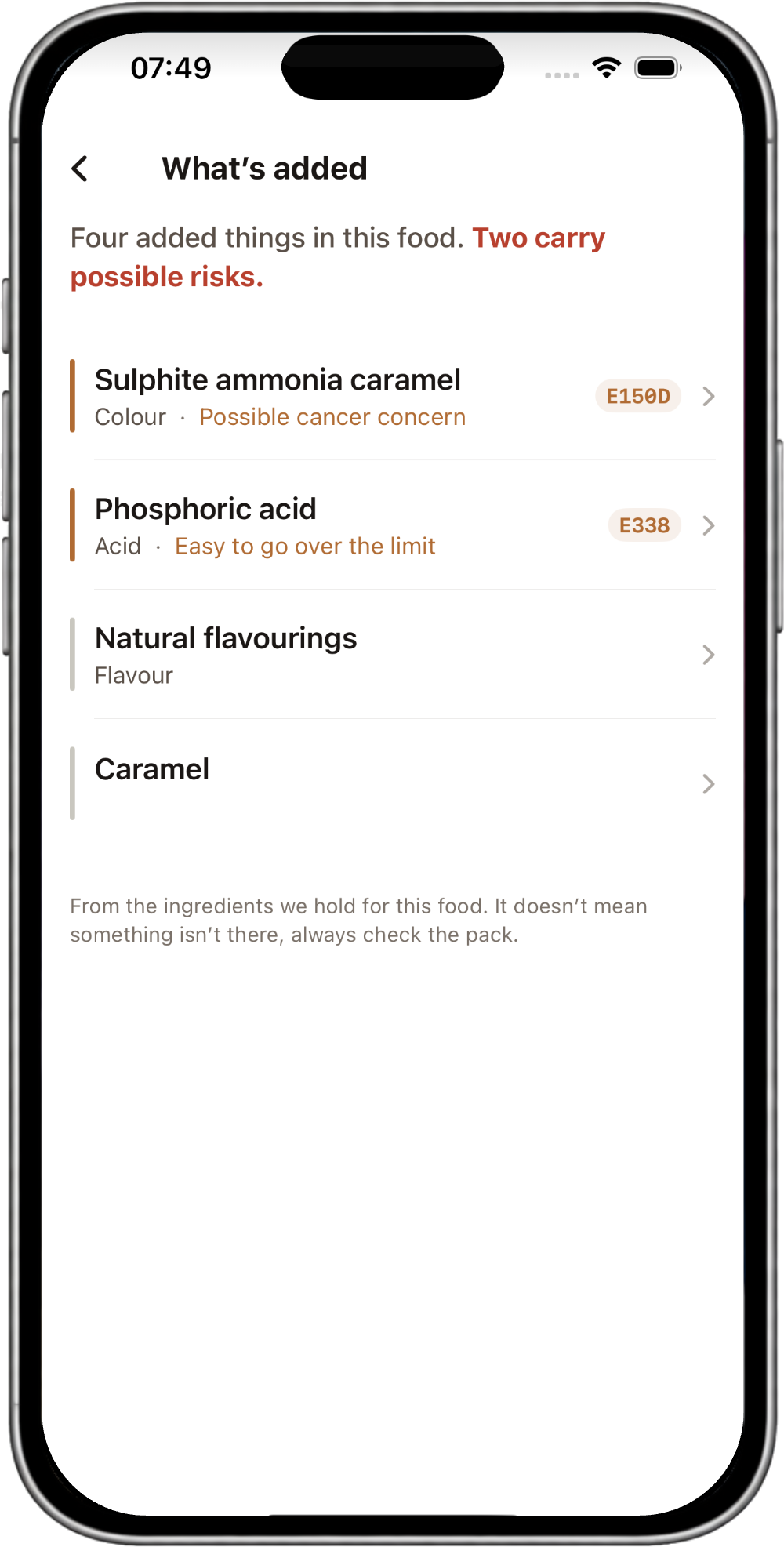
Scan a UK barcode and NutraSafe reads the additives on the label, by name or by code, and says in plain English what each one is and what the published evidence says.
Get NutraSafe on the App Store →The app is free to download, and naming each additive on a pack and explaining what it does is part of NutraSafe Pro.
NutraSafe Pro · £3.99/month · iOS
Last reviewed: 30 September 2026 · This page describes published research. It is not medical advice.