
Ultra-processed foods: the UK list, and what actually counts
Around 57% of the calories in the average UK adult's diet come from ultra-processed food, and half the arguments about it come down to which foods count. Here is the list by the NOVA definition, the foods people argue about, and the label markers that decide it. Scan any UK barcode with NutraSafe and we name the markers on that exact product.
Free download Pro £3.99/month iPhone, every fact sourced
NOVA sorts food by what was done to it, not what's in it
NOVA is the classification used in most published UPF research, developed by Monteiro and colleagues at the University of São Paulo. It has four groups, and only Group 4 is "ultra-processed". The UK's own advisory committee (SACN) screened eight processed-food classifications in 2023 and NOVA was the only one that passed its initial criteria.
Group 1 · Minimally processed
Food as it comes, or close to it: fruit, veg, milk, eggs, meat, fish, oats, dried pasta, plain rice, frozen vegetables, plain yoghurt. Washing, freezing, drying and pasteurising all stay in Group 1.
Group 2 · Culinary ingredients
Things you cook with, extracted from Group 1 or from nature: butter, oils, sugar, salt, honey. Not eaten on their own, used in kitchens to cook real meals.
Group 3 · Processed
Group 1 plus Group 2, preserved or transformed the traditional way: cheese, bakery bread, tinned fish, tinned tomatoes, cured bacon, wine and beer, tofu. Usually two to four ingredients you recognise.
Group 4 · Ultra-processed
Industrial formulations built from extracted substances (isolated proteins, modified starches, refined oils and sugars) plus additives you would not use at home: emulsifiers, flavourings, colours, sweeteners, thickeners. This is the UPF group. What the research says about those additives.
What counts as ultra-processed in a UK shop
Two lists, because the surprises run both ways. Plenty of "health" products sit in Group 4, and plenty of foods people apologise for buying do not.
Almost always ultra-processed
Supermarket sliced bread · most breakfast cereals · crisps and extruded snacks · fizzy drinks and squash with sweeteners · most ready meals · reformed meats (ham, hot dogs, nuggets) · most supermarket sausages · flavoured yoghurts · biscuits, cakes and pastries · instant noodles and packet sauces · protein bars and flavoured protein shakes · ice cream · margarine and spreads · meat-free mince and most meat substitutes.
Usually not, despite the aisle
Cheese · butter · milk · plain yoghurt · tinned tomatoes · tinned beans in water · tinned fish · frozen veg and fruit · dried pasta · plain rice · oats · shredded wheat · 100% nut butters · bakery bread (flour, water, yeast, salt) · plain tofu · cured bacon (processed, not ultra-processed, though the bowel-cancer link is its own story below).
The markers that decide it
On a UK ingredients list, Group 4 shows up as: emulsifiers (mono- and diglycerides, E471) · modified starch · isolated proteins (soya, pea, whey) · glucose-fructose syrup · hydrogenated or "fully refined" fats · sweeteners (aspartame E951, sucralose E955) · flavourings · colours · thickeners and gums. One marker is a hint. Three or more is a formulation.
The 30-second version
Would a home kitchen hold every ingredient on the list? If the answer is no, it is Group 4. If you would rather not read ingredient lists in an aisle, that is the part our scanner does for you: scan the barcode and we name the markers on that product, with sources.
The ingredients that make something ultra-processed, and how common each one is
A NOVA Group 4 food is defined by ingredients you would not find in a home kitchen. So rather than argue about which foods belong on a list, here is the list of markers themselves, counted across 29,101 UK supermarket products we hold that carry a full ingredients list. 45.2% of them (13,140) come out ultra-processed.
| Marker on the label | Share of products | What it is doing there |
|---|---|---|
| Flavourings | 53.6% 15,588 products | A legal catch-all. The pack need not say what is in it, only that it is a flavouring. |
| Acidity regulators | 35.7% 10,383 products | Mostly citric acid. Holds pH steady so colour and texture survive a long shelf life. |
| Glucose, fructose or glucose-fructose syrup | 33.8% 9,824 products | Refined sugars in liquid form, cheaper and sweeter than sugar and easy to blend in. |
| Emulsifiers (mono- and diglycerides, lecithins, polysorbates) | 27.5% 8,004 products | Hold oil and water together. The marker most strongly associated with a factory process. |
| Humectants and stabilisers (gums) | 26.7% 7,762 products | Xanthan, guar and carrageenan. They supply a texture the ingredients alone would not give. |
| Preservatives | 26.5% 7,707 products | Extend shelf life well past what the food itself would manage. |
| Added colours | 20.5% 5,958 products | Restore or add colour lost in processing. Most of these are natural sources, not synthetic dyes. |
| Palm oil | 18.4% 5,362 products | A cheap, solid-at-room-temperature fat used where butter once was. |
| Raising and anti-caking agents | 18.2% 5,290 products | Make dough rise on a production line and stop powders clumping. |
| Protein isolates and milk powders | 15.7% 4,581 products | Protein stripped out of its original food and added back as a dry ingredient. |
| Modified starch | 12.0% 3,490 products | Starch chemically or physically altered so it thickens more reliably than the plain version. |
| Maltodextrin | 8.3% 2,407 products | A processed starch used as a bulking agent and a cheap carrier for flavour. |
| Artificial sweeteners | 8.2% 2,385 products | Sweetness without sugar. Aspartame, sucralose and acesulfame K are the common three. |
| Flavour enhancers | 3.1% 904 products | Strengthen savoury taste. Monosodium glutamate is the best known. |
| Hydrogenated or interesterified fat | 0.5% 148 products | Liquid oil rearranged into a solid fat. Rare on a UK label now. |
Most products carry several at once, and that is the real signal. Of the 29,101 products, 2,848 (9.8%) declare none of these markers at all, and 2,249 (7.7%) declare seven or more. One emulsifier in a loaf is ordinary. Seven markers in one packet is a formulation, not a recipe.
Two honest limits. This counts what the label declares, not what analysis of the food would find, and the denominator is products with a usable ingredients list, never the whole database. And the colours line is mostly natural sources such as beetroot red, annatto and carotenes, not synthetic dyes, which are far rarer on a British pack than people expect.
Method: every product in our UK retail database with an ingredients list and a stamped processing grade, read on 20 September 2026. Cosmetics and household lines excluded by brand and by category. Each marker is matched against the declared ingredient text with word-boundary matching, and every figure above was hand-checked against the matched text on real products before publication.
What the evidence actually shows
The UPF debate has a loud end and a careful end. Here is what the biggest review to date found, and what the UK's own advisers actually concluded.
Linked to 32 poorer health outcomes
The largest umbrella review to date, published in the BMJ in 2024, pooled evidence covering almost 10 million people. Higher ultra-processed food intake was associated with 32 adverse health outcomes, with the most convincing evidence for cardiovascular disease deaths, type 2 diabetes, anxiety and common mental disorders, and earlier death from any cause. These are associations, and their strength varies by outcome, but the direction is consistent across the evidence base.
Source: Lane et al., BMJ 2024, umbrella review of 45 pooled analyses
The UK's advisers: concerning, and uncertain
SACN, the committee that advises the UK government on nutrition, reviewed the UPF evidence in July 2023 and again in 2025. Its position: the associations between higher UPF intake and worse health outcomes are concerning, but the studies are mostly observational, and it is not yet clear whether the processing itself does the damage or the energy, saturated fat, salt and sugar these foods deliver. There is no UK regulation of UPF, and no UK front-of-pack UPF label. Which means the ingredient list is the only tool a shopper actually has.
Source: SACN position statement, July 2023 · SACN rapid evidence update, 2025
The UK eats more UPF than almost anywhere in Europe
Analysis of the UK's National Diet and Nutrition Survey found ultra-processed food supplying around 57% of the average adult's calories, and nearly two thirds of the free sugars. UK and Ireland sit at the top of the European tables. This is the backdrop to every question on this page: in a UK supermarket, Group 4 is not the exception, it is the default.
Source: Rauber et al., analysis of NDNS 2008–2014
The foods people actually argue about
These are the most-searched "is it UPF" questions in the UK, answered by the NOVA definition and the ingredient list, not by vibes. Where the classification is debated, we say so.
Most Quorn products are, by the NOVA definition. Mycoprotein is made by industrial fermentation, and most recipes add stabilisers, flavourings and other proteins to it. The nutrition often reads better than a typical Group 4 product, which is exactly where the category gets blunt. Recipes vary a lot between products, so read each pack.
No. Plain tofu is soya milk set with a coagulant, which makes it a processed food in NOVA terms (Group 3), not ultra-processed. Flavoured and marinated tofu can carry flavourings and additives, so check those packs.
On a strict NOVA reading, yes. It is mostly wholegrain wheat, but the malted barley extract puts it in Group 4 by the letter of the definition. It also carries less sugar than most UK cereals. Weetabix is the food that shows the category's limits: the label tells you more than the classification does. Full answer: Is Weetabix ultra-processed?
No. Dried pasta is durum wheat and water, which NOVA counts among minimally processed foods. Instant noodles and flavoured pasta pots are a different thing: the flavour sachets and added oils put those in Group 4.
Most big-brand tins are, on a strict reading: the sauce usually carries modified starch and flavour extracts. They are also one of the cheaper sources of fibre in a UK supermarket. Some brands sell beans in plain tomato sauce without either marker, so it comes down to the tin.
Traditional cheese (cheddar, brie, feta) is a processed food in NOVA terms, Group 3, not Group 4. Processed cheese slices, spreads and cheese-flavour products carry emulsifying salts and belong in Group 4. Different products, same aisle.
Yes, by the NOVA definition: it is built from isolated proteins, powdered ingredients and a vitamin blend, and some flavours carry sweeteners. Huel argues the category says nothing about nutrient content, and that is the live debate around NOVA in one sentence. We show the ingredients and the markers; what you make of them is your call.
Plain cured bacon is NOVA Group 3, processed rather than ultra-processed, though packs with added flavourings tip into Group 4. The classification is not the point with bacon: processed meat is classed by the WHO's cancer agency as a Group 1 cause of bowel cancer, and the NHS caps processed meat at 70g a day.
Supermarket sliced bread almost always is: emulsifiers, flour treatment agents and preservatives are standard in the industrial baking process used for most UK loaves. A bakery loaf made from flour, water, yeast and salt is Group 3. Same word on the shelf, different foods.
Flavoured powders are: isolated protein plus flavourings plus sweeteners, usually sucralose or acesulfame K, is the Group 4 pattern exactly. Unflavoured single-ingredient whey or pea protein is still an industrial isolate, so strict readings keep it in Group 4 too.
Same story as Weetabix: the malted barley extract and added vitamins put them in Group 4 on a strict reading, while the fibre content is among the best on the cereal shelf. Check the sugar line too: bran flakes carry more sugar than most people expect.
Most cartons are: commercial oat drinks are made with industrial enzymes and usually carry added oil, minerals and stabilisers. A few brands run shorter lists. The oil and gum lines on the carton are the quick check.
No. The classic version is 100% wholegrain wheat, nothing else on the list, which makes it one of the very few big-brand UK cereals that is not ultra-processed.
A ready meal is not Group 4 by default: the classification follows the ingredients, not the format. Many Bigham's lists read closer to a home recipe than most of the chilled aisle, though recipes vary, so read each sleeve. The point stands for any brand: judge the ingredient list, not the aisle it sits in.
Most supermarket sausages are: preservatives (usually sulphites), stabilisers and flavourings are standard. They are also processed meat, which is the bigger flag: the WHO's cancer agency lists processed meat as a Group 1 cause of bowel cancer. Butcher's sausages vary, and the preservative is usually still there.
The simple ones sit on the line: fish, breadcrumb and oil is a short list, and some classifications call that processed rather than ultra-processed. Versions with minced fish, added starches and flavourings tip into Group 4. The coating list is where to look.
Plain ones are puffed rice and salt, though the puffing itself is an industrial extrusion process, which is why classifications disagree on them. Flavoured rice cakes add the flavourings and sweeteners that make the question easy: Group 4.
100% nut versions are not: one ingredient, ground peanuts. Mainstream jars usually add palm oil, sugar and stabilisers, which moves them into Group 4. This one is a two-second label check.
NOVA puts wine, beer and cider in Group 3, fermented but not ultra-processed. Alcohol itself is classed by the WHO's cancer agency as a Group 1 carcinogen, a known cause of several cancers, which matters more than the processing category.
Swap within the same shelf rather than overhauling your diet: shredded wheat instead of flavoured cereal, a 100% nut butter instead of the standard jar, bakery bread instead of long-life sliced, plain yoghurt with fruit instead of flavoured pots. Scanning as you shop shows which of your regulars carry the Group 4 markers, and logging in NutraSafe shows your processed-food share over time.
This is what we built NutraSafe for
Scan the pack and see where it lands
We built NutraSafe to make ultra-processed food easier to keep an eye on in a real weekly shop, because every answer above ends the same way: it depends on the exact product in your hand. Two loaves, two tins, two cartons of oat milk from the same shelf can land in different NOVA groups. Scan the barcode and we read the ingredient list for you: the processing level, every additive named, and any published concern flagged with the source on the line.
You won't find a letter grade or a verdict pill, because "ultra-processed" is where the reading starts, not where it ends. A flagged Weetabix and a flagged energy drink are not the same decision, and we would rather show you why than boil it down to a letter.
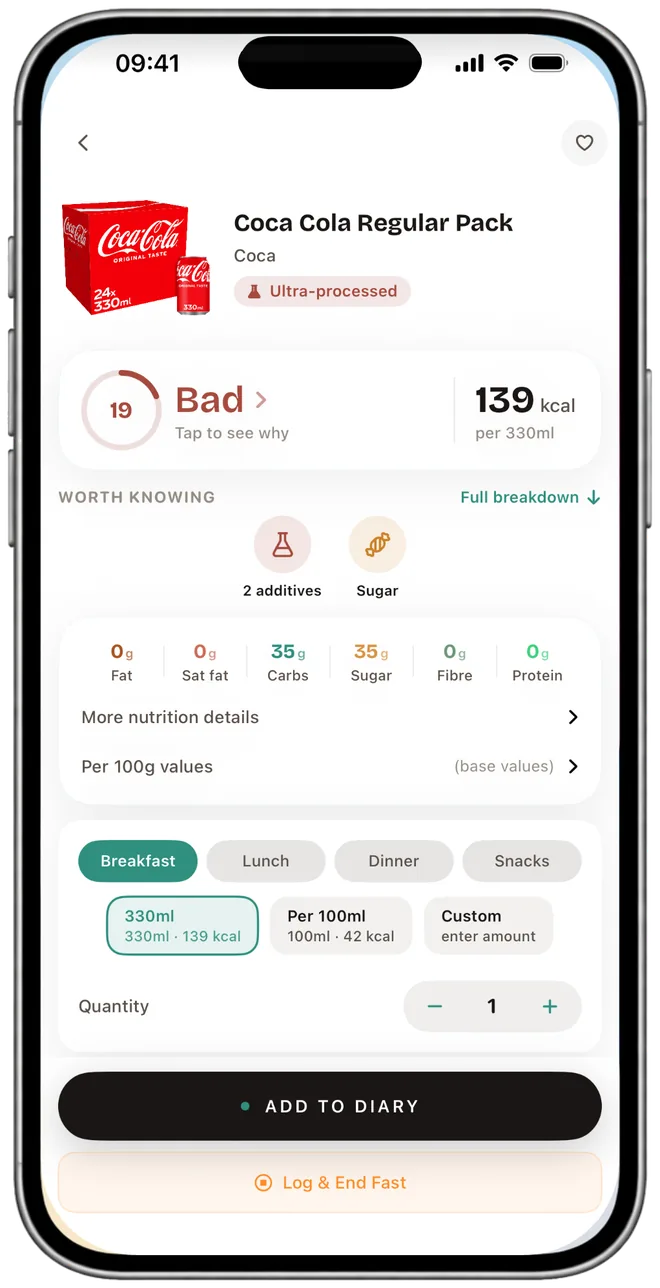
Every additive, sorted by what's known
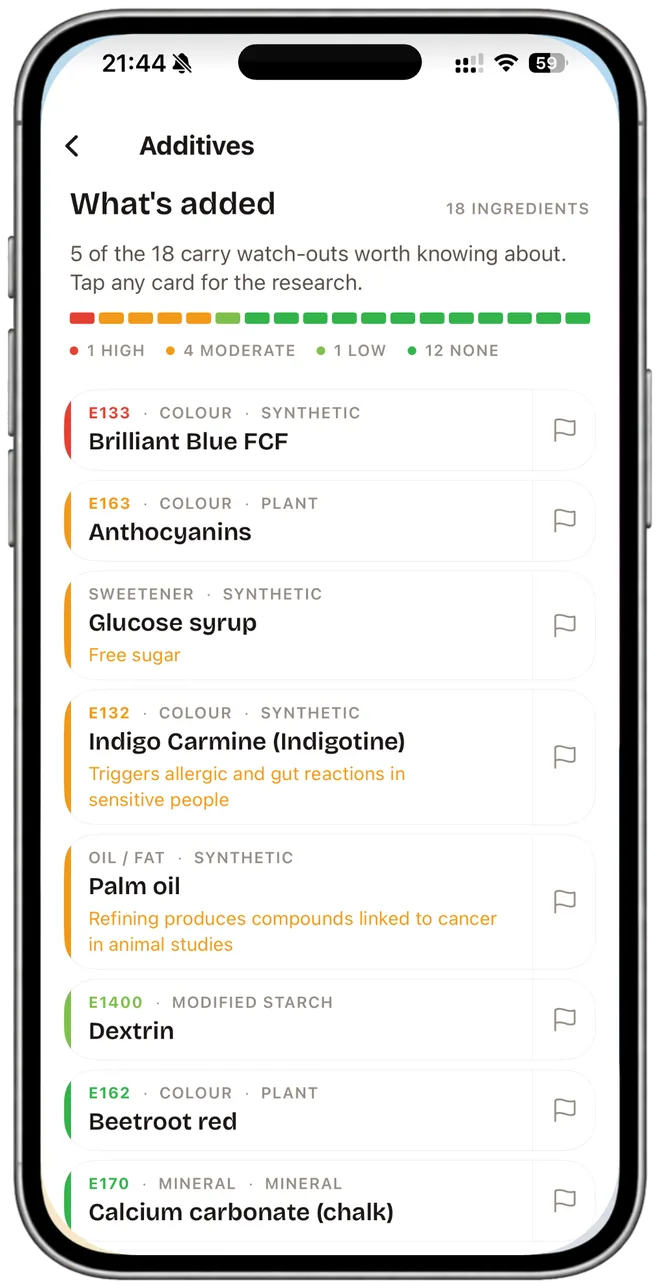
The Group 4 markers are additives with E-numbers and published research behind them, and that is our home ground. Each one on a scanned product links to what it is, where it turns up, and, where a concern has been published, who published it. The emulsifiers, the sweeteners, the colours with the legal child-behaviour warning: named, explained, sourced. If the codes themselves are the confusing part, start with what E numbers are and why UK packs rarely print them.
Read
next.
More on this, sourced the same way.
The latest UK evidence is more nuanced than a blacklist
SACN’s April 2025 rapid update found consistent associations between higher UPF consumption and adverse outcomes, but said important limitations remain. It is still unclear how much of the association is explained by processing itself and how much by established factors such as excess energy, saturated fat, salt, free sugars and low fibre.
SACN also noted that UPF subgroups do not behave identically. This list therefore explains NOVA markers without presenting one processing label as a diagnosis or nutrition score. Read SACN’s 2025 evidence update or use the UPF checker on an exact product.
Last reviewed: 20 September 2026
Know which group your basket is in
Not to scare you off your dinner. Just so the choice is yours, made with the facts, instead of theirs. Free to download. Pro is £3.99 a month if you want vitamins, workouts and the deeper insights.
iPhone · iOS 17 · Cancel any time