
The UK food tracker that reads the ingredients, not just the calories
Log a meal by name, by barcode or by photo, and we count the calories and the macros from UK products, branded and own-brand. We also read what's on the pack: the additives in the ingredients list, and your vitamins and minerals against UK reference values. Food, workouts, fasting and reactions all sit in the same diary.
Free download 25 food logs a day on the free tier UK barcodes, UK reference values
One diary for food, additives, vitamins and workouts
Calories, macros, additives, vitamins, minerals, workouts, fasting and how you felt afterwards, all logged in the same place.
Log a meal by barcode, by name or by photo
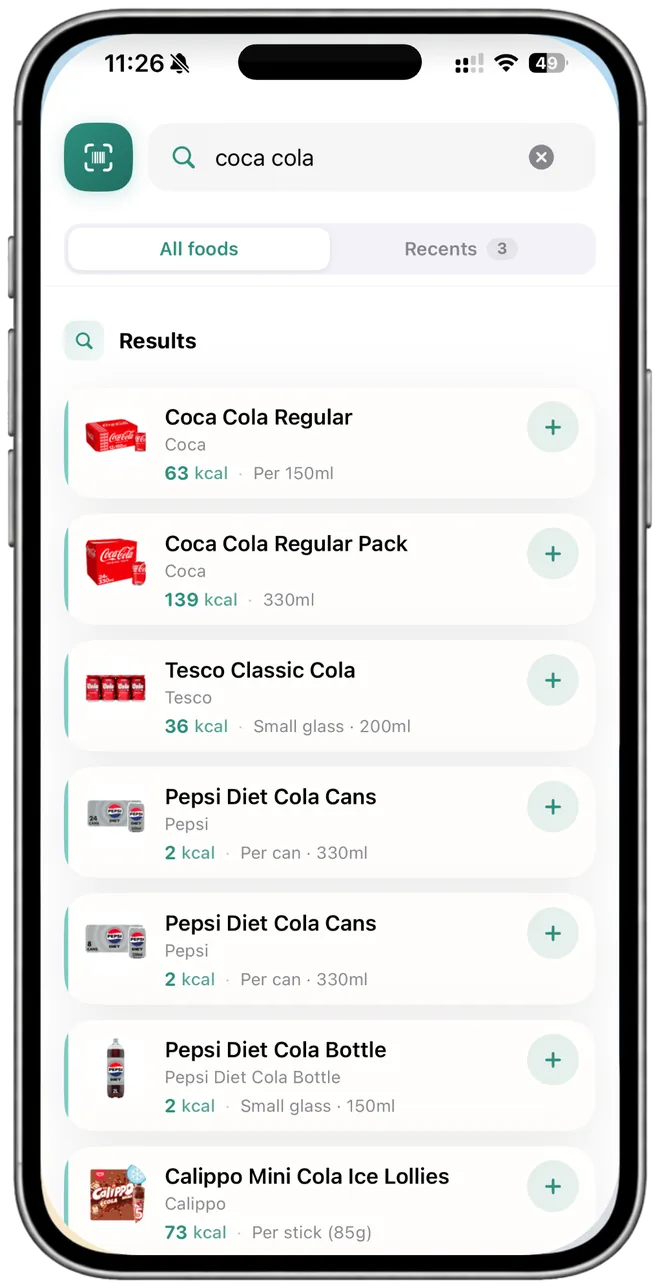
Type the food, scan the barcode, or photograph the plate. We search UK products, branded and supermarket own-brand, and fill in the calories, the macros and the additives straight off the label. Most results come back with the pack photo, so you can tell which of six variants you are actually holding before you add it.
Pick the meal and the portion and the day's running totals move: calories, protein, carbs, fat, fibre and salt against your targets. Logging is free up to 25 foods a day. Pro lifts the cap and adds the photo scan for food that never came with a label.
Food additive scanner
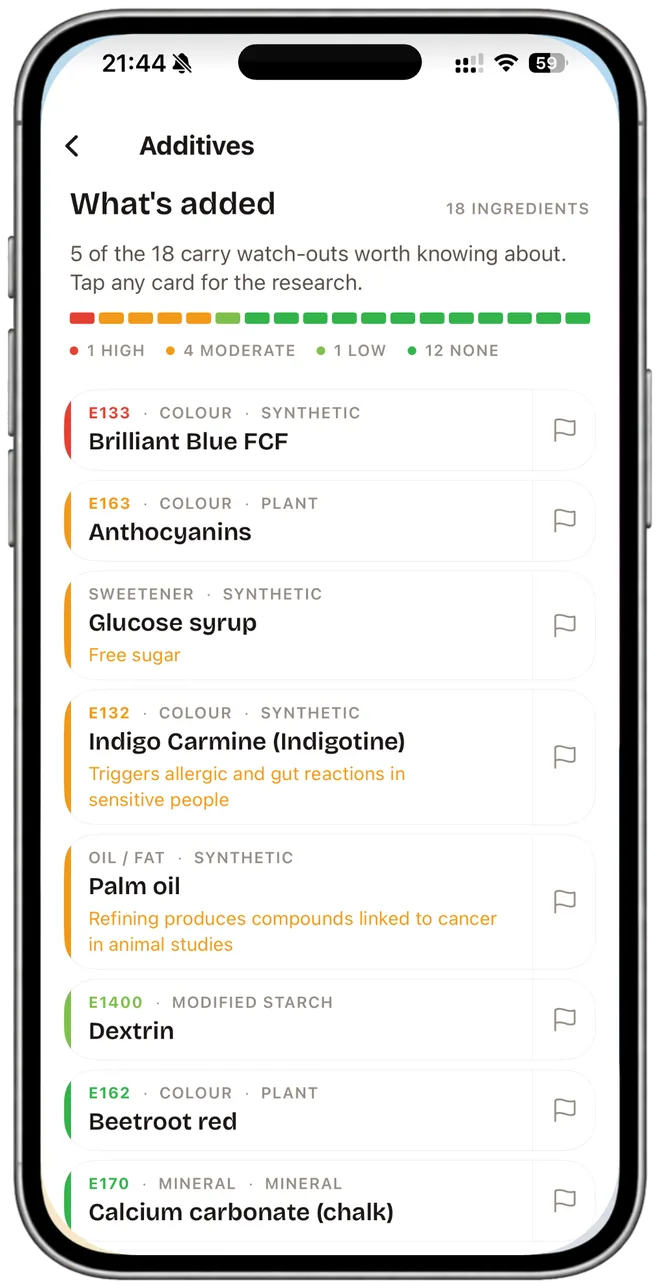
A calorie counter stops at the number on the front. We carry on to the ingredients list. Scan a product and we pull out every additive we recognise, count them, and sort them by how much is actually known about each one.
The scan, the food's score and the additive count are free, so you can see at a glance that a pack carries five added things rather than none. Pro names them: what each one is, what it does, and where any published concern came from, on the line. You get the evidence and the source. What you make of it is your call.
Vitamin and mineral tracker
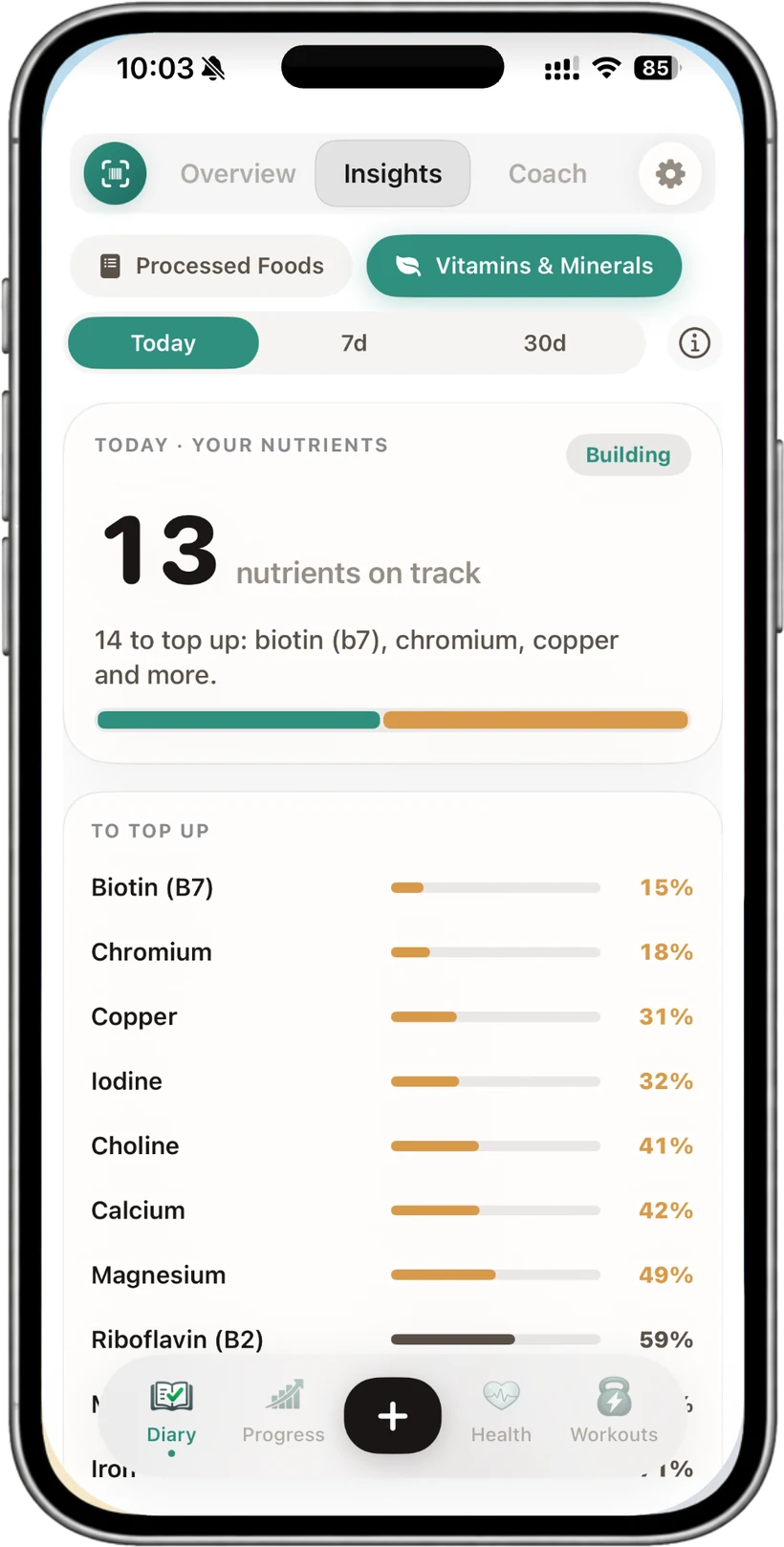
As you log, your day fills in against 13 vitamins and 12 minerals, on the foods we hold the data for, measured to the UK Nutrient Reference Values rather than an American chart.
So instead of one calorie figure you get where you actually stand: what you keep hitting, and what you keep missing, day by day and week by week. The UK's own national diet survey keeps finding gaps in vitamin D and folate that people only catch from a blood test. This shows the pattern first. Pro.
AI meal scanner
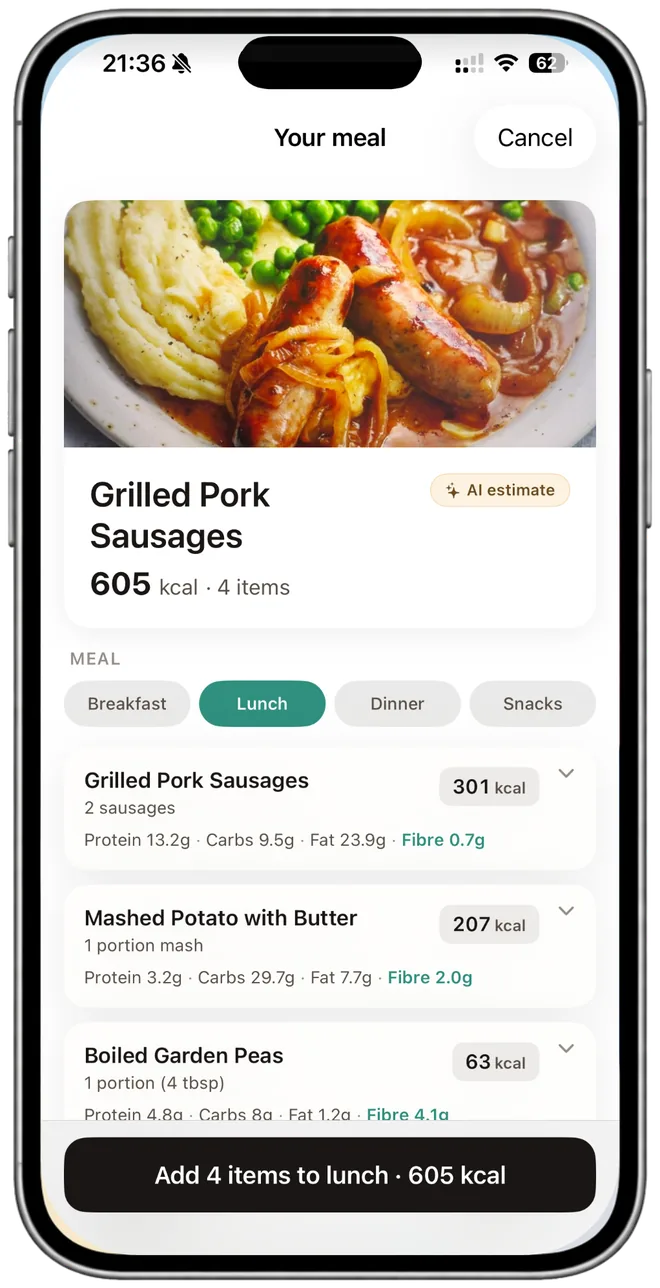
For a home-cooked dinner or a restaurant plate with no barcode, take a photo. The AI reads the plate, names each item, sausages, mash, peas, and estimates the calories and macros for the lot.
It is an estimate and the card says so, so you can open any item, correct the portion, and add the meal to your day. It is the quickest way to log the food that never came with a label. Pro.
Workout tracker
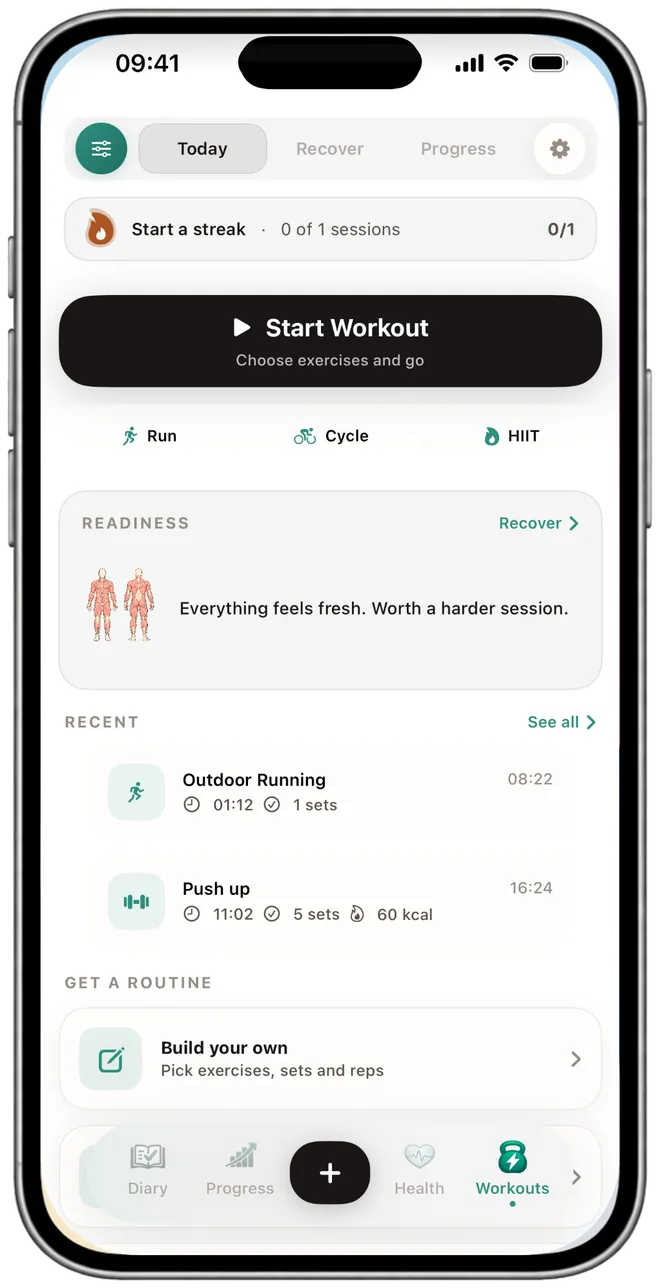
Log sets, reps, weight and personal bests by hand, or pull runs, rides and calories straight from your Apple Watch through Apple Health.
Because training sits in the same diary as the food, the two line up: the protein you ate against the session you did, the calories in against the calories out. No second app, no copying numbers between them. Pro.
Food reaction tracker
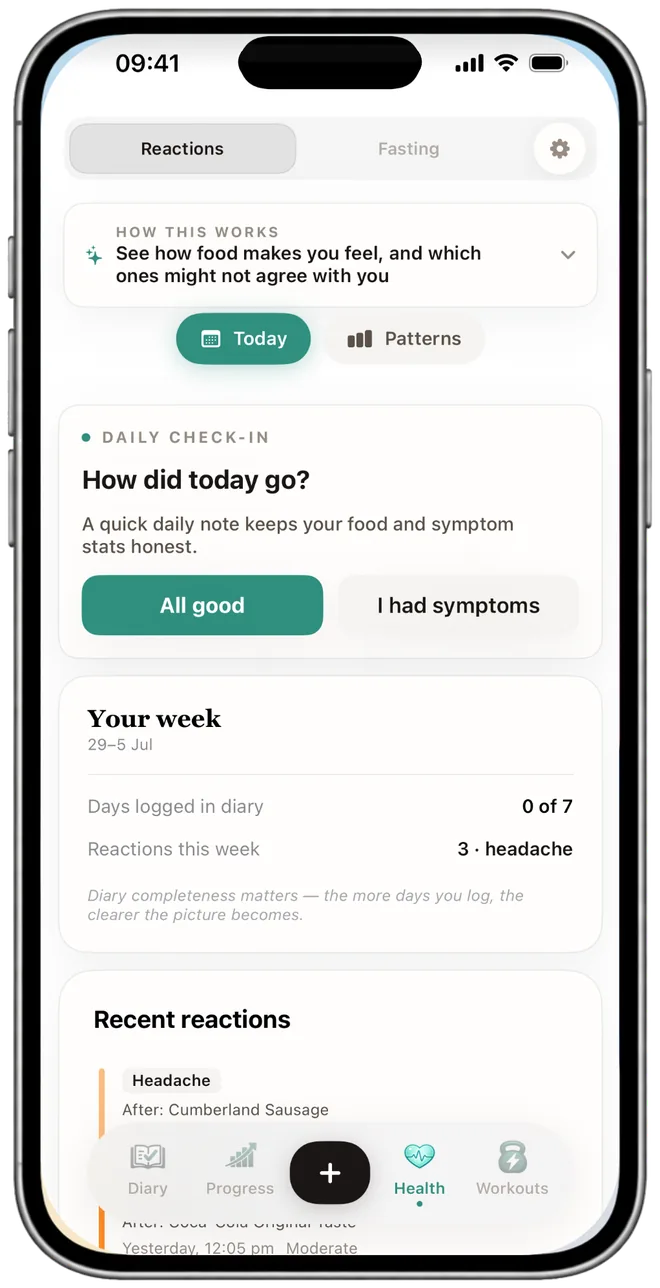
After a meal, note how you felt: energy, mood, sleep, skin, and gut symptoms like bloating. Two taps, and it attaches to the exact foods you logged.
Over weeks the diary joins the dots and surfaces the foods that keep turning up on the days you felt rough. It is your own record, built from what you actually ate, not a generic list of things to avoid. Free users keep logging while the app builds up a baseline; the full history and the suspected-triggers analysis are Pro. We don't diagnose intolerances. We give you something solid to take to your GP or dietitian.
How to check the calories in a UK food
Three routes to the number, and what sits behind it.
Most calorie checkers are a search box over a database built somewhere else, which is why the calories in a UK own-brand loaf so often come back as an American approximation of a loaf. Ours is built on UK packs, branded and supermarket own-brand, with the calories taken from the nutrition panel the manufacturer printed.
Scan the barcode
FreeAny UK GTIN or EAN, the code every supermarket prints. The scan returns the calories per 100g and per the portion you pick, the macros, the ingredients list and how many additives are on the pack.
Search by name
FreeType "coca cola" or "warburtons seeded" and the results come back with the pack photo, the calories, and the portion each figure refers to. A 150ml glass and a 330ml can are separate entries, because they are separate answers.
Photograph the plate
ProFor food that never came with a label. The AI names each item on the plate and estimates the calories for the lot. It is an estimate, the card says so, and you can correct any portion before it goes in.
The portion is where a calorie calculator goes wrong
A calorie figure is only as good as the portion behind it. "One serving" of a supermarket lasagne and half the tray are different meals, and plenty of trackers quietly assume the first. Pick the portion here and every number on the screen rescales with it: calories, protein, carbs, fat, fibre, salt, and on Pro the vitamins and minerals too.
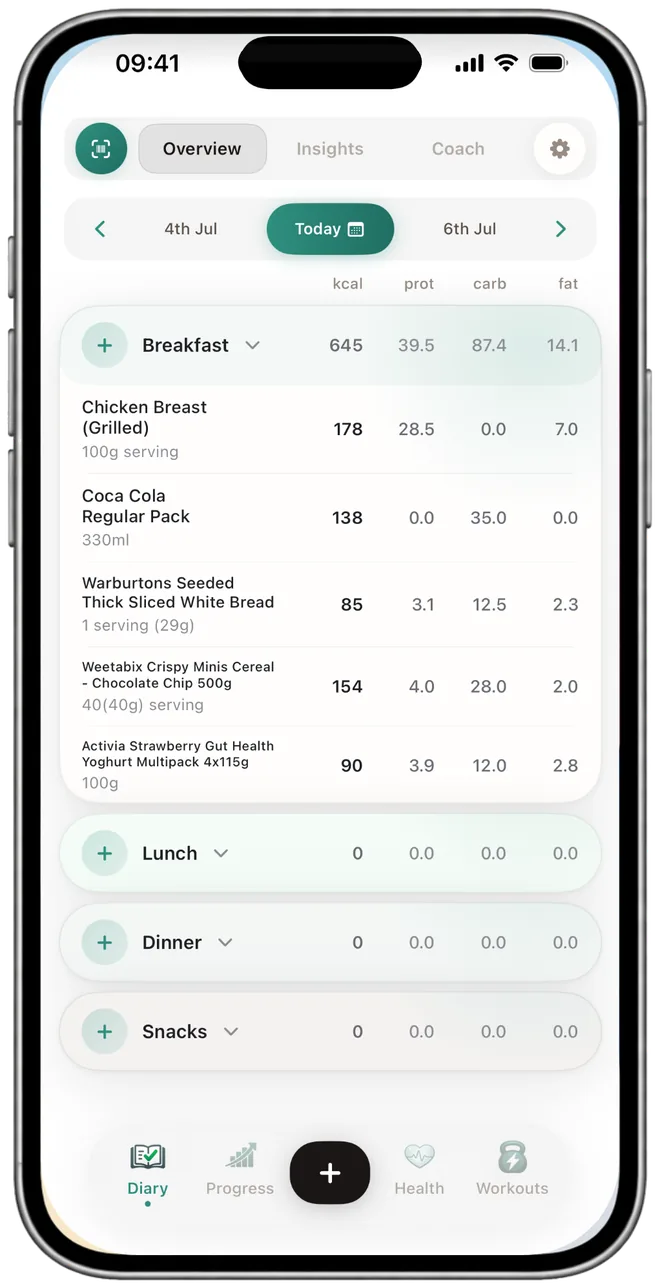
The day builds up by meal rather than as one lump. Breakfast, lunch, dinner and snacks each carry their own calorie and macro line, so when a day comes in high you can see which meal did it instead of guessing. Weigh something and it takes grams. Don't, and it takes the pack's own serving.
What a barcode scan gives you back
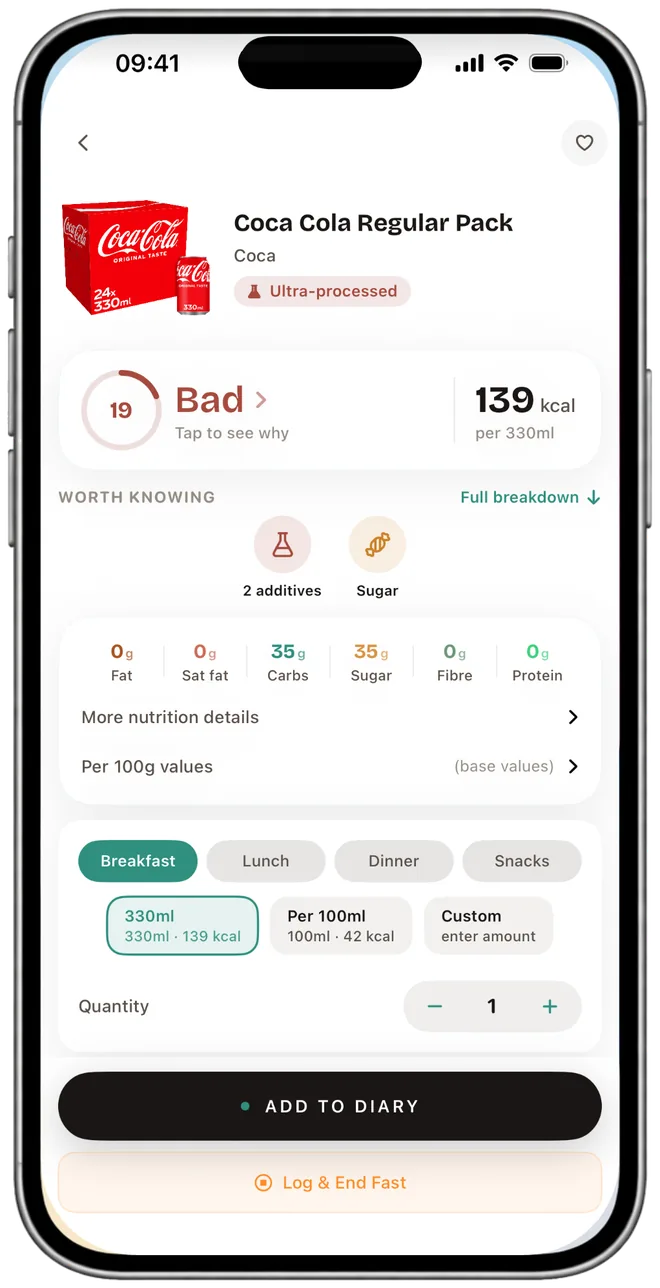
A can of Coca-Cola, from the beep to the ingredients list.
Scan a can of Coca-Cola
The nutrition comes straight off the can: the calories for the can you are holding rather than a per-100ml figure you have to do arithmetic on, plus the sugar, the salt and the macros. The score sits at the top with the reasons for it underneath, and the sugar in a 330ml can is the loudest of them.
Then the ingredients. The scan tells you how many additives are on the pack for free. Open one on Pro and you get the plain-English version: E150d is the caramel colour, and the concern attached to it is flagged to IARC, with the monograph named on the card rather than left implied. Every line carries where it came from, and the full E-number A to Z is free to read on this site.
Food tracker, meal tracker, diet tracker, nutrition tracker
Four names for jobs that overlap, and the differences are worth knowing before you install one.
Calorie counter
One number, energy in. You log what you ate, it totals the kcal, and that is the job finished. Useful if a calorie target is the only thing you are working to, and thin the moment you want to know anything else.
Meal tracker
The same logging, sorted by meal. Breakfast, lunch, dinner and snacks each carry their own totals, so you can see which meal is doing the damage rather than looking at one figure for the whole day.
Diet or nutrition tracker
Adds the composition. Protein, carbs, fat, fibre and salt on every tier, and on Pro the 13 vitamins and 12 minerals measured against UK Nutrient Reference Values.
Food analyser
Reads the pack instead of the totals. The ingredients list, the additives, how processed the product is. It answers "what is in this" rather than "how much did I eat", and almost no calorie app does it.
We do all four in one diary, and that is the honest reason to pick this over a plain calorie counter. Counting is the easy half. A supermarket ready meal and a home-cooked plate can land on the same calorie figure and be completely different foods, and the difference is in the ingredients list, not the front of the box.
The rest of the day goes in the same place. Fasting windows, workouts pulled from your Apple Watch, and a note on how you felt after a meal, all against the food that was already logged. See the free tier limits and what Pro adds, or read how we compare to MyFitnessPal and Cronometer.
What a calorie count leaves out
Counting tells you how much you ate. It says nothing about what you were short of.
National Diet and Nutrition Survey, 2019 to 2023
The UK NDNS 2019 to 2023 report (gov.uk, June 2025) found 18% of UK adults had low vitamin D status, and 83% of women of childbearing age had red-cell folate below the threshold associated with reduced neural-tube-defect risk.
Most people only learn about a gap like that from a blood test, after the fact. Log a normal week on Pro and the dashboard can tell you that you hit folate on two days out of seven. That is not medical advice and we won't tell you to take a supplement, but it is the kind of fact worth putting in front of your GP or dietitian.
We're a tracking tool, not a clinician. We don't diagnose and we don't prescribe. We show you the pattern.
Free to log. Pro is £3.99 a month
The download and the daily logging are free. Pro lifts the caps and opens the named additive breakdown, vitamins, workouts, fasting and the AI features.
- Up to 25 food logs a dayBarcode, search, or type it in.
- Barcode scan, score and additive countHow many added things are on the pack, and the food's score.
- Daily calorie & macro totalsProtein, carbs, fat, fibre, salt, by meal.
- Big 14 allergens on a scanFrom the ingredients we hold. The pack is the final word.
- Reaction logging while you build a baselineBloating, energy, mood, gut, skin.
- Which additive it is, and whyThe name, what it does, and the published source behind any concern.
- Vitamins & minerals13 vitamins, 12 minerals against UK NRVs.
- AI Coach & AI meal scanA coach that reads your diary. Photo logging for food with no barcode.
- Workouts & fastingSets, reps, Apple Watch sync. 16:8, 5:2, custom.
- Suspected triggers, lifted caps, processed-food insightsNo 25-a-day cap. Patterns across the week, not just the day.
Food tracker FAQ
The questions we see most in app reviews and support. If yours isn't here, our contact page goes to a real inbox.
It gives you one place to log every meal, snack and drink, then totals the calories, macros and (on Pro) the vitamins and minerals across the day and the week. Once a food is logged you get the nutrition breakdown, how many additives are on the pack, and the running totals for the day.
Scan the barcode, search the name, or photograph the plate. We hold UK products, branded and supermarket own-brand, with the calories read off the pack's own nutrition panel rather than an overseas equivalent. Pick a portion and the figure rescales to it, alongside protein, carbs, fat, fibre and salt.
Three ways. Scan a barcode (any UK GTIN or EAN, the code every UK supermarket prints). Search by name. Or take a photo with AI meal scan for restaurant and home-cooked food. Pick a portion, add it, and the day's totals move. Free users can log up to 25 foods a day; Pro lifts the cap.
Yes. We track 13 vitamins and 12 minerals against the UK Nutrient Reference Values, so you can see what you keep falling short on day by day and week by week. Vitamins and minerals against UK NRVs is a Pro feature (£3.99 a month or £34.99 a year, iOS).
Both, on different tiers. Scanning a barcode is free, and so is the food's score and the count of how many additives are on the pack, so a free scan will tell you a product carries five added things rather than none. Naming which additive it is, what it does, and the published source behind any concern is Pro, at £3.99 a month or £34.99 a year on iOS.
The download is free. The free tier covers up to 25 food logs a day, barcode scanning with the food's score and its additive count, daily calorie and macro totals by meal, the Big 14 allergens from the ingredients we hold, and the E-number library on this website.
Pro is £3.99 a month or £34.99 a year on iOS. It adds the named additive breakdown with sources, 13 vitamins and 12 minerals against UK NRVs, AI Coach, AI meal scan, fasting, workouts, suspected-triggers analysis and processed-food insights, and it lifts the daily logging cap.
Yes. We read the standard UK barcode (GTIN or EAN), the same code every UK supermarket prints. Tesco, Sainsbury's, Asda, Morrisons, Aldi, Lidl, Co-op and Waitrose own-brands look up the same way as branded products. Many come back with the actual pack photo, so you can tell which of six variants you are holding before you log it.
Yes. Log sets, reps, weight and personal bests by hand, or pull runs, rides and calories from your Apple Watch through Apple Health. Training sits in the same diary as the food, so the protein you ate and the session you did line up on one screen. Workouts are a Pro feature.
Yes. Any food in your diary can carry a reaction: bloating, headache, energy, mood, sleep, skin, gut. Free users keep logging while the app builds up a baseline; Pro opens the full history and the suspected-triggers analysis that flags foods turning up before symptoms. We don't diagnose intolerances. We surface patterns to take to your GP or dietitian.
A calorie counter gives you one number, energy in. A food tracker gives you what sits behind it: the macros, fibre and salt, the vitamins and minerals, the additives on the pack and how you felt afterwards. Calorie counting tells you how much you ate. Tracking tells you what.
We don't promise weight loss and we don't cure anything. What we can do is show you what's actually in your week. The UK National Diet and Nutrition Survey 2019 to 2023 (gov.uk, June 2025) found 18% of adults had low vitamin D status and 83% of women of childbearing age were below the red-cell folate threshold. Most people only find a gap like that when a blood test flags it. The tracker shows the pattern first.
Not yet. We're iPhone only at the moment. We'll list an Android release on the website when there's one to list.
Log a meal, scan a packet, and watch the week add up
Free download, 25 food logs a day, and the additive count on every scan. Pro adds the named additive breakdown, vitamins and minerals against UK NRVs, the AI Coach, workouts and fasting.
iPhone · iOS 17 · Cancel any time