
G1
Unprocessed and minimally processed.
Whole foods and basic preparations. Fresh fruit and veg. Eggs. Milk. Plain meat or fish. Pulses. Wholegrain flour. Plain yoghurt. Coffee.
Scan a UK barcode and NutraSafe names the ultra-processed markers on the ingredient list, the emulsifiers, the modified starches, the isolated proteins, and shows where the pack sits on the NOVA processing scale. Log a week and you can see your whole diet sorted from Whole to Ultra.
Free download Pro £3.99/month or £34.99/year UK barcodes, NOVA-aware
NOVA is a peer-reviewed classification developed by Monteiro and colleagues at the University of Sao Paulo. It groups foods by how they were made, not by their calories or nutrients. Ultra-processed food is Group 4. The FSA does not have a UPF category, so this is research, not UK food law, and we name the markers so you can see what counted. For the full breakdown of which UK foods land in which group, see the ultra-processed foods list.
Whole foods and basic preparations. Fresh fruit and veg. Eggs. Milk. Plain meat or fish. Pulses. Wholegrain flour. Plain yoghurt. Coffee.
Substances pressed, refined or ground from Group 1 foods. Butter. Olive oil. Sugar. Salt. Honey. Used to cook with, not eaten on their own.
Group 1 foods with Group 2 added. Tinned beans in tomato sauce. Cheese. Salted nuts. Smoked or salted fish. Plain bread. Recognisable food, just preserved or cooked.
Industrial formulations of substances extracted from foods, plus additives. Bottled fizzy drinks. Mass-produced bakery. Instant noodles. Reformulated meat products. Most breakfast cereals. The Group 4 markers are what we pick out.
A single scan reads one product. Logged over a week, the same reading turns into your Whole-to-Ultra breakdown, the processed-food drift most people never see.
Point your phone at any UK barcode and NutraSafe pulls the full ingredients line in the order the manufacturer printed it, then picks out every additive and tags the ones the NOVA literature treats as ultra-processed markers. Industrial emulsifiers, modified starches, isolated proteins, hydrogenated fats, high-intensity sweeteners and cosmetic colours are named on the line rather than buried in a block of small print.
Plain bread, flour, water, yeast and salt, sits in NOVA Group 3. It is the industrial markers, the E471 emulsifier or the DATEM dough conditioner, that push a loaf into Group 4. Because each marker is named against the published framework rather than a number pulled out of the air, you can see exactly what counted. Scanning and the per-product breakdown are free.
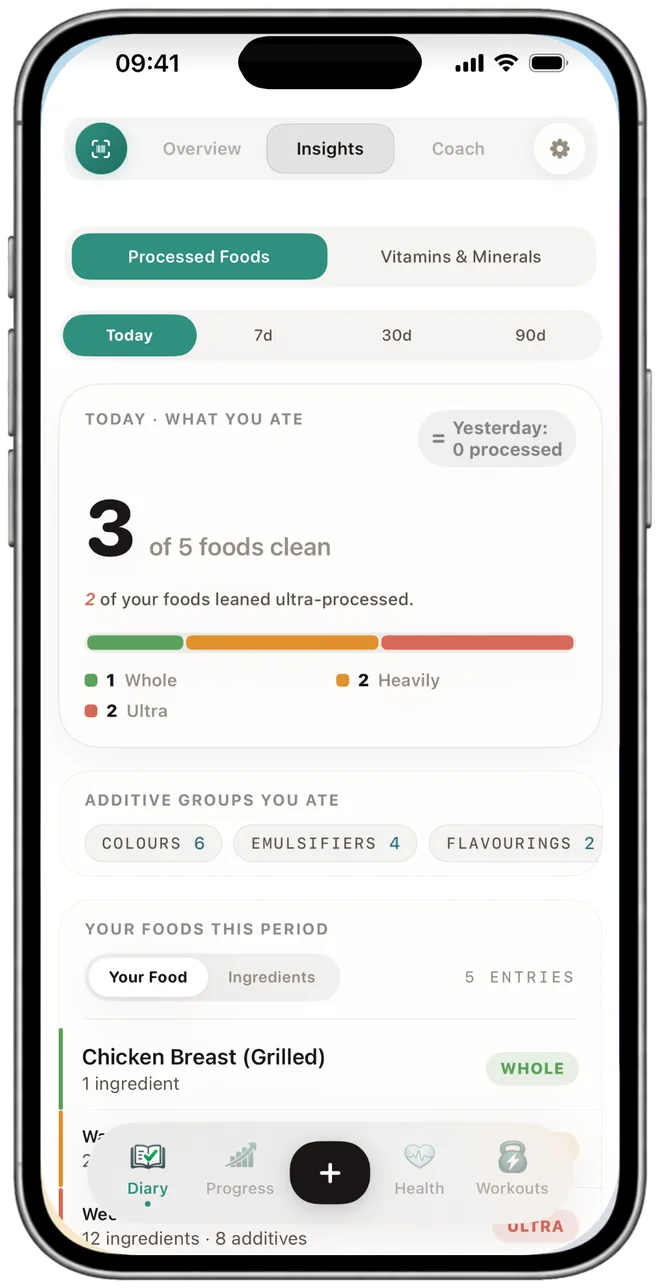
Each food you log that carries an ingredients list is placed on a four-step processing scale, Whole, Lightly processed, Heavily processed and Ultra-processed, mapped from the NOVA groups. The Processed Foods insight then shows the split, for example three of five foods coming back clean, so a run of home cooking or a day that tipped heavily into Group 4 both show up as a pattern rather than a one-off.
The UK context is why this matters. Analysis of the National Diet and Nutrition Survey put ultra-processed food at around 57% of the average UK adult's energy intake (Rauber et al, 2018), and a later Cambridge study of the same survey found roughly two thirds of a UK teenager's calories come from Group 4 foods (2024). Most people have no idea where they sit until they see it counted. The Processed Foods insight is a Pro feature.
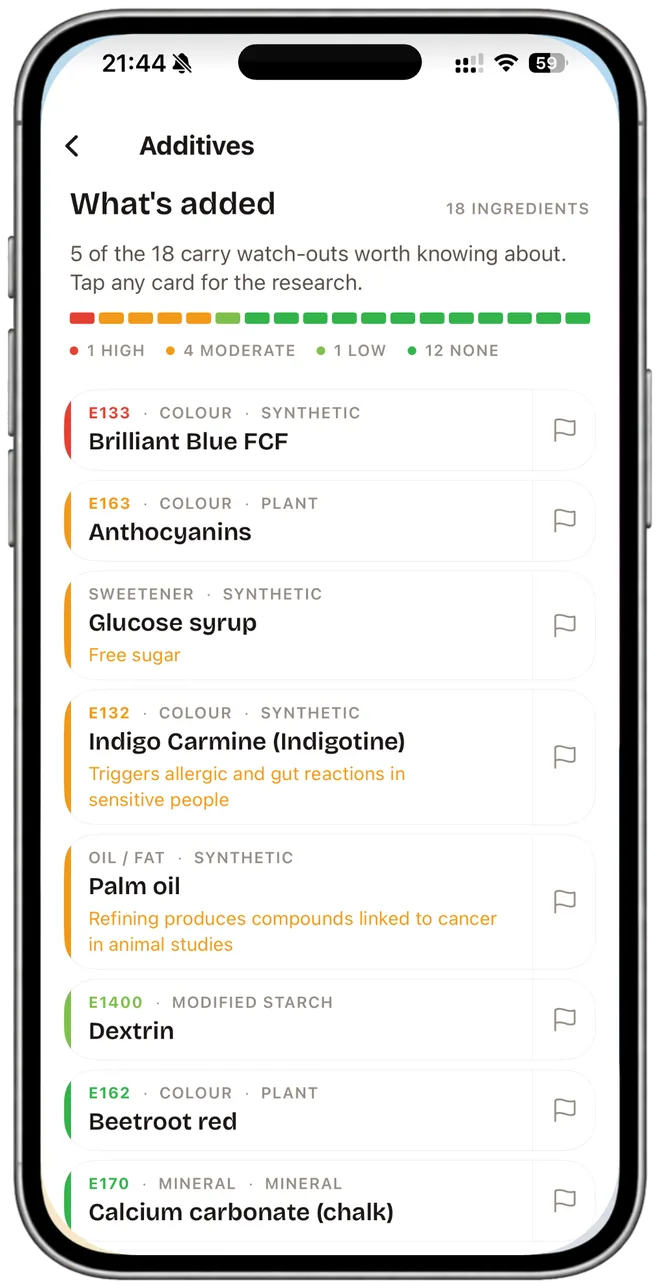
Tap any additive for the plain-English version: what it is, where it usually turns up, and, where there is published research, the concern and who published it. A polysorbate is described as an industrial emulsifier used in mass-bakery and ice cream, not left as "E433" for you to google in the aisle.
The markers follow the NOVA literature directly. Industrial emulsifiers such as mono- and diglycerides (E471) and DATEM (E472e). Modified starches (E1422, E1442). Isolated soya and pea proteins. Interesterified and hydrogenated fats. High-intensity sweeteners like aspartame (E951) and sucralose (E955), which the WHO issued non-sugar-sweetener guidance on in 2023. And cosmetic colours and formulated flavourings that exist to make an industrial product look and taste like real food.
A single scan tells you about one pack. The Processed Foods insight tells you about the habit. Log a normal week and the breakdown shows how much of what you ate sat in Group 4 versus Group 1, the drift that quietly builds when convenience food creeps in and that no calorie total will ever surface.
We do not set a target or tell you a number to hit. There is no UK regulatory threshold for ultra-processed food, the FSA regulates additives individually, and SACN's 2023 position was that the evidence has real limitations. What we can do is show you the pattern in your own diary, named and sourced, so it is a fact you can act on rather than a headline you half-remember. Pro.
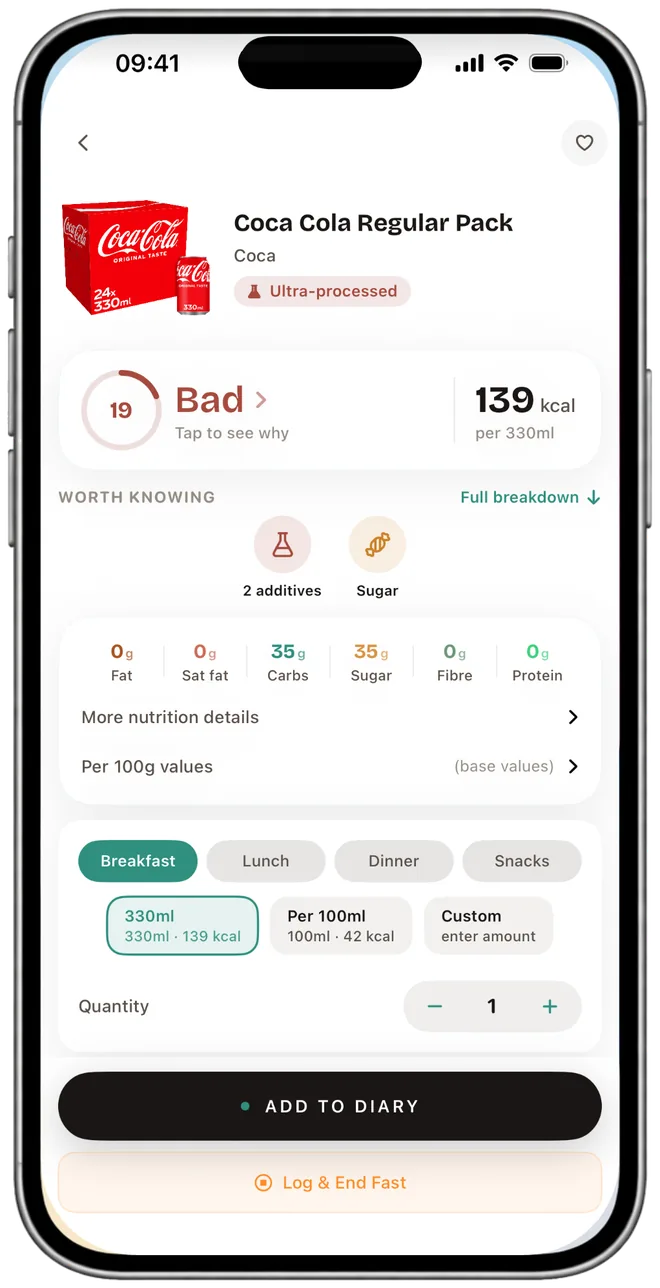
A 330ml can of Coca-Cola off the meal-deal shelf. Most people pick it up and move on. Here is what comes back the moment you scan it.
The scan returns far more than the calorie figure. Coca-Cola comes back as ultra-processed, with the sugar, the additives and the processing all laid out behind it. The nutrition is straight off the can: 139kcal and 35g of sugar in a 330ml can, more than an adult's whole daily free-sugar allowance in a single drink.
On the ingredient line, the caramel colour E150d is named and flagged to IARC, and the phosphoric acid and the flavourings are picked out as the industrial markers that make this a Group 4 product rather than a Group 1 one. Tap any additive for the plain-English detail and the source. You get the evidence, named and dated, so the call on whether to drink it is yours.
We name the markers and show you your pattern. We do not diagnose anything or tell you a food is off-limits.
The 2024 BMJ umbrella review (Lane et al) pooled 45 meta-analyses and found higher ultra-processed food intake associated with 32 health outcomes, including cardiovascular disease, type 2 diabetes, common mental disorders and earlier death. The associations vary in strength, and most are observational, so they show a link rather than proof of cause.
UK bodies have been cautious. SACN reviewed the evidence in 2023 and concluded the link is concerning but limited by how UPF is defined and measured. The NHS references ultra-processed food in its healthy-eating advice without setting a limit. We take the same line: we name the markers, we show you your Whole-to-Ultra pattern, and we leave the decision with you.
We are a tracking tool, not a clinician. We surface what published science says and where it came from. What you make of it is your call.
What people ask before they install. Sourced to peer-reviewed UPF research, the FSA position and NHS advice.
Ultra-processed foods are NOVA Group 4: industrial formulations made mostly from substances extracted from foods (oils, starches, isolated proteins) plus additives like emulsifiers, flavourings, colourings and sweeteners. NOVA was developed by Monteiro and colleagues at the University of São Paulo and is the most widely used UPF classification in peer-reviewed research.
Yes. Open NutraSafe, point your phone at any UK barcode, and we surface the full ingredients line, every additive picked out, and our per-product grade. The grade factors in NOVA Group 4 markers (industrial emulsifiers, modified starches, isolated proteins, hydrogenated fats, high-intensity sweeteners, cosmetic colours and flavours).
The 2024 BMJ umbrella review (Lane et al) found associations between higher ultra-processed food intake and 32 health outcomes, including cardiovascular disease, type 2 diabetes, depression and earlier mortality. The strength varies by outcome. WHO and SACN have referenced UPF in dietary guidance but neither sets a UK regulatory threshold.
The download is free. The free tier covers barcode scanning, the per-product grade, a count of the additives on the pack, the public E-number library and up to 25 food logs a day. NutraSafe Pro is £3.99 a month on iOS, which names each additive and what it does, and unlocks the AI features, the workouts, the fasting timer and the processed-food drift trend.
No. NOVA is a research classification. The FSA does not have a UPF policy and regulates additives individually. The NHS references UPF in dietary advice. We use NOVA because it's the most widely used framework in published research, and we name the markers so you can see what counted.
The checker identifies NOVA-style formulation markers; it does not claim that every food in Group 4 has the same nutritional profile or health effect. SACN’s 2025 update found the overall associations concerning but retained important cautions about confounding, inconsistent classification and the limited trial evidence.
That is why the result shows the ingredients behind the classification and keeps nutrition visible alongside it. For examples and edge cases, use the ultra-processed foods list. For the underlying UK review, read SACN’s rapid evidence update.
Last reviewed: 17 September 2026
Free download covers barcode scanning and the per-product processing breakdown. Pro is £3.99 a month or £34.99 a year on iOS for the Processed Foods insight over time, the AI features, the workouts and the fasting timer.
iPhone · iOS 17 · Cancel any time