What is Calorie Counting?
Calorie counting is the practice of tracking the total energy (measured in calories) you consume from food and drink each day. The goal is to monitor your intake to either lose weight, gain weight, or maintain your current weight by controlling the balance between calories consumed and calories burned.
A calorie is a unit of energy. Your body burns calories constantly — even at rest — to power essential functions like breathing, circulation, and cell production. When you eat more calories than your body burns, the excess is stored as fat. When you eat fewer calories than you burn, your body uses stored fat for energy, leading to weight loss.
Why Count Calories?
Calorie counting is one of the most evidence-based methods for weight management because it's based on a simple, proven principle: calories in vs calories out (CICO). While other factors like food quality, hormones, and metabolism matter, the fundamental energy balance equation determines whether you gain, lose, or maintain weight.
Benefits of calorie counting:
- Awareness: Most people significantly underestimate how much they eat. Tracking creates accountability.
- Flexibility: Unlike restrictive diets, you can eat any foods as long as they fit your calorie target.
- Data-driven: You can measure progress objectively and adjust based on results.
- Educational: You learn which foods are calorie-dense vs nutrient-dense, helping you make better long-term choices.
How to Count Calories: Step-by-Step Guide for UK Users
Here's exactly how to start counting calories effectively in the UK:
Calculate Your TDEE
TDEE (Total Daily Energy Expenditure) is the total calories you burn per day including activity. Use our TDEE calculator to find your baseline.
Set Your Calorie Target
For weight loss: TDEE minus 300-500 calories. For weight gain: TDEE plus 300-500 calories. For maintenance: eat at your TDEE.
Track Everything You Eat
Use a food diary, spreadsheet, or calorie tracking app. Log meals, snacks, drinks, cooking oils, and condiments. Everything counts.
Weigh Your Portions
Buy digital kitchen scales (£10-15 on Amazon). Weigh raw ingredients before cooking. Don't eyeball portion sizes — this is the #1 source of error.
Read UK Food Labels
UK labels show calories per 100g and per serving. Always check the serving size — it's often smaller than you'd actually eat.
Monitor Weekly Progress
Weigh yourself weekly (same day, same time). Adjust calories if you're not losing/gaining 0.25-0.5kg per week for 2-3 weeks straight.
🎯 Pro Tip: Prioritise Accuracy Over Perfection
It's better to track 80% of your intake accurately than to guess at 100%. Focus on weighing your biggest calorie sources (oils, nuts, cheese, meat, grains). Pre-packaged UK foods with verified labels can be logged without weighing.
How Many Calories Should I Eat Per Day?
The NHS recommends approximately 2,000 calories per day for women and 2,500 calories per day for men to maintain weight. However, this is an average and your personal needs vary significantly based on:
- Age: Metabolism slows by ~2-3% per decade after age 30
- Height: Taller people burn more calories at rest
- Weight: Heavier bodies require more energy to function
- Activity level: Sedentary vs active jobs and exercise routines
- Goals: Weight loss, muscle gain, or maintenance
UK Calorie Guidelines by Goal
For weight loss (creating a calorie deficit):
- Women: 1,400-1,700 calories/day (300-500 below maintenance)
- Men: 1,900-2,200 calories/day (300-500 below maintenance)
For weight maintenance:
- Women: 1,800-2,200 calories/day (depending on activity)
- Men: 2,300-2,700 calories/day (depending on activity)
For muscle gain (calorie surplus):
- Women: 2,100-2,500 calories/day
- Men: 2,700-3,200 calories/day
📊 Calculate Your Exact Calorie Target
Don't guess. Use our free TDEE & BMR Calculator which factors in your age, weight, height, gender, and activity level to give you a personalised daily calorie target for your goals.
Calorie Counting for Weight Loss: The Complete UK Guide
Calorie counting for weight loss works by creating a consistent calorie deficit — eating fewer calories than your body burns. Here's how to do it sustainably:
1. Start With a Moderate Deficit
Don't slash calories drastically. A deficit of 300-500 calories per day leads to steady, sustainable weight loss of 0.25-0.5kg (0.5-1 pound) per week. This pace preserves muscle mass, maintains energy levels, and is easier to stick to long-term.
2. Track Everything Accurately
Common sources of hidden calories UK dieters miss:
- Cooking oils: 1 tablespoon of olive oil = 120 calories. Measure it.
- Liquid calories: Lattes, fruit juices, alcohol add up fast. A pint of lager = 180 calories.
- Condiments and sauces: Ketchup, mayo, salad dressing. Check labels.
- Nibbles and tastes: Bites while cooking, finishing kids' meals. Log them.
- Weekends: Many people eat 500+ more calories on Saturdays/Sundays. Track every day.
3. Focus on Satiety
Not all calories are equally filling. To feel satisfied on fewer calories:
- Protein: Aim for 1.6-2.2g per kg of body weight. Chicken, fish, eggs, Greek yogurt, tofu keep you full.
- Fibre: 25-30g per day from vegetables, fruits, whole grains, legumes. Adds volume without calories.
- Water-rich foods: Soups, salads, berries have low calorie density (few calories per 100g).
- Limit ultra-processed foods: Biscuits, crisps, sweets are calorie-dense but not filling.
4. Plan for UK Social Eating
Eating out, pub lunches, family dinners — UK social life revolves around food. Strategies:
- Look up restaurant menus online beforehand. Chain restaurants (Nando's, Greggs, Wetherspoons) publish nutrition info.
- "Bank" 200-300 calories earlier in the day if you know you're going out.
- Choose grilled over fried, ask for dressings/sauces on the side, skip the bread basket.
- Don't drink your calories. Swap sugary cocktails for spirits with diet mixers (vodka & slim-line tonic = 60 calories).
5. Expect Plateaus
Weight loss isn't linear. Water retention from salt, hormones, new exercise, or stress can mask fat loss for 1-2 weeks. If you plateau for 3+ weeks:
- Double-check portion accuracy. Weigh everything for one week.
- Reduce calories by another 100-200/day (but not below 1,200 for women or 1,500 for men).
- Increase activity slightly (add 2,000 steps/day or one extra gym session).
Best Methods and Tools for Calorie Counting UK
You can count calories manually or use apps. Here are the most popular methods for UK users:
Manual Method: Food Diary + Calculator
Write down everything you eat in a notebook. Look up calories using UK food labels or online databases. Add them up manually. This works but is time-consuming and prone to math errors.
Pros: Free, no technology needed, builds awareness
Cons: Slow, tedious, easy to make mistakes, no nutrient tracking
Spreadsheet Tracking
Create a Google Sheet or Excel file. Log foods and their calories. Use formulas to auto-calculate daily totals. Better than paper but still manual data entry.
Pros: Free, customizable, can track anything
Cons: Requires setup, no barcode scanner, still time-consuming
Calorie Counting Apps (Recommended)
Apps are the fastest, most accurate method. They include UK food databases, barcode scanners, and automatic calculations. Here's how the top UK options compare:
Why NutraSafe for UK Calorie Counting?
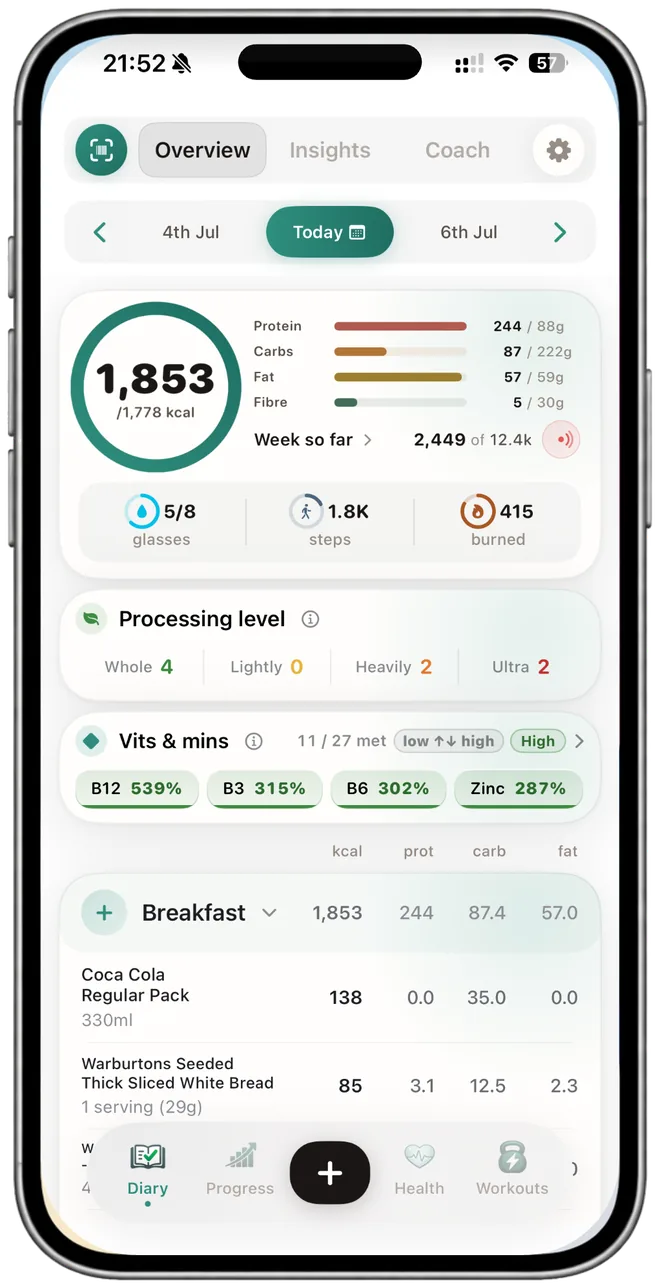
NutraSafe is designed specifically for British users who want more than basic calorie tracking:
- Free tier: 5 food logs per day with barcode scanning and UK database access — no credit card required.
- UK supermarket focus: Tesco, Asda, Sainsbury's, Morrisons, Aldi, Lidl products verified.
- Beyond calories: Track protein, carbs, fat, fibre, vitamins, and minerals in one place.
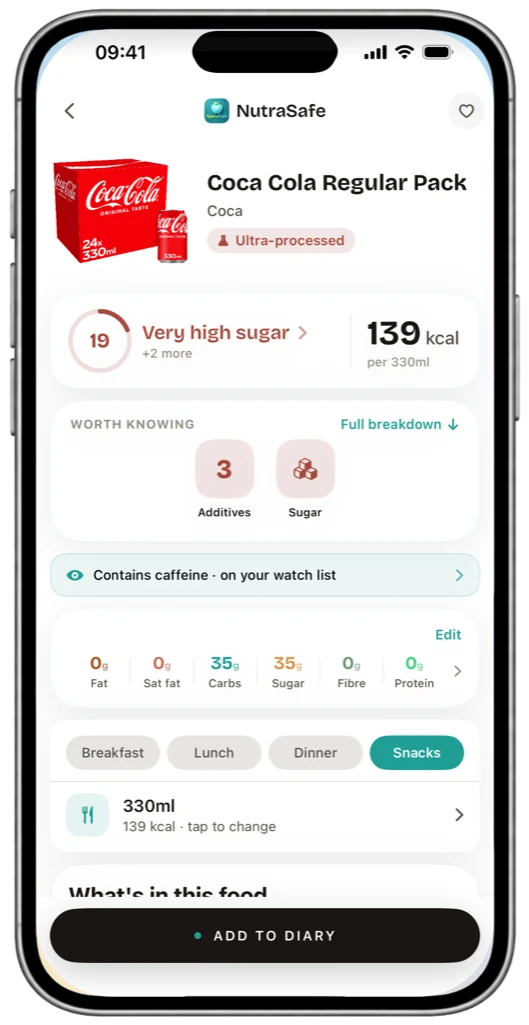
- Additive warnings: See E-numbers and food additives in scanned products (unique feature).
- No ads: Clean, distraction-free interface even on free plan.
- Affordable premium: £2.99/month for unlimited logging (vs £9.99 for MyFitnessPal).
Start Counting Calories for Free
Download NutraSafe and log your first meal in under 60 seconds. Free plan includes 5 logs/day with UK barcode scanning.
Download Free on iOS12 Common Calorie Counting Mistakes (And How to Avoid Them)
Most people make these errors when counting calories. Fix them to improve accuracy and results:
1. Not Weighing Food
Eyeballing portions leads to 20-40% underestimation. A "handful" of nuts could be 50g (300 calories) or 100g (600 calories). Use kitchen scales for accuracy.
2. Forgetting Cooking Oils
1 tablespoon of oil adds 120 calories. If you fry food in 2 tablespoons daily, that's 840 calories per week unaccounted for. Measure oil or use spray bottles.
3. Logging After Cooking Instead of Before
Raw chicken is 110 calories per 100g. Cooked chicken is 165 calories per 100g (water loss concentrates calories). Weigh ingredients raw, log raw values.
4. Ignoring Liquid Calories
Orange juice (200ml) = 90 calories. Latte (medium) = 150 calories. Pint of beer = 180 calories. These add up fast and don't fill you up like solid food.
5. Using Generic Database Entries
MyFitnessPal has user-created entries that can be wrong. Always verify against the actual UK product label or use barcode scanner for packaged foods.
6. Not Tracking "Small" Bites
Tasting while cooking, finishing kids' plates, grabbing a biscuit with tea — these "little bits" can add 200-400 hidden calories per day.
7. Forgetting About Weekends
Being strict Mon-Fri but relaxed Sat-Sun wipes out your deficit. If you're 500 under Mon-Fri (2,500 deficit) but 1,000 over on weekends (2,000 surplus), you only lose 0.07kg per week.
8. Setting Calories Too Low
Eating below 1,200 (women) or 1,500 (men) calories is unsustainable, slows metabolism, causes muscle loss, and leads to bingeing. Stick to moderate deficits.
9. Not Adjusting as You Lose Weight
A 90kg person burns more calories than an 80kg person. Recalculate your TDEE every 5kg lost and adjust your calorie target accordingly.
10. Trusting Exercise Calorie Burns
Gym machines and fitness trackers overestimate calories burned by 20-30%. Don't "eat back" all your exercise calories. Be conservative.
11. Obsessing Over Daily Weight
Your weight fluctuates 0.5-2kg daily due to water, food in gut, hormones. Weigh weekly (same day/time) and look at 2-4 week trends, not daily changes.
12. Giving Up After One "Bad" Day
One 3,000-calorie day doesn't undo a week of deficits. Weight loss happens over weeks and months. Log it, move on, and get back on track the next day.
Frequently Asked Questions About Calorie Counting UK
To count calories for weight loss: (1) Calculate your TDEE using a calculator, (2) Subtract 300-500 calories to create a deficit, (3) Track everything you eat using an app or food diary, (4) Weigh portions with kitchen scales, (5) Monitor weekly weight and adjust if needed. Aim for 0.25-0.5kg loss per week.
The average UK adult needs 2,000-2,500 calories per day to maintain weight (2,000 for women, 2,500 for men). Your specific needs depend on age, height, weight, activity level, and goals. For weight loss, women typically eat 1,400-1,700 calories, men eat 1,900-2,200 calories. Use a TDEE calculator for your exact target.
The best free calorie counter for UK users should include a UK food database and barcode scanner. NutraSafe offers free calorie counting (5 logs/day) with UK supermarket coverage and no ads. MyFitnessPal has the largest database but includes ads. Nutracheck is UK-focused but only offers a 7-day free trial.
Calorie counting can be 90%+ accurate when done properly: weigh portions, use verified food data, log immediately, and track consistently. UK food labels are accurate within 20% by law. Most errors come from eyeballing portions (leads to 20-40% underestimation) and forgetting to log small items. Accuracy improves with practice.
For active weight loss, yes — consistency is key. Track 7 days per week for best results. Once you've reached your goal weight and maintained it for 6+ months, you can switch to intuitive eating or tracking 5 days per week. Many people track Mon-Fri and eat intuitively on weekends once they've learned portion control.
You should see scale changes within 2-3 weeks with a 300-500 calorie deficit. However, visual changes (clothes fitting better, face slimming) take 4-6 weeks. Others noticing takes 8-12 weeks. Be patient — sustainable weight loss is 0.25-0.5kg per week. Losing 5kg takes 10-20 weeks, which is healthy and maintainable.
Technically yes — for pure weight loss, only calories matter ("a calorie is a calorie"). But for health, energy, satiety, and muscle retention, food quality matters. The 80/20 rule works well: 80% whole foods (lean protein, veg, fruits, whole grains) and 20% treats. This keeps you satisfied, nourished, and sustainable long-term.
Many UK chains publish nutrition info online: Nando's, Greggs, Pizza Express, Wagamama, Wetherspoons, Prezzo. Check before you go. For independent restaurants, estimate portion sizes and search for similar dishes in your app. Be conservative — restaurant meals often have 20-30% more calories than you'd guess due to oils, butter, and sauces.
Yes, log everything for accuracy. Non-starchy vegetables (lettuce, broccoli, peppers, cucumber) are very low calorie (20-40 per 100g) but still count. Starchy vegetables (potatoes, sweet potatoes, corn, peas) have 70-150 calories per 100g and definitely need logging. Don't skip vegetables — they add volume, fibre, and nutrients to your diet.
One high-calorie day won't ruin your progress. Even if you eat 1,000 calories over your target, that's only 0.14kg of fat gain (7,700 calories = 1kg fat). Most of the next-day weight spike is water retention from extra carbs and salt. Just log it, learn from it, and return to your deficit the next day. Weekly and monthly averages matter more than single days.
📚 Related Calorie Counting Resources
Looking for more detailed nutrition guidance? Check out these related pages:
- TDEE & BMR Calculator UK — Calculate your exact daily calorie needs
- Macro Tracking Guide UK — Go beyond calories with protein, carbs, and fat tracking
- Best Diets for Weight Loss UK — How calorie counting compares to keto, low-carb, and other diets
- High Protein Diet Guide — Optimize protein intake for muscle retention during weight loss
- Food Scanner Apps UK — Compare barcode scanner apps for easier calorie tracking
Start Your Calorie Counting Journey Today
Calorie counting is the most flexible, evidence-based approach to weight management. It works because it's based on fundamental science: eat less than you burn, and you'll lose weight. With modern tools like UK calorie counter apps, barcode scanners, and food databases, tracking has never been easier.
The key to success is:
- Accuracy: Weigh your food and log honestly
- Consistency: Track every day, even weekends
- Patience: Sustainable weight loss takes months, not weeks
- Flexibility: One bad day doesn't erase your progress
Whether you choose manual tracking, spreadsheets, or a calorie counting app like NutraSafe, the method matters less than sticking with it. Pick the approach that fits your lifestyle and commit to at least 8-12 weeks before judging results.
Ready to Start Counting Calories?
Download NutraSafe free and scan your first UK product in seconds. Free plan includes 5 logs per day with barcode scanner and UK food database.
Get Started FreeLast updated: February 2026