What Are Food Additives?
Food additives are substances added to food during manufacturing or processing. They serve various purposes: preserving freshness, enhancing flavour, improving texture, adding colour, or extending shelf life.
In the UK and EU, approved food additives are assigned E-numbers — codes that identify each specific additive. While all approved additives have passed safety assessments, some people prefer to limit certain types, and some additives have raised concerns in scientific research.
Categories of Food Additives
Food additives are grouped into categories based on their function. Each category has a specific E-number range:
Colours
Give or restore colour to food. Includes natural colours (like beetroot) and synthetic dyes (like tartrazine).
E100-E199
Preservatives
Extend shelf life by preventing bacterial growth, mould or oxidation. Common in processed meats, bread and drinks.
E200-E299
Antioxidants
Prevent food from going rancid or changing colour. Used in fats, oils and processed foods.
E300-E399
Emulsifiers & Stabilisers
Keep ingredients mixed together and improve texture. Found in ice cream, mayonnaise and dressings.
E400-E499
Anti-caking Agents
Stop powders clumping together. Used in salt, flour and powdered products.
E500-E599
Flavour Enhancers
Boost existing flavours without adding their own. MSG is the most well-known example.
E600-E699
Sweeteners
Add sweetness with fewer or no calories. Includes aspartame, sucralose and stevia.
E900-E999
Glazing Agents
Coat food surfaces for protection or appearance. Used on sweets, fruits and baked goods.
E900-E999
Common E-Numbers Explained
Examples You'll See on UK Food Labels
E100
Curcumin
— Natural yellow colour from turmeric. Generally considered safe.
E150a
Plain Caramel
— Brown colour made from sugar. Found in cola, sauces, bread.
E211
Sodium Benzoate
— Preservative in soft drinks and pickles. Some sensitivity concerns.
E300
Ascorbic Acid
— Vitamin C. Used as an antioxidant. Completely safe.
E322
Lecithin
— Emulsifier from soy or sunflower. Found in chocolate, bread.
E621
MSG
— Monosodium glutamate. Flavour enhancer. Safe but some people are sensitive.
E951
Aspartame
— Artificial sweetener in diet drinks. Approved but debated.
How to Check Food Additives
There are several ways to check what additives are in your food:
1. Read the Label
All additives must be listed in the ingredients. They appear either by name or E-number (or both). However, understanding what each one means can be difficult.
2. Use a Food Scanner
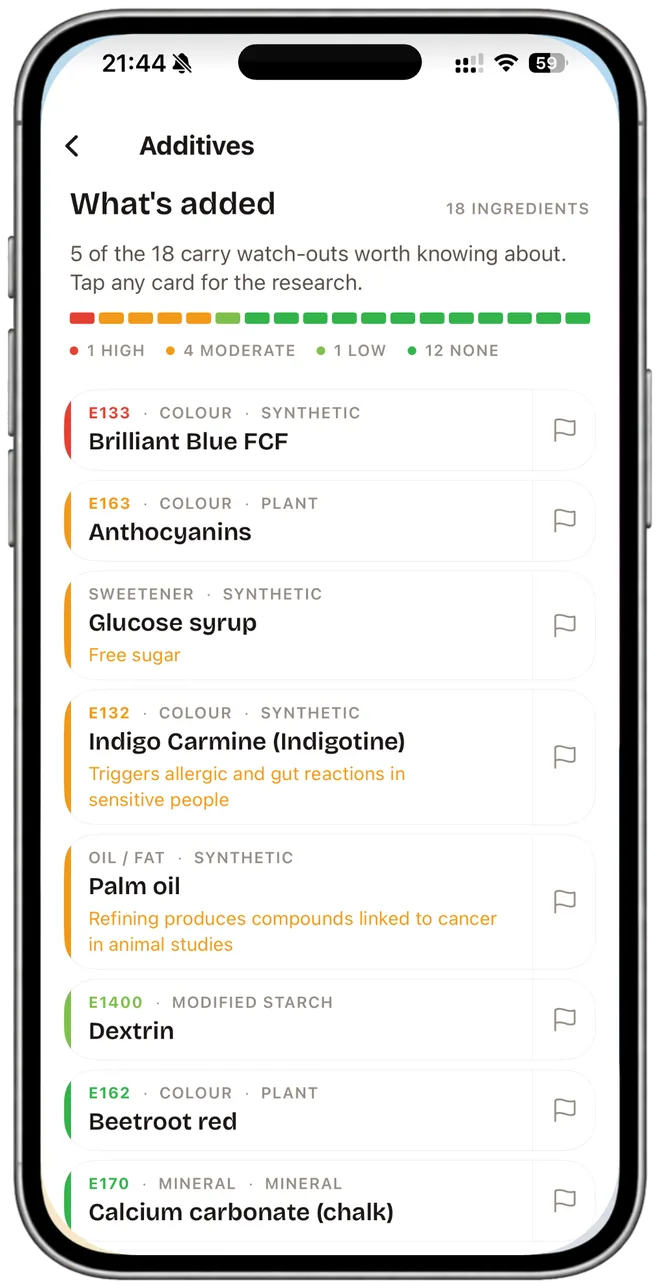
The quickest way to understand additives is to scan the barcode. NutraSafe instantly identifies all additives in a product and explains:
- What each additive is and its purpose
- Safety information based on scientific research
- Whether it's natural or synthetic
- Potential concerns or sensitivities
3. Check Our E-Numbers Database
Browse our comprehensive E-numbers database to look up any additive and understand what it does.
Additives to Watch Out For
While all approved additives are considered safe by regulators, some have raised concerns:
Artificial Colours
Some artificial colours (E102, E104, E110, E122, E124, E129) are linked to hyperactivity in children. UK foods containing these must carry a warning label.
Preservatives
Sodium benzoate (E211) may trigger reactions in people sensitive to aspirin. Nitrites (E249-E252) in processed meats have been linked to health concerns when consumed in large amounts.
Artificial Sweeteners
Aspartame (E951) is one of the most studied additives. While approved as safe, some people report sensitivity. Newer sweeteners like stevia (E960) are plant-based alternatives.
Natural vs Artificial Additives
"Natural" doesn't automatically mean safe, and "artificial" doesn't automatically mean harmful. However, many people prefer to choose foods with fewer synthetic additives.
Natural additives include colours from plants (beetroot, turmeric), preservatives from salt or vinegar, and emulsifiers from eggs or soy.
Artificial additives are synthesised in laboratories. They may be identical to natural compounds or completely new substances.
Food Additives FAQs
What are food additives?
Food additives are substances added to food during processing to preserve freshness, enhance flavour, improve appearance, or extend shelf life. In the EU and UK, they are identified by E-numbers. Common categories include preservatives, colourings, sweeteners, emulsifiers, and flavour enhancers.
Are food additives safe?
All food additives approved for use in the UK have been assessed for safety by regulatory bodies. However, some people may be sensitive to certain additives. Some additives are considered completely safe, while others have raised concerns in scientific research. It's worth being informed about what you're consuming.
What are E-numbers?
E-numbers are codes used to identify food additives in the European Union and UK. The 'E' stands for 'Europe' and the number indicates the specific additive. For example, E100 is curcumin (a natural yellow colouring), E300 is vitamin C (ascorbic acid), and E621 is MSG (monosodium glutamate).
How can I check food additives in products?
You can check food additives by reading ingredient labels or using a food scanner like NutraSafe. Simply scan any barcode and the app will identify all additives and E-numbers, explain what they are, and provide safety information based on scientific research.
Which additives should I avoid?
This depends on your personal health and preferences. Some people avoid artificial colours (E102, E110, E129) especially for children, artificial sweeteners (E951), and certain preservatives (E211, E220). If you have specific sensitivities, a food scanner can help you identify problem ingredients quickly.
Are natural additives better than artificial ones?
"Natural" doesn't automatically mean safe, and "artificial" doesn't mean harmful. However, many people prefer to limit synthetic additives. Natural additives come from plant, animal or mineral sources, while artificial ones are synthesised. Both types are regulated for safety.
Last updated: February 2026