
Food additive scanner for any UK barcode
Point your camera at a UK barcode and NutraSafe pulls every additive out of the ingredients list, names it in plain English, and flags the ones that carry a watch-out. Tap any E-number for what it is, where it turns up, and, where research exists, the concern and who published it, so every flag comes with its source.
Free download Pro £3.99/month or £34.99/year UK barcodes, sources cited
Scan the barcode, read the additives
A calorie counter stops at the number on the front. NutraSafe reads the ingredients line on the back, picks out every additive and E-number, and tells you which are worth a second look.
Scan a barcode and every additive is pulled out
Point your camera at any UK barcode and the pack opens in a second. NutraSafe reads the full ingredients line in the order it appears on the label, then lifts every additive and E-number into its own list. A tub of ice cream or a multipack of crisps can hide a dozen of them between the flavourings, the colours and the emulsifiers. You see all of them at once, not buried in a paragraph of small print.
Anything with published research behind it is flagged and sorted, so the additives worth a second look sit at the top and the plain filler stays at the bottom. The count is there too: eighteen ingredients, five with a watch-out. It reads the same standard UK barcode (GTIN/EAN) that every supermarket uses, so a Tesco own-brand and a branded pack from Aldi or Lidl look up the same way.
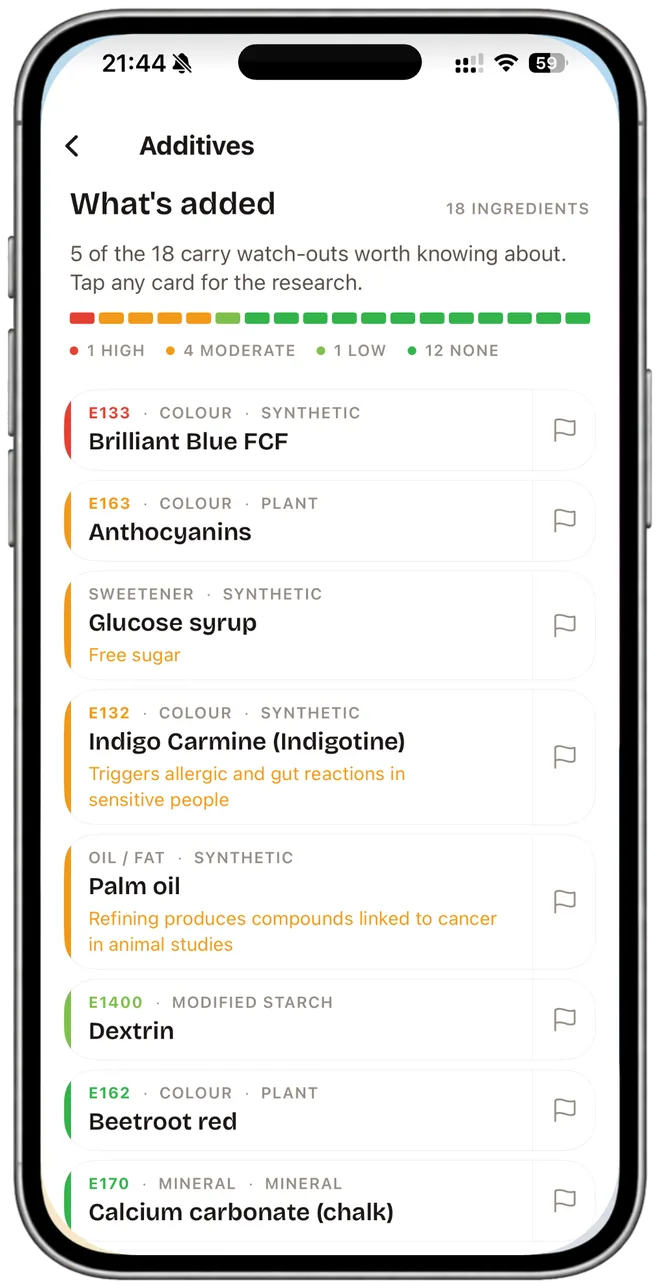
Tap an E-number for the plain-English version
An E-number on its own tells you nothing. Tap any one in the list and NutraSafe opens the plain-English card: what the additive actually is, what job it does in the food, and where you tend to find it. E250 becomes the curing salt in bacon and ham. E102 becomes tartrazine, the yellow colour. E951 becomes aspartame, the sweetener in diet drinks.
Where there is published evidence, the card carries the concern, the regulator and the source on the same line. Processed-meat nitrites sit under the line that the WHO's IARC classes processed meat as causing bowel cancer (Group 1, 2015), with the NHS 70g a day figure next to it. The Southampton Six colours carry the FSA warning that they may affect activity and attention in children. You get the finding and who published it, and what you make of it is your call.
See the whole picture, not just the additives
The additive list sits inside a wider what's-in-this-food view, so the E-numbers are read next to the sugar, the salt and how processed the food is, rather than in isolation. A biscuit with two flagged colours and 34g of sugar per 100g is a different thing from a single colour in an otherwise plain food, and seeing them together is the point.
The nutrition is taken straight off the UK label, per 100g and per the serving you actually eat. Where a food is heavily processed we say so and show the markers behind it, the industrial emulsifiers and modified starches the NOVA research uses to define ultra-processed food. It is a full read of the pack, not a single grade.
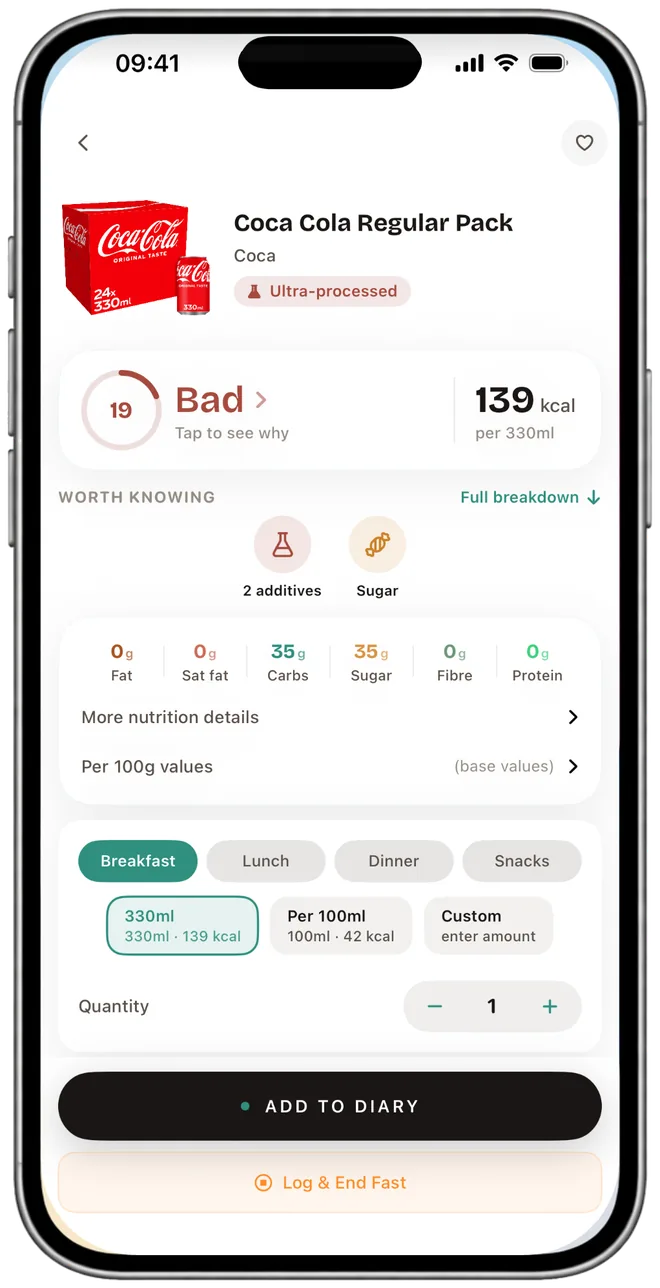
A worked example, a can of cola
Anyone who has picked up a can and thought "what is E150d and why is it in everything?" is who we built this for. Here is what comes back the moment you scan a 330ml UK can.
Scan a 330ml can of Coca-Cola
Point the camera at the can and the pack opens in the diary. The nutrition is straight off the UK label: 139 kcal and 35g of sugar in the can. The two additives are named rather than left as codes, caramel colour (E150d) and phosphoric acid (E338), each on its own line, so you are not left looking anything up.
Tap the caramel colour and the source comes with it. E150d can form trace 4-MEI during manufacture, which IARC lists as possibly causing cancer (Group 2B, 2013), and California requires a Prop 65 warning above 29µg of 4-MEI a day, which is why most major colas reformulated to stay under it. You get the fact and the body that published it, on the pack you were about to buy.
A source on every flag, and where we stop
We do not invent verdicts. Every flag traces back to a named body, and where the science is unsettled we leave the additive without one.
Every flag on an additive points back to who published it: the EFSA panel that set the intake limit, the IARC monograph that graded the evidence, the FSA warning on the Southampton Six colours, the NHS and SACN guidance on processed meat. Aspartame (E951) carries the IARC 2023 Group 2B classification next to the JECFA intake figure, both on the same line, because the two bodies said different things and you deserve to see both.
We are a scanning and tracking tool, not a doctor or a dietitian. We do not diagnose, and we do not tell you a food is off-limits. We show you what is in the pack and what published research says about it, so you can take a clearer picture to your own decision, or to a professional if it matters to you. If you want the full write-up on any additive, the E-number A to Z on this site goes deeper than the card in the app, and what to watch sorts them by concern.
Food additive scanner FAQ
The questions we see most often about the additive scanner. Short answers, sources cited. If yours is not here, our contact page goes to a real inbox.
Point your phone at any UK barcode and we surface the full ingredients line in pack order, with every additive and E-number picked out and a plain-English line on what it is and what it does. Where research exists, the flag carries the concern and the regulator that published it, right on the line.
The Southampton Six colours (E102, E104, E110, E122, E124, E129) carry the FSA warning that they may affect activity and attention in children. Aspartame (E951) carries the IARC 2023 Group 2B classification alongside the JECFA intake figure. Processed-meat nitrites (E249, E250, E251, E252) carry the IARC line that processed meat causes bowel cancer (Group 1) plus the NHS 70g a day figure. Caramel colour E150d carries the IARC Group 2B (2013) note on 4-MEI.
Any UK barcode (GTIN/EAN). It is one global barcode database, not a per-retailer integration, so Tesco, Sainsbury's, Asda, Morrisons, Aldi, Lidl, Co-op and Waitrose own-brands and branded products all look up the same way. Coverage is broad but not total. If a smaller pack is not in the database yet, send it via the in-app report and we add it.
The download is free. The free tier covers barcode scanning, the additive breakdown with plain-English notes, the E-number library on this website, and up to 25 food logs a day. NutraSafe Pro is £3.99 a month or £34.99 a year on iOS, and adds allergen warning detail, vitamin and mineral tracking, the AI features, workouts and fasting.
An E-number is the code an additive carries on the UK and EU permitted list. The prefix tells you the job: E100s are colours, E200s are preservatives, E300s are antioxidants, E400s are thickeners and emulsifiers, E500s are acidity regulators, E600s are flavour enhancers, and E900s are sweeteners and glazing agents. The full A to Z covers all of them.
No. We are a scanning and tracking tool, not a doctor or a dietitian. We show you what is in the pack and what published research says about it. We do not diagnose, and we do not rank one product against another with a letter or a verdict. What you do with the information is your call, and it is the kind of thing you can take to your GP if it matters to you.
Scan any UK pack and see every E-number in plain English, with a source on every flag
Free download covers barcode scanning and the additive breakdown. Pro is £3.99 a month or £34.99 a year on iOS for allergen detail, vitamins, the AI features, workouts and fasting.
iPhone · iOS 17 · Cancel any time