
Food and symptoms, lined up
The food that did it was probably not the last thing you ate.
The NHS puts it plainly: with a food intolerance "you usually get symptoms a few hours after eating the food or ingredient you're intolerant to". A few hours is two or three meals ago, which is exactly why the food people blame is so often the wrong one. The NHS answer is a food and symptoms diary, kept properly, taken to a GP. Here is how to keep one that actually finds something, what the NHS says not to do, and the line where this stops being a tracking job.
NHS guidance quoted · A diary method, not a diagnosis · See a GP for the answer
Why guessing
never works.
Three things break the obvious approach of blaming whatever you ate last.
The delay
The NHS states symptoms usually appear a few hours after eating. In that window you have probably eaten again, drunk something, been somewhere and done something. The last meal is the most memorable suspect and the least likely one.
The dose
Intolerance is often about quantity rather than presence. A small amount of something may cause nothing at all while a larger amount causes a lot, so the same food appears innocent on Monday and guilty on Friday. A yes or no list cannot describe that. A record of how much can.
The overlap
A typical day contains dozens of ingredients, and the ones that recur most across a week are the hardest to see precisely because they are always there. Bread, dairy, onion and garlic hide in this way, which is why bloating is so often blamed on the wrong thing. You cannot spot a constant by memory.
- 08:00Breakfast
- 12:30Lunch
- 15:30Something at your desk
- 18:00Dinner, the meal that gets blamed
- 18:40Symptoms
An illustration of the window the NHS describes, not measured data. If symptoms usually arrive a few hours after eating, the shaded rows are the candidates and the meal you remember is the one least likely to be responsible.
Allergy and intolerance
are not the same thing.
This matters before anything else, because one of them is an emergency and the other is not.
The NHS is direct about it. A food intolerance "is not caused by your immune system overreacting to certain types of food, which means you cannot have a serious allergic reaction". A food allergy is the immune reaction, and it "causes symptoms such as itchy skin, wheezing, or swelling of the lips, face and eyes".
That difference changes what you should do. Allergy symptoms, particularly anything involving breathing, the throat, the face or the lips, are urgent and are not a diary exercise. Nothing on this page applies to them. If that is what is happening, this is a matter for a doctor now, not for pattern spotting later. For label checking against the 14 declarable allergens, see allergen alerts on a scan.
Intolerance is the slower, duller, more confusing one. It usually shows up hours later, it varies with how much you ate, and it rarely announces itself. That is the one a diary is genuinely good at, and it is the reason the NHS asks for a diary rather than a test.
Allergy
The immune reaction. The NHS says it "causes symptoms such as itchy skin, wheezing, or swelling of the lips, face and eyes". Anything involving breathing, the throat, the face or the lips is a matter for a doctor now.
Intolerance
Not an immune reaction, so the NHS says you "cannot have a serious allergic reaction". Slower, dose dependent, usually hours later. This is the one worth tracking.
What a diary has
to record to work.
Most food diaries fail for the same reason: they record the food and not the rest of it.
Everything, not the meals
The gaps are where the answer usually is. A coffee, a handful of something at your desk, the sauce rather than the dish. If it only records the three meals, the diary is describing an edited version of your day and any pattern found in it is describing that edit.
The time, on both ends
What you ate and when. How you felt and when. Without the two timestamps you cannot line anything up, and lining things up is the entire job. A symptom at 9pm points at a different meal than one at 3pm.
Severity, not just presence
A mild day and a bad day are different data. Recording how bad it was is what lets a pattern separate from background noise, and it is what turns "I sometimes feel rough" into something a clinician can read.
Two things the NHS
tells you not to do.
Both are common, both are easy to get wrong, and one of them is a small industry.
Do not cut food groups out on your own. The NHS wording is "it's important to not cut foods out of your or your child's diet without the advice of a GP or food and nutrition specialist (dietitian)". The reason given is that you can end up missing vitamins and minerals, which matters especially for a child's growth and development. An elimination diet is a clinical tool, run with support, not something to start because a diary produced a suspect.
Be wary of tests sold direct to you. On commercial food intolerance tests the NHS says "Some tests you can buy that claim to diagnose food intolerances are not recommended", noting there is limited evidence they give accurate results and that "they may suggest you should avoid multiple foods, which can be harmful". A test that returns a long avoid list is not a more scientific version of a diary. It is often the thing that sends people into unnecessary restriction.
This is also the honest limit of what any app can claim, including ours. A diary produces a pattern, which is a hypothesis. Turning a hypothesis into an answer needs a clinician. Anything that skips that step is selling certainty it does not have.
"Some tests you can buy that claim to diagnose food intolerances are not recommended... they may suggest you should avoid multiple foods, which can be harmful."
NHS, food intolerance
When to stop tracking
and book an appointment.
The NHS line is short: "See a GP if you or your child have any symptoms of a food intolerance that keep coming back."
Recurring is the word doing the work there. A one off bad evening after an unusual meal is not a pattern. The same symptom returning across weeks is, and that is the point at which a diary has done its job and a person needs to look at it.
Bring the record with you. A few weeks of what you actually ate, when, and how you felt, is far more use in a ten minute appointment than trying to reconstruct it from memory in the room. It also lets a GP rule things out faster, because much of what causes recurring gut symptoms is not a food intolerance at all. If you are comparing tools for this, we keep a roundup of food allergy and reaction tracking apps.
Go now, do not track
Anything involving breathing, swelling of the face, lips or throat, or a reaction that comes on within minutes, is not this. That is allergy territory and it is urgent.
We are the diary,
not the diagnosis.
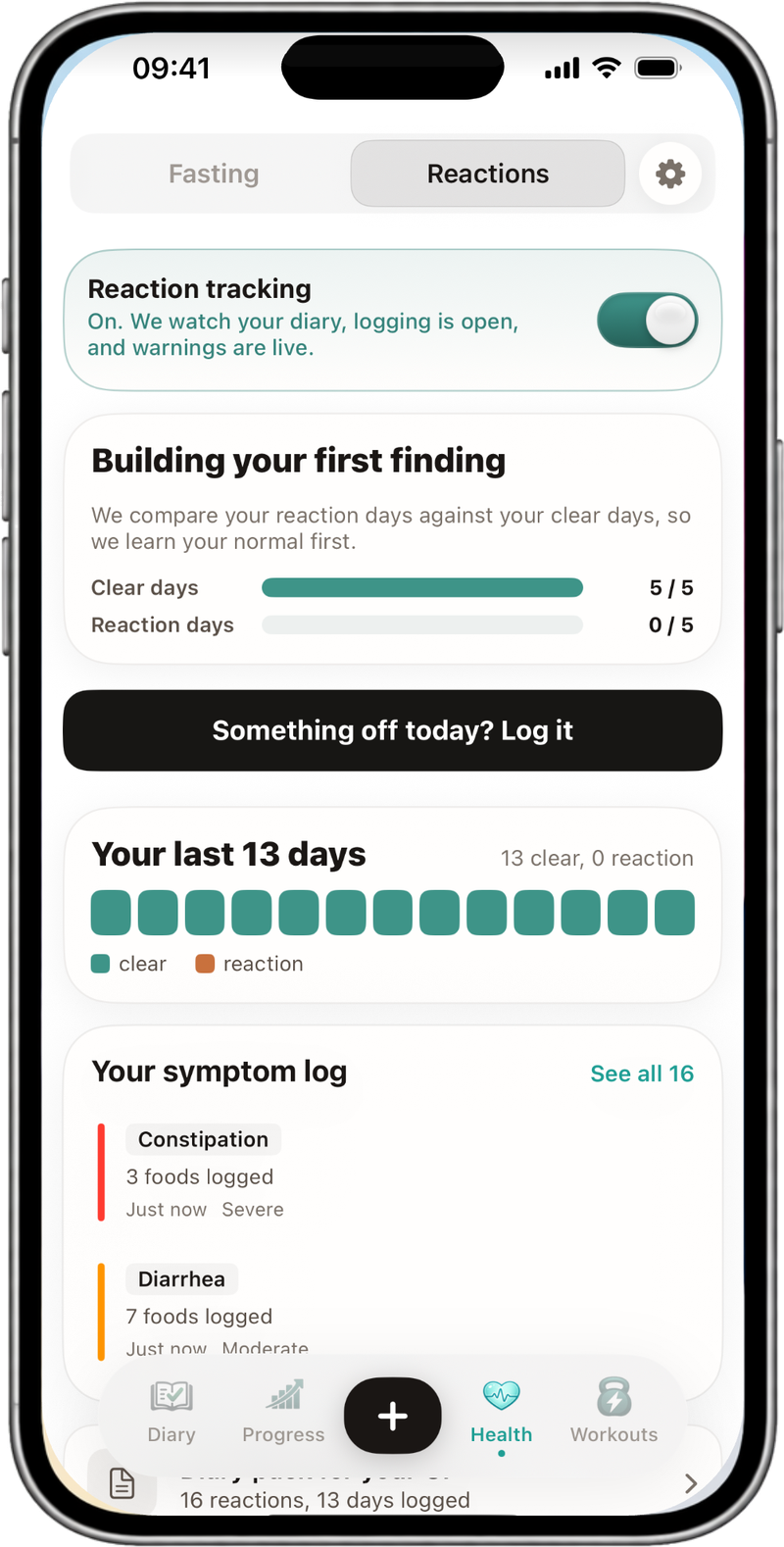
The NHS says you may be asked to keep a food and symptoms diary. That is the thing we built.
Off the label, not memory
Scan a UK barcode and the ingredients come off the pack rather than out of your memory, so a recurring ingredient buried in a sauce is visible. Logging and barcode scanning are on the free tier, up to 25 entries a day. More on the reaction tracker.
With times and severity
Log how you felt and when, with severity. Both halves carry timestamps, which is what makes them line up. You can keep logging reactions while you build up a baseline without paying.
The pattern, as a shortlist
Once there is enough history to be worth reading, the suspected triggers view shows which foods keep appearing before your worst days. That analysis is on Pro, and the suspected triggers page explains how it is built. It is a shortlist to take to a GP, not a verdict, and we do not tell you to cut anything out.
Frequently
asked.
Answered from NHS guidance. We are not a medical service and none of this replaces a GP.
The NHS says you usually get symptoms a few hours after eating the food or ingredient. That delay is why the last thing you ate is rarely the culprit, and why a diary with timestamps finds things that memory does not.
An allergy is the immune system overreacting and can cause itchy skin, wheezing or swelling of the lips, face and eyes. The NHS states that intolerance is not immune mediated, which means you cannot have a serious allergic reaction from it. Allergy symptoms are urgent and are not a tracking exercise.
Not on your own. The NHS says it is important not to cut foods out of your or your child's diet without the advice of a GP or a dietitian, because you can end up short of vitamins and minerals. An elimination diet is something to run with clinical support.
The NHS says tests you can buy that claim to diagnose food intolerances are not recommended, that there is limited evidence they give accurate results, and that they may suggest avoiding multiple foods, which can be harmful.
Long enough for a repeat to be visible rather than a coincidence, which in practice means weeks rather than days. A single bad evening is not a pattern. The same symptom recurring across several weeks is what a GP can work with.
No. An app can show which foods keep appearing before your worst days, which is a shortlist. Confirming a food intolerance is a clinical process, and the NHS is explicit that recurring symptoms are a reason to see a GP.
The
sources.
NHS pages, quoted rather than summarised, so you can check the wording yourself.
The food half and the symptom half, in one place.
Free download. Scan UK barcodes, log what you ate and how you felt, and keep building a record while you get a baseline. Up to 25 logs a day on the free tier; the suspected triggers analysis is Pro, £3.99/month or £34.99/year.
iPhone · iOS 17 · Cancel any time