
Why the counting drifts
They reported 1,028 calories. They ate 2,081.
That gap is from a 1992 New England Journal of Medicine study of people who could not lose weight on a diet they believed was low in calories. Measured properly, their actual intake was roughly double what they reported, a 47% under-report, and it was not deliberate. It is the clearest demonstration of why calorie counting drifts. Here is where the gap actually comes from, the four places to check before deciding your metabolism is broken, and the one thing on a food label that is legally allowed to be approximate.
NEJM 1992 · NHS and FSA guidance · No metabolism myths
The study that
settled this.
Lichtman and colleagues, New England Journal of Medicine, 1992. It is old, and it has never been the surprising part since.
The researchers took people who reported being unable to lose weight despite eating what they described as a low calorie diet, and measured what they were really doing rather than asking. Over the study period the group reported an intake of about 1,028 calories a day. Their actual measured intake was 2,081 calories a day.
That is a 47% under-report. The same people also over-estimated how much physical activity they were doing. The paper's conclusion was that the failure to lose weight came from an intake substantially higher than reported and an overestimation of activity, and not from any abnormality in how their bodies burned energy.
The important part is that this was not lying. People were describing their eating as accurately as they could and were still out by roughly half. Self-report of food intake is simply not an accurate instrument, and knowing that is the difference between fixing the measurement and concluding your metabolism is broken.
Where the calories
actually go missing.
Almost all of the gap comes from four places, and none of them is metabolic.
Portions, not foods
The food gets logged and the amount gets estimated. Oil in a pan, a poured rather than measured cereal, a restaurant portion sized by someone else. The food name is right and the number attached to it is a guess, and a guess that is 30% light on several items a day compounds fast.
The things that are not meals
Milk in coffees, a slice taken while cooking, the end of a child's plate, a drink out. Individually trivial, collectively the single most common leak, and the one that never makes it into a diary because it never felt like eating.
The weekend
Five tracked days and two untracked ones is not a tracked week. A deficit built Monday to Friday can be cancelled across Saturday and Sunday without either day feeling excessive, and the weekly average is the only number that decides anything.
The target moved
A smaller body needs less energy. As weight comes down, the intake that once created a deficit gradually stops creating one, so the same number that worked in month one does nothing by month four. Nothing has gone wrong, the arithmetic has just moved.
The number on the pack
is an average.
Worth knowing before you treat a label calorie figure as exact, because in law it is not meant to be.
Under retained EU food law, the energy and nutrient content on a pack is declared as an "average value", which the guidance defines as "the value which best represents the amount of the nutrient which a given food contains, and reflects allowances for seasonal variability, patterns of consumption and other factors which may cause the actual value to vary".
Manufacturers are held to a range around the declared figure rather than to the figure itself.
This is not a scandal and it is not a reason to stop counting. It is a reason to treat a daily total as a good estimate rather than a measurement, and to read the weekly direction instead of the daily digit. A diary is a consistent instrument, which is what makes trends in it meaningful even when any single number carries some slack.
"It is not possible for foods to always contain the exact levels of energy and nutrients that are labelled, due to natural variations and variations from production and during storage."
UK tolerance guidance on nutrition labelling
Four things to check
before changing anything.
In order. Most stalls are answered by the first two, and neither involves eating less.
One. Weigh things for one week, not forever. Not as a permanent regime, as a calibration. A week of weighing the things you eat most often tells you how far your eyeball estimate is from the real portion, and after that you can go back to estimating with a correction you actually know. This is the single highest yield fix, because portions are the biggest leak.
Two. Log the untracked days first. If weekends are not in the diary, add them before touching your target. A week that contains every day is the first honest week, and quite often the stall explains itself at that point without any change to what you eat.
Three. Read the weekly average, not the day. Daily weight swings by a kilo or more from water, salt and carbohydrate before any fat has moved, which we cover in how to lose water weight. Judging a diet on a Wednesday reading is reading noise.
Four. Then, and only then, revisit the number. The Eatwell Guide puts average adult needs at around 2,000 calories a day for women and 2,500 for men, and any personal target sits somewhere around that depending on size and activity. If the first three checks are genuinely clean across a few weeks and nothing is moving, the target is the thing to adjust, and our TDEE and BMR calculator gives you a starting estimate. There is more on setting the number in how many calories to eat to lose weight.
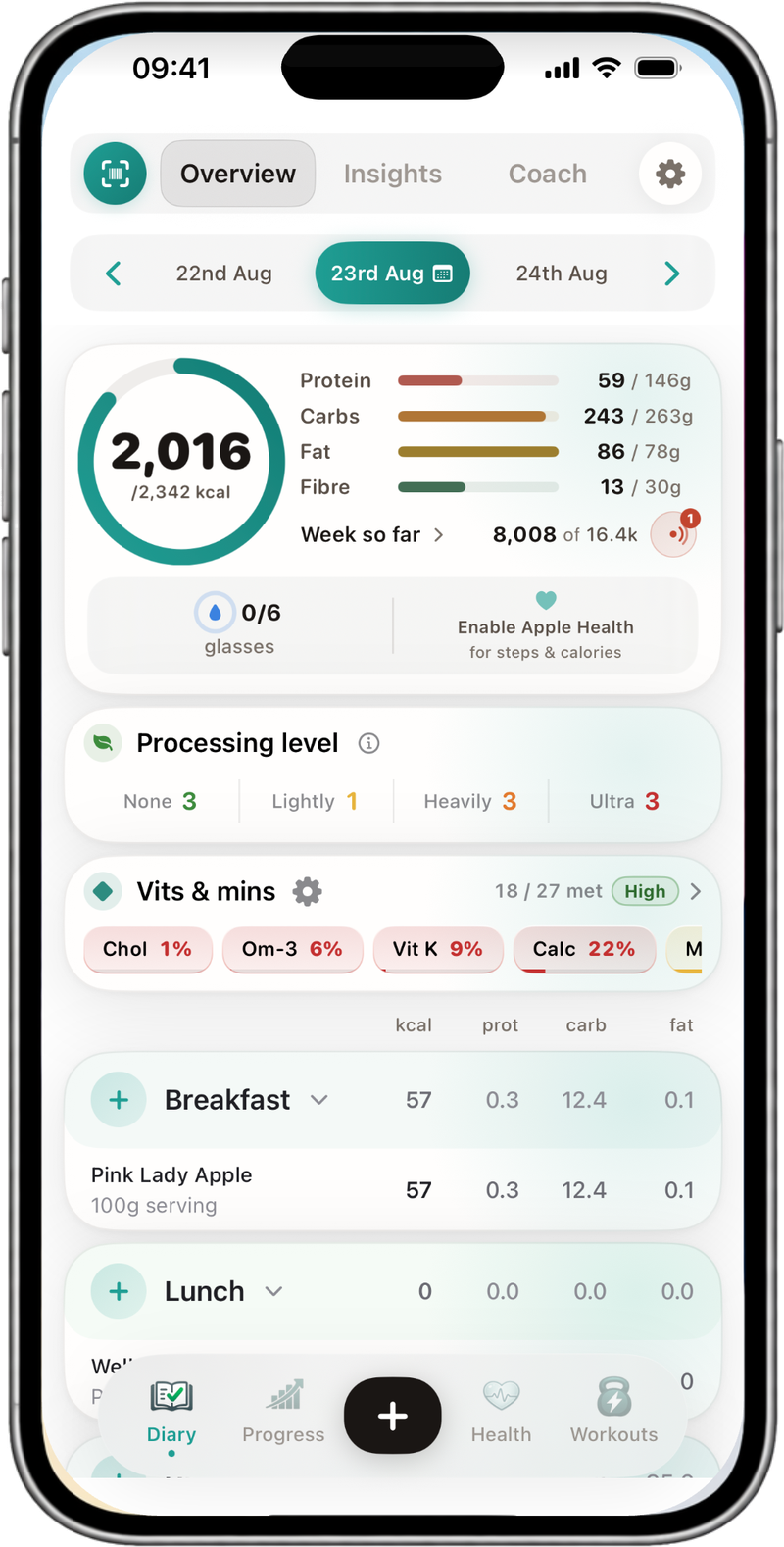
A diary that closes
the obvious leaks.
We cannot fix self-report. We can make the parts that get skipped take a few seconds instead of a minute.
Scan instead of search
A UK barcode gets you the pack figures without hunting through a list of near matches, which is where most abandoned logs die. Barcode scanning and logging are on the free tier, up to 25 entries a day. More on the calorie and macro tracker.
Portions in real units
Log a slice, a tin, a bag or a gram figure rather than translating everything into grams in your head. The saved servings you use most stay one tap away, which is what keeps the small untracked things from staying untracked. Protein, carbs and fat total alongside, covered on the macro tracker.
The week, not the day
The diary totals across the week so you read a trend rather than a single day, and you can see at a glance which days are missing entirely.
Frequently
asked.
Answered from the published research and UK guidance.
The most common answer is that the count is lower than the intake. A 1992 New England Journal of Medicine study measured people who reported 1,028 calories a day and found an actual intake of 2,081, a 47% under-report, with no metabolic abnormality involved. Portions, untracked extras and untracked days account for most of it.
No. Energy and nutrients are declared as an average value, and the official tolerance guidance states that it is not possible for foods to always contain the exact levels labelled because of natural variation and variation from production and storage. Treat a daily total as an estimate and read the weekly direction.
A smaller body needs less energy, so the intake that created a deficit at the start gradually stops creating one. That is arithmetic rather than damage. The 1992 study specifically ruled out an abnormality in energy expenditure as the explanation for people not losing weight on a reported low calorie diet.
The Eatwell Guide puts average adult needs at around 2,000 calories a day for women and around 2,500 for men. Your own figure depends on size and activity, and a target is only worth adjusting once your logging is actually complete.
Not permanently. Weighing the foods you eat most often for a single week tells you how far your estimates are off, and after that you can estimate with a correction you know rather than one you assume.
That is water rather than fat. A kilo of fat is roughly 7,700 calories, which nobody eats by accident overnight. Salt and carbohydrate both pull water in and it settles within a day or two.
The
sources.
The study, the labelling guidance and the NHS figures behind every number above.
Count what you actually ate.
Free download. Scan UK barcodes, log in real portions and read the weekly total rather than the daily one. Up to 25 logs a day on the free tier; Pro £3.99/month or £34.99/year lifts the cap.
iPhone · iOS 17 · Cancel any time