
Five beliefs, against the wording
Carbs are not capped. Juice counts once. Five a day is missed by most.
The UK actually has published guidance, and it is more specific and less dramatic than most of what gets said about it. Official advice keeps total carbohydrate at around 50% of energy, caps fruit juice and smoothies at a combined 150ml a day however much you drink, and sets fibre at 30g. Meanwhile only 17% of adults meet the five a day recommendation at all. Here are five common beliefs held up against the actual wording, and what each one means for a normal week of eating.
NHS Eatwell Guide · SACN Carbohydrates and Health · NDNS 2019 to 2023
"Carbs are
the problem."
UK guidance does the opposite of cutting them. It keeps them at roughly half of energy intake.
SACN's 2015 Carbohydrates and Health report recommended that total carbohydrate be maintained at a population average of approximately 50% of total dietary energy. That is not a grudging allowance, it is the recommended level, and it has not changed since.
What the same report did recommend cutting was narrower: free sugars should not exceed 5% of total dietary energy. It also recommended that the dietary reference value for fibre be increased to 30g a day for adults. So the guidance moves in two directions at once within the same category, down on free sugars and up on fibre, while the total stays put.
That is the actual shape of the advice. It is a recommendation about which carbohydrates, not how few. Treating bread, potatoes, oats and beans as a single banned category collapses a distinction that the guidance is built around, and it usually takes the fibre down with it. Where processing rather than the carbohydrate itself is the concern, see what counts as ultra-processed.
"Juice and smoothies
count towards five a day."
They count, once, and only up to a fixed amount. This is the most commonly missed detail in the whole guide.
The NHS position is that fruit juice and smoothies together count towards no more than a combined total of 150ml a day. Not 150ml each, not 150ml per portion. A single 150ml glass is the entire contribution juice can make, no matter how much of it you drink.
The reason is that juicing releases the sugars that are otherwise held inside the structure of the fruit, which is what turns them into free sugars, the exact thing SACN capped at 5% of energy. A large bottle of smoothie can carry a substantial share of a day's free sugar allowance while contributing one portion.
The rest of the recommendation is the plain one: at least five portions of a variety of fruit and vegetables a day. Variety is in the wording and is usually the part that quietly disappears when the same two items do all the work. Free sugars hide in more products than most people expect, which is what a label scan makes visible.
150ml a day
Fruit juice and smoothies together. Not 150ml each, not 150ml per portion, and no more portions however much you drink.
Five portions, of a variety
Variety is in the recommendation, and it is usually the part that disappears when the same two items do all the work.
"Everyone else
is eating properly."
The national survey says otherwise, and it is worth knowing before you conclude you are uniquely bad at this.
The guidance describes a target, not a description of how the country eats. Five out of six adults are not hitting the most famous single recommendation in British public health, which suggests the barrier is practical rather than a matter of anyone not having heard it.
The useful conclusion is not despair. It is that moving from two portions to four is a real change worth having, and that the guidance is a direction rather than a pass or fail. Nothing in the Eatwell Guide is scored daily.
"A balanced diet
means a balanced day."
The guide describes the overall balance of what you eat, not a checklist that resets at midnight.
The Eatwell Guide splits the diet by proportion: fruit and vegetables just over a third of what we eat each day, starchy foods just over a third, then smaller shares for protein foods and dairy or alternatives, with oils and spreads in small amounts. It also sets weekly rather than daily targets in places, such as at least two 140g portions of fish a week, one of them oily.
Proportions and weekly targets are the tell. A single unbalanced meal cannot break a proportion measured across everything you eat, and a week with no fish on Tuesday is not a failure if Thursday had some. This is why judging yourself on one day is both harsh and uninformative.
It is also why a week of records is worth more than a perfect day of them. A perfect day tells you what you can do when you are paying attention. A normal week tells you what you actually eat, and that is the thing the proportions are describing. That is the case we make for a food diary over a one off audit.
"You need supplements
to cover the gaps."
UK advice is food first, with one specific and well defined exception.
The exception is vitamin D, and it is not a hedge. The NHS advises that children from age 1 and adults need 10 micrograms a day, and that everyone should consider taking a daily 10 microgram supplement during autumn and winter, because at UK latitudes sunlight cannot supply it for that part of the year.
Some groups are advised to take it all year round: people who are not often outdoors, people in a care home, anyone who usually covers most of their skin outdoors, people with an African, African-Caribbean or south Asian background, and children aged 1 to 4. The NHS also states an upper limit of 100 micrograms a day for adults.
Outside that, the advice is that the nutrients come from food, and the NHS is explicit that you should not cut food groups out without advice from a GP or a dietitian. A cupboard of supplements is not a substitute for the pattern of eating the guidance describes, and it does not address the fibre, the variety or the fish.
We do not sell supplements and we do not tell you to take any. What we cover in more detail is which nutrients the UK actually runs short of, with the measured figures behind each one.
- 10µg a day, adults and children from 1
- 100µg stated adult upper limit
The one exception
Everyone is advised to consider a daily 10 microgram vitamin D supplement for that part of the year, because at UK latitudes sunlight cannot supply it.
Food first
The NHS is explicit that you should not cut food groups out without advice from a GP or a dietitian. Supplements do not address the fibre, the variety or the fish.
The week, in
proportions.
The guidance is about proportions across a week, which is exactly the thing memory is worst at.
What you actually ate
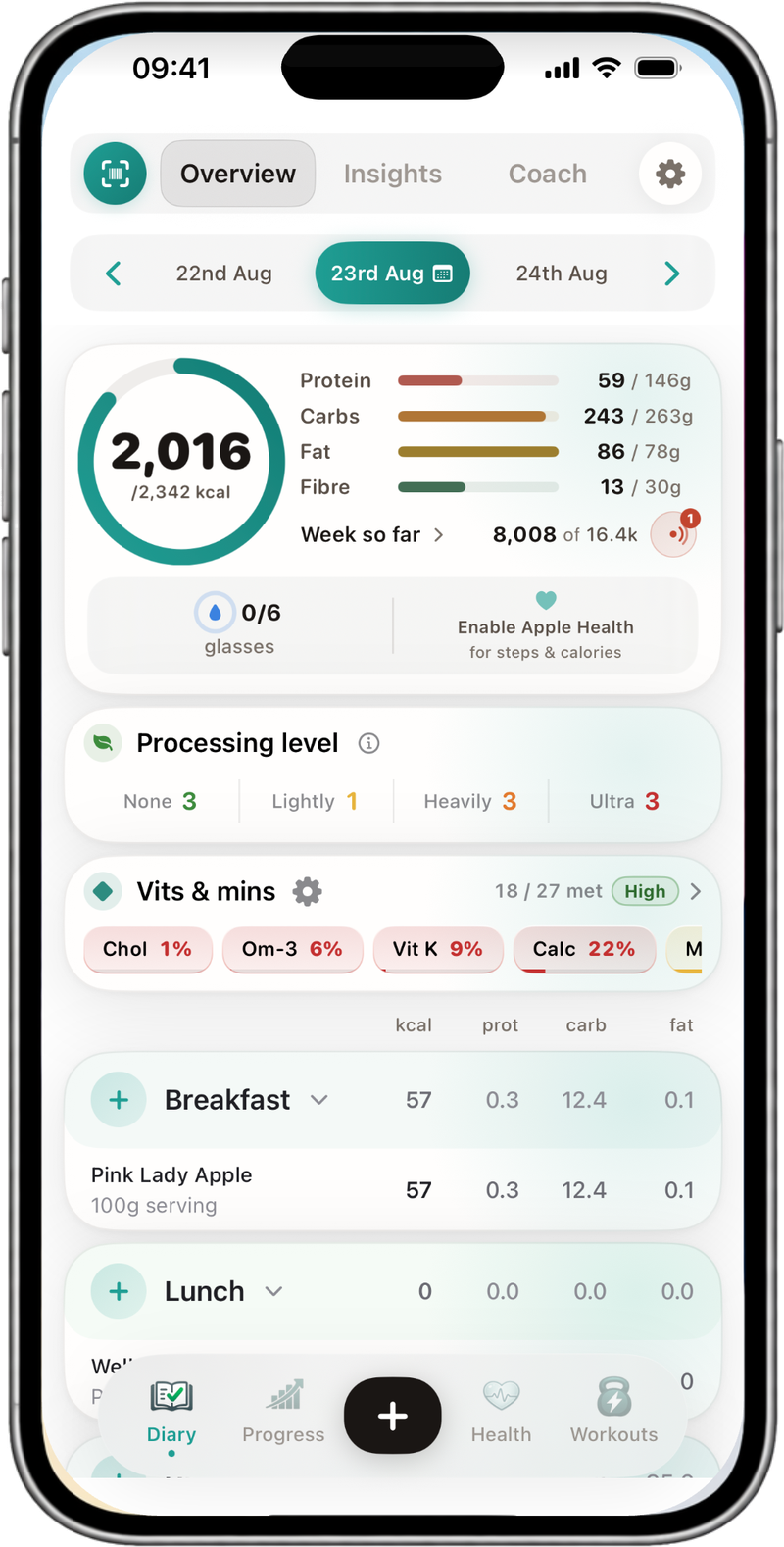
Scan a UK barcode or log a food and it goes in with the pack figures rather than an estimate. Logging and barcode scanning are on the free tier, up to 25 entries a day.
Fibre, sugar and salt totals
The diary totals fibre against the 30g reference value and salt against the NHS 6g cap, so the two things SACN moved in opposite directions are both visible rather than assumed.
And what is in it
Scanning also reads the ingredients list, so a food that looks like one thing and lists twenty is not a surprise. Naming and explaining each additive is on Pro; the count is free. The E-number library on this site is open to everyone, and what to watch for covers the ones that matter.
Frequently
asked.
Answered from the Eatwell Guide, SACN and the national survey.
UK guidance does not treat them that way. SACN recommends total carbohydrate stays at around 50% of total dietary energy. What it recommends limiting is free sugars, to no more than 5% of energy, while raising the fibre reference value to 30g a day for adults.
Once, and up to a limit. The NHS counts fruit juice and smoothies towards no more than a combined total of 150ml a day, however much you drink, because juicing releases sugars that then count as free sugars.
17% of adults met the recommendation in the 2019 to 2023 National Diet and Nutrition Survey, and 9% of children aged 11 to 18. The survey covered 4,370 people with fieldwork from October 2019 to July 2023.
SACN recommended the dietary reference value for fibre be increased to 30g a day for adults in its 2015 Carbohydrates and Health report.
UK advice is food first. The specific exception is vitamin D, where the NHS advises everyone to consider a 10 microgram daily supplement in autumn and winter, and advises some groups to take one all year. The NHS also says not to cut food groups out without advice from a GP or dietitian.
The Eatwell Guide recommends at least two 140g portions of fish a week, one of which should be oily.
The
sources.
Every claim above traces to one of these four. Nothing here is our opinion dressed as guidance.
A normal week, not a perfect day.
Free download. Scan UK barcodes and log your food to see fibre, sugar and salt across a week rather than a day. Up to 25 logs a day on the free tier; Pro £3.99/month or £34.99/year.
iPhone · iOS 17 · Cancel any time