
Vitamins and minerals
Five nutrients the UK keeps running short of.
The National Diet and Nutrition Survey takes blood from a few thousand people every year, so this is measured rather than guessed. In the 2019 to 2023 round, 18% of adults aged 19 to 64 had a vitamin D blood level below 25 nmol/L, and 83% of women aged 16 to 49 sat below the red blood cell folate threshold used for neural tube defect risk. Iodine, iron and magnesium keep appearing too. Here is what each number means, what the NHS advises, and the point at which this stops being a diet question and becomes a GP one.
NDNS 2019 to 2023 · 4,370 people · NHS guidance quoted, not paraphrased
How do we know
what is missing?
Two different things get measured, and mixing them up is where most articles go wrong.
What is in the blood
The National Diet and Nutrition Survey takes blood samples. That measures status, meaning what actually reached the body after eating, sunlight, absorption and everything else. The 2019 to 2023 round covered 4,370 people, 2,296 adults and 2,074 children, with fieldwork from October 2019 to July 2023.
What is on the plate
The same survey records four days of everything eaten and compares it to the Lower Reference Nutrient Intake, the level below which intake is likely to be inadequate. This is intake, not status. A low intake for one week means little. Sustained over years it matters.
Why the difference matters
Blood status is the stronger signal, because it accounts for absorption and for sunlight in the case of vitamin D. Intake data is broader, because blood is not tested for every nutrient. Both appear below, labelled, so you can see which kind of evidence sits behind each one.
What the blood
tests found.
From the 2019 to 2023 survey. These are measured blood levels, not intake estimates.
The two that show
up in intake data.
Blood is not tested for everything. For these two the evidence is dietary intake, measured across nine years.
Iron. Across NDNS Years 1 to 9, covering 2008/09 to 2016/17, the survey reported that "some age/sex groups had mean intakes of iron below the RNI and substantial proportions with intakes below the LRNI, in particular girls aged 11 to 18 years and women aged 19 to 64 years". The proportion falling below the threshold rose over the period rather than fell.
The reason is not mysterious. The NHS sets iron at 14.8mg a day for women aged 19 to 49 against 8.7mg for men and for women over 50, because monthly blood loss has to be replaced. The NHS notes that women who lose a lot of blood during their period are at higher risk of iron deficiency anaemia and may need supplements. So the single largest driver of low iron in the UK is a normal physiological one, met by a diet that was not built around it.
- 14.8mg women 19 to 49
- 8.7mg men 19 and over
- 8.7mg women 50 and over
Magnesium
The same nine year analysis found "evidence of low intakes of magnesium for children aged 11 to 18 years, adults aged 19 to 64 years and adults aged 65 years and over". Unlike iron, magnesium intakes barely moved across the period. They were low at the start and low at the end.
A threshold is not a diagnosis
Neither of these is a blood measurement, and that distinction is worth keeping. A low intake reading says the food eaten during the survey days fell short of a population threshold. It does not say a given person is deficient. Only a blood test does that, and only a GP can order and read one.
What the NHS
actually advises.
Quoted rather than paraphrased, because the detail is where these get misreported.
Vitamin D
Children from age 1 and adults need 10 micrograms a day. Everyone is advised to consider a 10 microgram daily supplement during autumn and winter. Some groups are advised to take it all year: people not often outdoors, people in a care home, anyone who usually covers most of their skin outdoors, people with an African, African-Caribbean or south Asian background, and children aged 1 to 4. The stated upper limit for adults is 100 micrograms a day.
Iron
Men aged 19 and over need 8.7mg a day. Women aged 19 to 49 need 14.8mg, dropping to 8.7mg from 50. The NHS lists red meat, beans such as red kidney beans, edamame and chickpeas, nuts, dried fruit such as dried apricots, fortified breakfast cereals and soy bean flour. Liver is on the list but not during pregnancy.
Folate and iodine
Folate matters most before and during early pregnancy, which is why the 16 to 49 figure is reported the way it is. Iodine comes largely from dairy and white fish in the UK diet, which is why intakes track changes in those two. For both, the route to knowing where you stand is a GP, not a home test.
So what do you
do about it?
Three steps, in the order that makes sense. Only one of them involves buying anything.
First, find out whether this is you. The survey figures describe a population, not a person. If you are tired, breathless, or have symptoms that keep coming back, that is a GP conversation and a blood test, not a supplement aisle. A national average cannot tell you your own ferritin.
Second, look at where your food actually lands. Vitamin D aside, these gaps are mostly a food pattern rather than a single missing item. The 17% figure for 5 A Day is the clue: the same eating that misses fruit and vegetables tends to miss magnesium, folate and iron together, because they largely travel in the same foods. Knowing which of the five you are short on across a normal week is more useful than any one day's meal. The wider question of whether the guidance itself is what people think it is we cover in balanced diet myths.
Third, follow the specific advice rather than the general mood. Vitamin D is the one nutrient where the NHS advises almost everyone in the UK to supplement for part of the year, because latitude, not diet, is the limiting factor from October to March. For the rest, food first is the standard advice, and the NHS is explicit that you should not cut food groups out on your own. Where food and supplements actually differ is covered in food versus supplements.
What we do not do here is tell you to take a supplement, or name a product. We are a tracking tool, not a dietitian and not your GP. What we can do is show you where your own week actually lands against the UK nutrient reference values, which is the thing worth taking to an appointment.
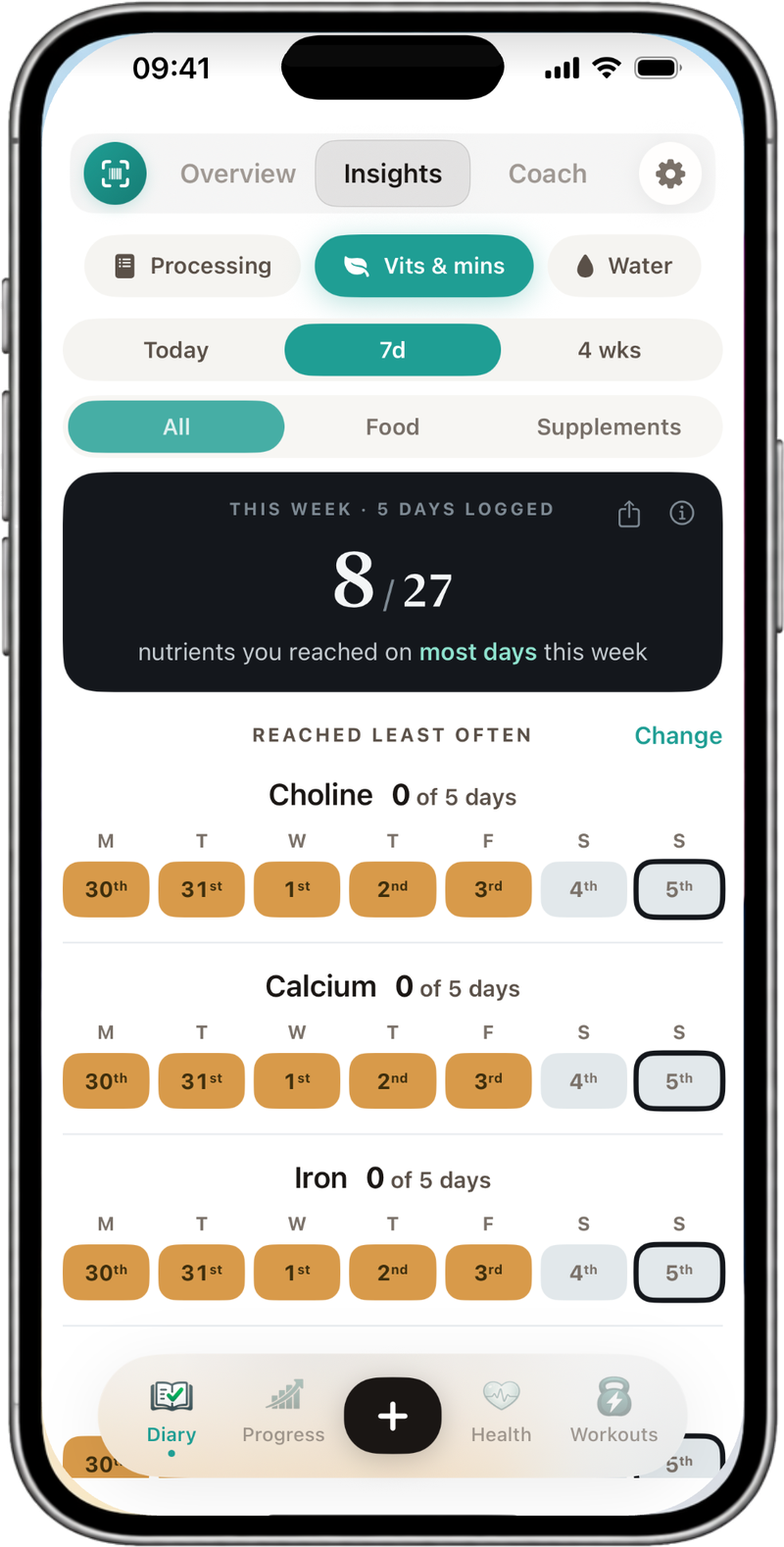
Your week, against
the UK reference values.
We total 13 vitamins and 12 minerals from what you log and show each one against the UK nutrient reference values.
Off the label, not a guess
Scan a UK barcode and we read the panel from the pack. Where a food has no declared micronutrient panel we fall back to reference composition data, and the food page tells you which of the two you are looking at.
A week, not a day
One day tells you nothing about folate or iron. The vitamins and minerals view totals across the period so you can see a pattern rather than a Tuesday. This part is on Pro, and how to track vitamins and minerals walks through it.
Something to take to a GP
If a nutrient sits low across weeks, that is worth raising at an appointment. A log of what you actually ate is more use to a clinician than trying to remember. We do not diagnose anything and we do not tell you to supplement.
Frequently
asked.
Answered from the NHS and the national survey, with the figures attached.
On measured blood levels, vitamin D. In the 2019 to 2023 National Diet and Nutrition Survey, 18% of adults aged 19 to 64 and 23% of 11 to 18 year olds had a level below 25 nmol/L. It is also the one nutrient where the NHS advises most people in the UK to consider a supplement in autumn and winter. We go into the detail in vitamin D deficiency symptoms.
A blood test through your GP. Survey figures describe a population, not you, and the NHS does not recommend commercial home tests for this. If you have symptoms that keep coming back, that is the route.
In the 2019 to 2023 survey, 83% of women aged 16 to 49 were below the red blood cell folate threshold of 748 nmol/L used to judge neural tube defect risk. That threshold is deliberately set higher than the clinical deficiency one, which 4% of adults aged 19 to 64 fell below. The two numbers answer different questions.
The NHS advises everyone to consider a daily 10 microgram supplement during autumn and winter, and advises some groups to take one all year, including people who are rarely outdoors, people who cover most of their skin, people with an African, African-Caribbean or south Asian background, and children aged 1 to 4. The stated adult upper limit is 100 micrograms a day.
The NHS sets iron at 14.8mg a day for women aged 19 to 49 against 8.7mg for men, because monthly blood loss has to be replaced. It notes that heavy periods raise the risk of iron deficiency anaemia. NDNS found substantial proportions of girls aged 11 to 18 and women aged 19 to 64 below the intake threshold.
No, and any app claiming otherwise is overreaching. Deficiency is a blood measurement. What we can show is what you actually ate against the UK nutrient reference values over a period, which is useful context to bring to a GP rather than a diagnosis.
The
sources.
Every figure on this page comes from one of these. No number here is our estimate.
Your vitamins and minerals, against the UK values.
Free download. Scan UK barcodes and log your food; the vitamins and minerals view totals 13 vitamins and 12 minerals against UK reference values on Pro. Up to 25 logs a day on the free tier; Pro £3.99/month or £34.99/year.
iPhone · iOS 17 · Cancel any time