
The floor and the ceiling
0.75 or 1.62 grams per kilo? Both, for different reasons.
The UK Reference Nutrient Intake for protein is 0.75g per kg of body weight a day. The largest meta-analysis on protein and resistance training, pooling 49 studies and 1,863 people, found that gains in lean mass stop improving at around 1.62g per kg a day. Those numbers are not in conflict. One is the floor that prevents a deficiency, the other is the ceiling above which more protein stops adding anything. Here is what sits between them, and why the number above the ceiling is the one most people are actually paying for.
Morton 2018, Br J Sports Med · 49 studies, 1,863 participants · UK RNI from SACN
Why the guidance and
the gym disagree.
They are answering different questions, and neither one is wrong.
The UK RNI
A Reference Nutrient Intake is set at a level expected to meet the needs of 97.5% of a group. It is the amount that stops you being short, calculated for a general population that is not deliberately trying to add muscle. It was never designed as a training target and does not claim to be one.
The research
Morton and colleagues pooled 49 randomised studies covering 1,863 participants doing resistance training. Extra protein improved gains in lean mass and strength up to roughly 1.62g per kg a day, and the curve flattened after that. The confidence interval reached about 2.2g per kg, which is the honest upper edge of the estimate.
What sits between them
For an 80kg person that is 60g a day at the RNI and about 130g at the plateau. The gap is the difference between not being deficient and getting everything protein can give a training programme. Which one applies depends entirely on whether you are lifting.
What happens
above 1.62.
This is the part the supplement aisle is quietest about.
The meta-analysis found a dose-response relationship that plateaus. Below roughly 1.62g per kg a day, more protein produced measurably better gains in fat-free mass. Above it, the additional protein stopped producing additional gains in the pooled data.
The 95% confidence interval extended to around 2.2g per kg, which is the statistically honest way of saying the exact plateau point is uncertain and could sit higher for some people. It is not a licence to treat 2.2 as the target. It is the width of the estimate.
What it does mean is that the difference between 1.6g and 3g per kg is very unlikely to be the reason a training programme is or is not working. Total training volume, consistency and being in the right energy balance all move the needle more, and none of them is sold in a tub.
The honest limit of this evidence. These were resistance training studies in healthy adults. They do not tell you what to do if you have kidney disease, and protein intake in that situation is something to raise with your clinician rather than change on your own. They also say nothing about protein for endurance sport, which is a different question with different numbers. For where protein sits in UK guidance generally, see balanced diet myths.
What that looks
like on a plate.
The number only matters if you can hit it repeatedly, so the practical question is where it comes from.
Work out your own two numbers first. Multiply your body weight in kilos by 0.75 for the UK reference intake and by 1.62 for the training plateau. A 65kg person is looking at roughly 49g and 105g. A 90kg person, roughly 68g and 146g. Everything else is detail around those two figures.
Most people miss it by less than they think, or by far more. Protein is the macronutrient people are worst at estimating, because it is concentrated in a few foods and invisible in most others. The only way to know which side of the plateau you are on is to total it for a normal week rather than a deliberately good day.
Spread beats stacking, but not by enough to obsess over. Getting protein across the day's meals rather than in one large evening portion is the usual advice and it is reasonable. It is a smaller factor than the daily total, so if you can only fix one thing, fix the total.
Food counts the same as powder. Nothing in the meta-analysis makes supplemental protein superior to protein from food. Supplements were the intervention studied because they are easy to standardise in a trial, not because they work better. If your total is already at the plateau from food, a shake adds cost rather than muscle.
Protein is not
the hard part.
Worth saying plainly on a page about protein, because the ranking is not close.
The studies in the meta-analysis all had one thing in common before protein entered the picture: everyone was doing resistance training. Protein supplementation "significantly enhanced" the gains from that training. It did not create gains on its own, and no protein intake substitutes for the training itself.
So the order that matters is training consistently, then eating enough total energy to support it, then getting protein into the 1.6g per kg region, then everything else. If the energy half is the part that keeps slipping, why calorie counting stops working covers where it goes. Reversing that order is how people end up with an expensive cupboard and a stalled programme.
The reason to track protein at all is that it is the one of those four you cannot feel. You know whether you trained. You do not know whether you hit 130g without counting it.
- 1 Train consistently
- 2 Eat enough total energy to support it
- 3 Get protein into the 1.6g per kg region
- 4 Everything else
Your protein total,
next to the session.
Two things in one place, because the number only means anything alongside the training it is supporting.
The daily protein total
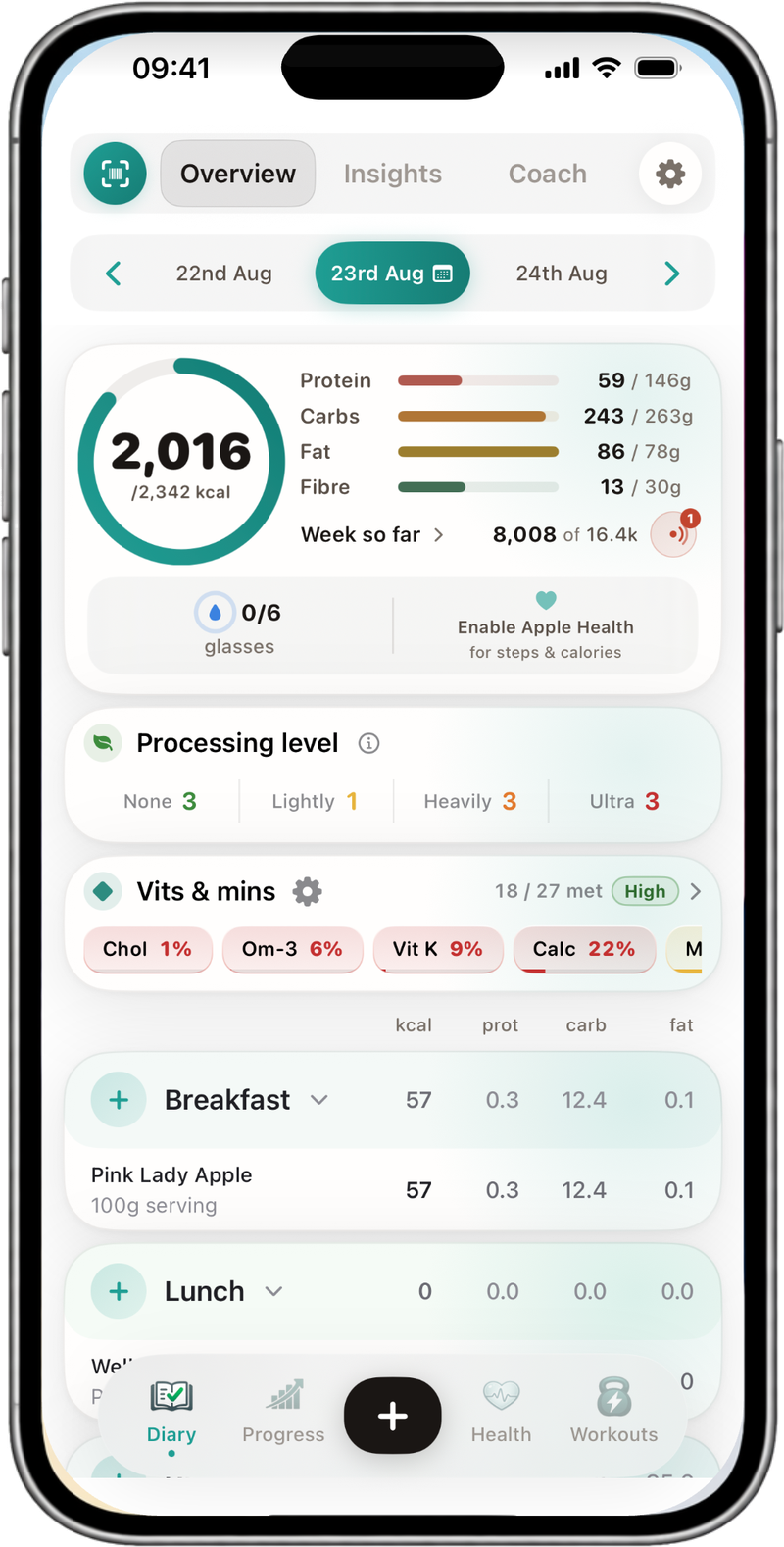
Scan a UK barcode or log a food and the diary totals protein along with everything else, so you can see where a normal week actually lands against your own figure rather than a good day. Logging and scanning are on the free tier, up to 25 entries a day. More on the macro tracker.
Sets, reps and bests
The workout tracker records sets, reps and weight, and keeps your personal bests and estimated one rep max so progression is visible rather than remembered. The workout side is on Pro, and the workout tracker page shows what it records.
What you have trained recently
Sessions feed a body map showing which muscle groups you have worked and how recently, which is the practical version of the question people actually ask about recovery. Also on Pro.
Frequently
asked.
Answered from the published meta-analysis and UK dietary reference values.
The largest meta-analysis on the question, pooling 49 studies and 1,863 participants, found gains in lean mass plateau at around 1.62g per kg of body weight a day, with a confidence interval reaching about 2.2g per kg. For an 80kg person that is roughly 130g a day.
It is enough to meet the UK Reference Nutrient Intake, which is set to cover the needs of 97.5% of the population and prevent a shortfall. It is not the amount associated with maximum gains from resistance training, which the research puts far higher.
The pooled evidence does not show additional benefit to lean mass above the plateau. The upper end of the confidence interval is around 2.2g per kg, which reflects uncertainty in where the plateau sits rather than a recommendation to aim there.
No. Supplements were used in the studies because they are easy to standardise, not because they outperform food. If your daily total already reaches the plateau from meals, a shake adds cost rather than muscle.
Spreading protein across the day rather than taking it all in one meal is the usual advice and is reasonable, but it is a smaller factor than the daily total. If you fix one thing, fix the total.
Plenty of people do. Tracking matters because protein is the one variable in the list you cannot judge by feel. You know whether you trained; you do not know whether you hit your figure without counting it for a while.
The
sources.
The meta-analysis and the UK reference values behind every figure above.
- Morton RW et al. A systematic review, meta-analysis and meta-regression of the effect of protein supplementation on resistance training-induced gains in muscle mass and strength in healthy adults. Br J Sports Med 2018
- Correction to Morton RW et al. (2020)
- SACN statement on expressing energy, fat and carbohydrate intakes and recommendations (GOV.UK)
- NHS: The Eatwell Guide
Your protein and your training, in one app.
Free download. Log food and scan UK barcodes for your daily protein total; the workout tracker with sets, reps, personal bests and a recovery map is Pro, £3.99/month or £34.99/year.
iPhone · iOS 17 · Cancel any time