
What's really in UK food, and what the label buries
Around 57% of the calories in the average UK adult's diet now come from ultra-processed food. The additives, the hidden sugars and the industrial ingredients are all on the label, in print small enough and language dense enough that almost nobody reads it in an aisle. Scan a barcode with NutraSafe and it reads the back of the pack for you, with the regulator's own source on the line.
Free download Pro £3.99/month iPhone, every fact sourced
Long ingredient lists have become normal, and hard to read
Ultra-processed food is engineered to be cheap, convenient and hard to put down. The additives, emulsifiers, stabilisers and colours are all declared, just not in a form you can read in thirty seconds. NutraSafe pulls them out and shows what the regulators actually said.
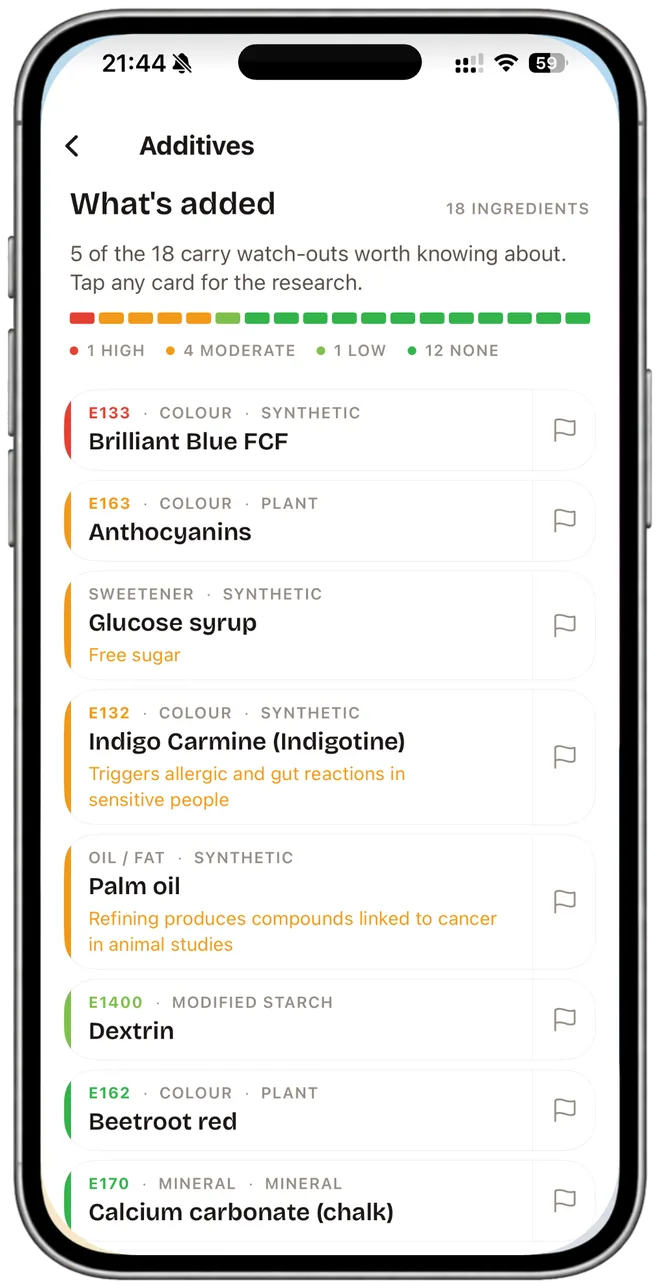
Every additive on the label, sorted by what's known
A back-of-pack ingredients list runs the additives together in a wall of E-numbers and chemical names. Scan the barcode and NutraSafe reads that list, pulls out every additive, and flags the ones that carry a published concern. The colours, the acidity regulators, the preservatives and the flavourings are grouped, and each one is scored by how much is actually known about it, not by a guess.
Take a caramel-coloured drink. NutraSafe surfaces that some caramel colours (E150 class) contain a compound the regulators treat as a possible carcinogen, and that regular phosphoric acid (E338) intake stresses the kidneys and bone. Tap any card for the plain-English version: what it is, where it turns up, and, where there is published research, the concern and who published it. You get the evidence and the source, so what you make of it is your call.
Hidden sugars and "no added sugar" decoded
Sugar hides on labels under other names, and it is legal to print "no added sugar" on the front of a drink that has been filled with sweeteners instead. One of those sweeteners, aspartame, was classed possibly carcinogenic to humans by the WHO's cancer agency in 2023. "No added sugar" does not mean there is nothing to think about; it usually means one thing was swapped for another and they bet you would read the front, not the back.
Our "what's in this food" panel puts it in plain terms. It decodes the ingredients, tells you what you would expect from a product like this (for a cola, "pure liquid sugar"), and lists the additives, the vitamins and minerals it holds, and the allergens it found. It is what we found in the ingredients we hold, so it always says to check the pack too. No single-letter grade, no verdict, just the facts laid out.
Some of it is a legal warning, printed small
None of the facts below are hidden, exactly. They are on the label or in the regulator's own opinion. They are just easy to miss. All of them are true, and all of them have a source you can check.
Processed meat causes bowel cancer
Ham, bacon, salami and hot dogs are classed Group 1 by the World Health Organisation's cancer agency, the top category, the same one as tobacco, kept for things with solid evidence that they cause cancer. For processed meat, the cancer is bowel cancer, and the nitrite that cures it (E250) is part of the picture. It is nowhere near as dangerous as smoking, and nobody serious says it is, but the NHS caps processed meat at 70g a day, about three rashers.
Source: IARC (WHO) Monograph 114, 2015 · NHS / SACN
Six colours carry a legal child-behaviour warning
Six food colours, E102 Tartrazine, E104 Quinoline Yellow, E110 Sunset Yellow, E122 Carmoisine, E124 Ponceau 4R and E129 Allura Red, the Southampton Six, were linked to hyperactivity in children by a UK government-funded study in 2007. The law that followed means any food or drink containing them has to carry the line "may have an adverse effect on activity and attention in children". It is required by law, printed small enough that almost no parent notices it, and still sitting in sweets, squashes and lollies.
Source: Southampton study 2007 (FSA-funded) · retained EU Regulation 1333/2008
Titanium dioxide is banned in EU food, still legal here
Titanium dioxide (E171) is a white powder used to make sweets, sauces, icing and chewing gum look brighter. In 2021 the European Food Safety Authority said it could no longer rule out that it damages DNA, and the EU banned it from food in August 2022. The UK reviewed the same evidence and kept it, so the additive that is off the shelves in the EU is still legal here. You just have to know to look for E171 on the back.
Source: EFSA opinion 2021 · EU ban August 2022 · UK FSA / COT (retained)
What a can of Coca-Cola shows you
Scan the barcode, read the whole pack
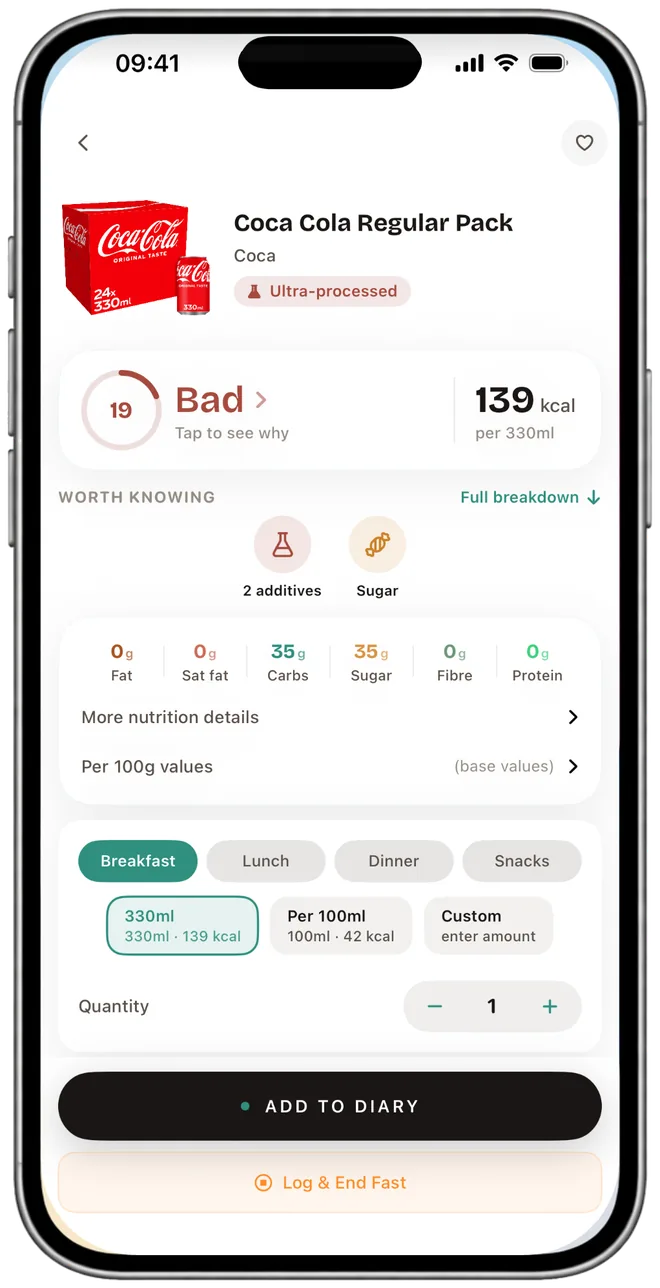
The scan returns more than the calorie count. Coca-Cola comes back flagged ultra-processed, with two additives and the sugar surfaced under "worth knowing", and 139 kcal per 330ml. The nutrition is straight off the can: 35g of sugar in a single can, which is more than a whole day's free-sugar allowance for an adult under the NHS.
Each additive carries its source. The caramel colour (E150 class) is the one the regulators treat as a possible carcinogen; tap in for the plain-English detail on each one and where the concern was published. This is where the additives, the hidden sugar and the processing all sit in one place, decoded, so the choice is yours, made with the facts.
What's in UK food, answered
The questions people search most about what is really in their food. If yours isn't here, our contact page goes to a real inbox.
Around 57% of the calories in the average UK adult's diet come from ultra-processed food (analysis of the National Diet and Nutrition Survey, Rauber et al.). These products carry long ingredient lists of additives, emulsifiers, stabilisers and colours you would not use cooking at home. It is all on the label, but in small, dense language most people never read in an aisle.
The ones the regulators have flagged. Processed meat and the nitrite that cures it (E250) are classed a Group 1 cause of bowel cancer. Six colours, the Southampton Six, carry a legal child-behaviour warning. Aspartame was classed possibly carcinogenic to humans in 2023. Titanium dioxide (E171) is banned from food in the EU. NutraSafe pulls these out of the ingredients list and puts the source on the line.
Six food colours, E102 Tartrazine, E104 Quinoline Yellow, E110 Sunset Yellow, E122 Carmoisine, E124 Ponceau 4R and E129 Allura Red, were linked to hyperactivity in children by a UK government-funded study in Southampton in 2007. Any food or drink containing them must carry the line "may have an adverse effect on activity and attention in children". They still turn up in sweets, squashes and lollies.
In 2021 the European Food Safety Authority said it could no longer rule out that titanium dioxide (E171) damages DNA, and the EU banned it from food in August 2022. The UK reviewed the same evidence and kept it, so the additive that is off the shelves in the EU is still legal here. You have to know to look for E171 on the back of the pack.
Scan a UK barcode and NutraSafe reads the back of the pack: it lists every additive, flags the ones that carry a published concern, decodes the ingredients into plain English, and shows what the regulator actually said with the source on the line. The processing level and the sugar are surfaced too. What you make of it is your call.
The download is free, and the free tier scans UK barcodes for the food's score and a count of the additives on the pack, and logs up to 25 foods a day. NutraSafe Pro is £3.99 a month on iOS and names each additive and what it does, and adds vitamin and mineral tracking against UK reference values (13 vitamins and 12 minerals), the AI meal scan, AI Coach, workouts, fasting and processed-food insights.
Scan the pack, read what the label buries
Not to scare you off your dinner. Just so the choice is yours, made with the facts, instead of theirs. Free to download. Pro is £3.99 a month if you want vitamins, workouts and the deeper insights.
iPhone · iOS 17 · Cancel any time